Walter Breen's Encyclopedia of United States and Colonial Proof Coins 1722-1989
Walter Breen
Half Dime. [2+] Large date and 5 C. (As in 1834 and earlier years, taller than letters in legend.) V-2. Obv. has first star well away from bust, unlike V-3, and date on an even curve with successive figures placed farther apart, unlike V-10 obv. Rev. S in motto below E in STATES. (1) D. M. Bullowa, May 1952. (2) Lohr: 249. (3) Reed Hawn: 573 at $525, ex 1971 ANA: 613, ex H.W., ex Merkin 4/66:67. I have seen at least 2, possibly 3 others which I am reasonably sure are not identical with these. Cf. "Dupont": 1366.
- Smaller date, large 5 C. V-5. Close date, the 1 too high; 5 very low, about touching border, C. higher. (1) Eliasberg. (2) Merkin 6/72: 214, cleaned.
- Small date and 5 C. V-I. Date rather widely spaced, curl begins over 5, long curved top to 5; rev. R recut, the period much too high. Newcomb collection at private sale, exhibited in ANS 1914.
- Same type. V-7. Very closely spaced date, recut, the 3 low, curl begins over inner curve of 3. Rev. top loops of S's filled. I know this from the former Carl Wtirzbach, Brand, New Netherlands specimen. Cf. also Neil: 1568. Parmelee: 1050 has not been identified.
Dime. [2+] B. I-A, C-I. Wide date, "horned" 8, recut 3, high 5, UN even but too high. Tall 0 in 10 C. on this and next (taller than 1). (1) Norweb. (2) WGC: 498, probably to Adolph Friedman, 1946 ANA: 255, believed Reed Hawn: 697 at $950. (3) Neil: 1236, somewhat the worse for contact with other coins. Compare also Wolfson: 543; one or two others seen.
- *B.1-new. Rev. Tall 0, UNI successively lower, D below E, RI almost touch. Lower arrow point has an extension into border. (1) Phila. Estate, ex Numismatic Gallery 5/12/45. (2) S pvt. sale, seen at 1967 CSNA convention.
- B. 3-E, C-2. Wide date, 5 leans left, curl begins r. of center of 5, 3rd star about touches border. Rev.
Tall 0, lower than I-C. ST too low. Only one seen, lost track of years ago. Possibly ex Cleneay:1514.
B. 4-F. Low 1 in date. Rev. "Small 0," not taller than I-C. Both T's in STATES very heavy. (1) Boyd, WGC :497, Adolph Friedman, 1946 ANA:254. (2) Neil: 1235, same piece? This type in business strike form is rarer than the tall 0.
-Unattributed. Parmelee 1049, Newcomb I:559, Lichtenfels II: 2975 and/or KS 5/66: 1006. Some of these possibly are represented above.
Quarter. [2+] B-I. High 3, coarse dentils. Rev. Leftover die of 1834 B-3, period after C., crack joins STA and through field above head to wing and RIC. (1) Newcomb, privatelysold, exhibted ANS 1914. (2) Clapp, Eliasberg. (3) Neil:907. Cf. Parmelee:l048. Use of an old cracked die for proofs is unusual.
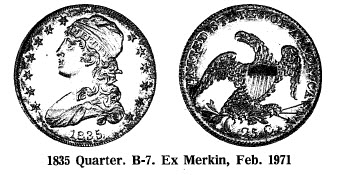
- B-7. High 1 in date. Rev. No period after C. (1) Eliasberg. (2) Winsor:606, possibly reappearing as Mougey:702. Either of the above may be ex McCoy:5I5, Levick colI. (3) LM 2/71:574, possibly ex W.L. Carson.
Half Dollar. [2+] Most offered of this date, when not mere early business strikes, are restrikes similar to those described for 1833-34. See Restrikes and Fantasy Pieces, below. Originals exist, however, but die variety information is negligible. Compare T. James Clarke, NN 47: 1277-8 (carelessly made); McPherson: 893, Cass, "Empire": 1340 (original or restrike?); N.Y. State Specialist. That ex Krouner, "Gentleman's Study Collection," (Deutsch, 1969-70) is unlisted though deceptively similar to Overton 110. Obv. Ov. 110in earliest state, with 8 and first three and 7thstars recut, rev. several stripes (lines of azure) extend to r. into feathers, 0 C farther apart (11,4 mm), center dot between lines 4 and 5, otherwise similar to Overton 110. Cf. McCoy: 460, to Levick.
Quarter Eagle. [2+] Only the one obv.; rev. of 1834 II-3: U close to leaf, A M apart, split berry. (1) Smithsonian, from Mint coll. (2) Davis-Graves: 685. (3) Parmelee: 1046 - Mills: 549 - Woodin: 954 -F.C.C. Boyd (possibly via Waldo Newcomer) - WGC: 102 -"Memorable": 96. The fourth one reported, Melish: 1124, turned out to be a first strike, but others may exist. Wayte Raymond knew five, including nos. I and 3 above.
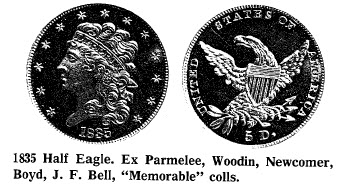
Half Eagle. [2+] B-2, head of 1834. Short, narrow end to truncation. Short 1; first star close to bust; leaf runs into base of U. (1) 51, from Mint. (2) Parmelee: 1047 - Woodin -Newcomer - F.c.c. Boyd - WGC: 385 - "Memorable": 334. (3) 1946 ANA: 1285, impaired, Others are reported; Wayte Raymond knew one more.
Sets: Probably only the two for Emperors of Japan and Cochin-China (returned to U.S., most likely dispersed)
1836
*Half Cent. Originals are of the same general type as those of 1835. Borders most often will be rounded and stars may not be all sharp enough to show their centers. About 12 known. (Those having high wire edges, bulged obv., and weight away from the norm are restrikes; see the chapter Restrikes and Fantasy Pieces. Standard weight 84 grains, tolerance generally a grain or so either way. Three are in museums (Johns Hopkins University, Smithsonian, and Massachusetts Historical Society); about nine in collectors' hands, two of these being worn (Lester Merkin's and "Century": 102 being demonstrably different). Eugene Gardner's proof brought $600 eleven years ago, and Brobston's restrike was offered a t the same figure; the Mills-Clapp-Eliasberg, F. J. Schaeffer 4/42-Phila. Estate, "Dupont"-Bareford, Clarke, Cass - "Empire": 103, Holmes, Kreisberg 2/28/55: 43 - Ruby and NN 51st sale coins are all different. The presence of worn examples shows only that proofs were occasionally spent.
Cent. N-1. Double peak to 1 in date. Newcomb mentions proofs from perfect dies (State I) and with rev. crack from rim above A through tops of TES to rim above 0, and from top of F to rim above M (State II). (1) 51 ex Mint. (2) Brock, Univ. of Pennsylvania, P.H. Ward, privately resold via Dochkus, whereabouts unknown. (3) Early State III: faint trace of obv. crack, rim through lowest point of 5th star to L and coronet line above I, etc. Obv. proof, rev. unc. Unnamed English source, NN 56:581, Wayne G. Slife, reconsigned to NN, to Jon Hanson who resold it ten years ago at $500. (4) Also state III early: Mougey: 192, Wurzbach, Hines, Sheldon, Ernest Henderson, T. James Clarke, Calif. Specialist, always at private sale. As Newcomb could hardly have known any of these, we must conclude that at least one more apiece exists in states I and II. (Newcomb could not have seen the Mint's proofs, as the 1844, 46 and 47 are of varieties unknown to him.)