Walter Breen's Encyclopedia of United States and Colonial Proof Coins 1722-1989
Walter Breen
Half Cent. [2+] Only one variety. Specimens exist with and without clash marks, those on reverse coming in some instances from the IS33 die, but later polished off, and in still later instances from the 1834 die. Business strikes are known of both earlier and later die states, i.e. struck before and after the proofs. About 18 examples of the 1834 proof are now known. Brobston's was priced at $400 a dozen years ago, and went to Wayne G. Slife. One is impounded in the Smithsonian, from the Mint collection. The "Dupont" coin went to D. N., the Jackman-Alvord-Ryder piece to L. W., Clarke had another one, and so forth.
Cent. *N-7. Large date, stars, letters, with high leaf under r. side of S; small dot die defect below base of T in CENT. Obv. die cracked up from rim above 6th through 8th and 9th stars. Why the rev. was not saved is unknown. (1) J. C. Morgenthau 444: 355 (6/16/42) - Newcomb II: 656 -Philadelphia Estate. (2) Dr. French - C. M. Williams: 404 -Calif. Specialist - C. Peterson - Kreisberg - Philadelphia Estate, badly cleaned; exhibited at ANS, 1914. (3) Calif. Specialist ex Dr. French:540 as "A6," T. James Clarke privately. The Newcomb coin was the discovery piece and then believed unique.
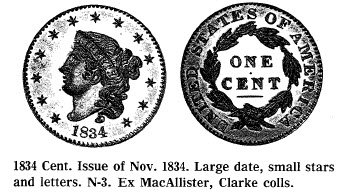
-N-3. [2+] One of the last mintages of the year. Large 8 (large date), small stars, small letters. Obverse die cracked, from rim through 12th and 13th stars to rim below 4. As this same obverse die is found perfect on a minority of business strikes of N-3 and the majority of business strikes of N-4, presumably the proofs of N-3 were coined after the N-4's and before some N-3's. This is the variety found in the proof set sent to the King of Siam, pictured on p.70 of The Fantastic 1804 Dollar. It is known that these proofs were made up after mid November 1834. Possibly some of the business strikes of N-3 might have been executed early in 1835; not impossibly proof cents of 1834 were included in the (otherwise 1835-dated) proof sets made up for the Emperors of Japan and Cochin-China, so much rarer are the proof cents of1835 than those of 1834 -though proofs of other denominations of 1835 are not so rare as the cents. (1) SI, ex Mint, cleaned. (2) King of Siam proof set. (3) McCoy: 717 - Leslie - Cleneay: 1883 -Mougey:178, Beckwith:81, H. c., pictured in Standard Catalogue. (4) Calif. Specialist, ex J. G. MacAllister, T. James Clarke, possibly Mougey:179. (5) Philadelphia Estate ex Sawicki: 666, scratched up, believed ex Winsor:944, H. P. Smith. Possibly 9 or 10 known in all.
Half Dime. [2+] *Not in Valentine, obv. V-4, rev. new. Low date, 8 high, 7th star points to top of band. Rev. E in STATES too low, defect on r. side of first A in AMERICA, crack through bases of CA to arrow. Smithsonian, from Mint collection, no. 1011. Probably this reverse die broke up and was replaced by the production die next to follow.
- V-4. Obv. as last, perfect and later with cracks from throat to drapery down to rim, and at 7th star. Rev. third stroke of M in AMERICA, missing on business strikes of V-3(same rev. die), shows here: either earlier state, or the stroke was cut in by hand. RI about touch; first A of AMERICA recut; defect on right half of N in UNITED (filled). (1) Eliasberg. (2) David M. Bullowa, May 1952. (3) Landau: 356, ex Brand via J. J.Ford. (4) Bartlett:467 at $325. (5) Lester Merkin auction 4/66: 66, at $675 -superb. (6) (7) Both ex W. L. Carson collection, both presumably from these dies. (8) C. Jay: 123, possibly same as (3) above. (9) 1962 N.Y. Metropolitan Convention auction: 897. (10) Dunham :43, Phila. Estate. There are about fifty auction records during the past fifty years. I have seen at least 15 that I can be fairly sure are different specimens. This is R-6, not R-7.
Dime. [2+] Type I: Large 4. B. I-A, Clapp 2. Large perfect 4, E S apart. In King of Siam set. Two others seen.
-Large imperfect 4 (crossbar broken partly off, leaving a jagged point). *B. 3-C, Clapp 4. 18 too close; final A touches C and arrow. (1) Byron Reed estate, now in Omaha City Library. (2) WGC:492, Menjou:185, Philadelphia Estate. (3) John H. Clapp originally described the variety, but Eliasberg does not have the coin despite having bought the Clapp collection intact. Apparently it was either sold with some duplicates or described from someone else's coin. I have seen two others, and can well credit reports of still other large 4 proofs. The reverse die was used both perfect and cracked on business strikes; this obv. is found only on proofs, though other dies have the large imperfect 4.
- Small 4. B. 5-E, Clapp 1. 1 in date even with other digits; U too low, E in UNITED above D at base. Cf. Cleneay:1511; I have seen one (maybe the same piece) and heard of others. Compare W. L. Carson and Newcomb 1:558.
The large 4 is known on other grounds to have preceded the small, so if the large 4 type was found in the Siam set, this presumably means that coins were left over and remained available, rather than being' specially struck late for the purpose. Presumably far smaller numbers of Small 4 dimes were made up, the dies replaced in the presses and used for business strikes, afterwards wearing out or cracking up, the proofs meanwhile having been dispersed. Not impossibly the die I call Obv. 3 was specially made up for proofs at some unknown time during the year.
Quarter. [2+] B-1. No period after C in 25 C; perfect dies. (1) "Dupont": 1810, later Edgar A. West:666 (May 1957), present owner unknown. (2) Eric P. Newman. (3) Mougey:701. (4) Newcomb coll., exhibited at ANS 1914. Barely possibly the last three could be the same coin.
- B-2. Small weak period after C. Double-tipped tongue to eagle. (1) WGC:115 - Jerome Kern (Golden Jubilee): 1420, present owner unknown. (2) Mougey: 700 - Bement:277, cleaned. (3) .Ex Chapman, Dr. Ruby, "Gillhousen": 606, possibly same as last. Others are reported.
- B-4. 25 C. far apart, more than the width of the 5. Only one proof seen: Eliasberg, perfect die.
Others exist, but varieties are not identified. (1) King of Siam set - either B-1 or B-2, as both have the same obv. with upright of 4 pointing along left edge of curl. (2) Winsor: 605. (3) McCoy:514, Levick, same as last? I have seen also at least three others of the date, under glass, at convention exhibits - not exactly a suitable way of ascertaining die varieties. As the order of striking appears to have been B-1, 2, 5, 4, 3, it is singular that the Siam proof set would have had one of the first two varieties in proof rather than the later B-4. The explanation may be the same as for the dimes.
Half Dollar. [2+] Type I: Large date and stars, large letters. At least two die varieties come in proof, according to Stewart Witham. One of these (Overton 103) is in the King of Siam proof set. Cf. also Bolender- Cass - "Empire" :1336; Woodin:206 (1911); Davis-Graves: 528; Philadelphia Estate, ex Mehl 12/12/39 (Overton 101); Lichtenfels 1:2785. One of these is possibly ex McCoy: 457, Levick.
As the large date, stars, letters type was the earliest of the year, it is singular that a specimen of it would have been used for the Siam proof set. Possibly no other types had at that time been struck in proof. Those claimed to exist of Type IIIa (small date, large stars, small letters, large C in 50 C.) have proved to be restrikes using an apparently original obverse, altered at border to produce the plain raised rim outside the beading as on 1836 Gobrecht coins, combined with a reverse similarly treated, most like 1836 Ov. 106. (However, the Ov. 106 die cracked up and the cracked die coins have normal borders, so it is a different die.) See Restrikes and Fantasy Pieces. No specimens have been seen of the other types (II: large date and stars, small letters; IIIb: as IIIa but small c; IV: head of 1835, small date, stars and letters, bust sloping down much more than formerly).
Silver Proof Sets. A broken set, so identified, lacking the dime, was sold piecemeal in Cogan 9/16"20/1878: 1504-1508; half cent, cent, half dime, quarter and half dollar, varieties not described.
Quarter Eagle. With Motto. [2+] Breen type I-I. Rev. of 1830-33, used on business strikes and proofs in each year. (1) Adam Eckfeldt (1838), Mint, SI. (2) Clapp, Eliasberg. (3) A. J. Allen, Ira Reed, T. L. Gaskill, NN 48:201, EF ex-Proof. (4) Newcomer, Green, Kern: 22, impaired, not verified. The King of Siam's proof set has space for the coin, even though that particular coin was lost years ago. (It may have been spent, melted, or sold into another collection; it may even be the source of one of the above.)