Walter Breen's Encyclopedia of United States and Colonial Proof Coins 1722-1989
Walter Breen
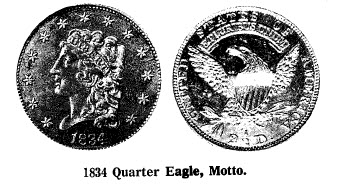
- No Motto. "Classic Head." [2+] Breen II-I, *state A. Small head, 4 well away from curls, recuttings on bases of E of STATES, 0 in OF. (1) Mint, SI. (2) Parmelee:1033, Woodin:950, Bement:227, Newcomer, Col. Green, B. G. Johnson, J. F. Bell, "Memorable": Kern:23, T. L. Gaskill, NN 48:202, N.Y. State specialist. (3) Clapp, Eliasberg, possibly ex D. S. Wilson:I77 and/or Wilharm:71. (4) King of Siam proof set. (5) J. Klausen, ex Harlan White, "from a broken set". (6) WGC :101, impaired. (7) "Cicero" collection, NN 55:266, EF, formerly proof. Two others reported, and I know that I have seen at least one not identical with any of preceding.
Half Eagle. With Motto. Breen 1-3. Crosslet 4. Only one proof known: Eliasberg, ex Clapp. No space for any such coin in the King of Siam set. Unverified rumors of others.
- Motto, plain 4. Breen I-I. SI, ex Mint. Dubious.
- No Motto. "Classic Heads." First Head. Breen II-I. [2+] Truncation large and wide; large 4; wide date, 4 away from curl, A's clear of wing and arrow, leaf away from U. *Early state: guide lines left and f. of 5D., left of base of U (when coin is held so that U is upright), between bases of D S, between bases of F A. (1) SI, from Mint collection. (2) Clapp - Eliasberg. (3) Norweb. (4) Parmelee: 1031 - Woodin - Boyd, WGC :381. Pictured in ANS 1914, p1.l5 (5) WGC: 382 - Eliasberg -NN 49:386 - M.A.C. Minor rubbing. (6) Jerome Kern -"Golden Jubilee": 365. (7) Melish: 1962 to Kagin, somewhat impaired. (8) Col. Flanagan: 1112 -Mason Williams: 1006, possibly same as one of above.
- Breen II-4. Same head, large 4. Date very closely spaced and high, 8 and 4 a little low, 1st and 13th stars very close to bust and curl. Rev. A joins arrow. (1) King of Siam proof set. (2) Melish: 1961 to Kagin. At least two others seen, one impaired.
Note that the second head, with small narrow truncation, and always with small 4, appears on at least six varieties including the famous Crosslet 4 as well as on three varieties of 1835, and that the rev. of the Crosslet 4 coin reappears in 1835. From this we may conclude that the second head was put into use late, that the small 4 punch followed the breaking of the large 4 (seen on the dime obverses), and that presumably the large 4 dime obverses must have preceded the small 4 obverses in order of manufacture. This is the argument alluded to earlier for placing the large 4 coins first.
The very earliest proof set or sets of the year presumably contained among other coins the N-7 cent, large 4 dime, B-1 quarter, and if any gold was included, the quarter eagle and half eagle with motto; the later proof sets, aside from the special ones for diplomatic use (Siam, Muscat, etc.), presumably contained later types -N-3 cent, no motto gold, etc. It is very unlikely that more than one or two sets were actually made up early in 1834. I find it very significant that the mint people did not have any leftover half-eagles with motto for use in the sets for Siam and Muscat.
1835
In this year two proof sets in special cases were made up for diplomatic presentation (by Edmund Roberts, as before) to the Emperor of Japan and the Emperor of Co chin-China (Indo-China). As Roberts died in Siam in 1836, he never got to Japan or Cochin-China and the proof sets were returned to the USA at some later date, thereafter probably to be broken up and their contents turned over to coin collectors. The most probable contents of the proof sets: regular proof coins of 1834-1835 from half cent through half dollar, 1804 dollar of first type, 1835 quarter eagle and half eagle, and 1804 plain 4 eagle. I derive this from the account in the Newman-Bressett book earlier alluded to.
Half Cents. [2+] B-81, Gilbert 2. Regular obv., only the one die of the year; rev. of 1833-34, S T spaced well apart. Only two reported. One of these, Brobston's, had proof obv., unc. rev. The other was a regular proof and it dropped out of sight years ago, possibly being confused with one of those next to follow.
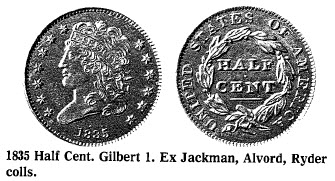
- B-82, Gilbert I. Rev. ST closely spaced, otherwise very similar to last. Probably about 15 of these survive. Brobston's was offered at $375, later LM3/68:146, GJS; NN 56:460 brought $270 some fifteen years ago. Others demonstrably different: SI, ex Mint; "Dupont"; T. J. Clarke; Jackman-Alvord-Ryder:314; and at least five others in private hands.
Cent. [2+] Newcomb 11. Head of '34 (short rounded coronet point), small date and stars, like the next. Date to left, curl begins over center of top of 5, 10th star away from hair, faint crack through base of date and to r. Rev. leaf point at F slightly left of upright; base of E in ONE double. (1) ANS, ex Barney Bluestone, Feb. 1938, via George H. Clapp. (2) Newcomb II :666 to Philadelphia Estate, impaired. The variety is rare, as its rev. smashed up immediately after it was put into the regular press for business strikes.
- N-13. Same type. Date high, first and last stars unusually close to bust and 5, E and base of 5 recut. Rev. high leaf far beyond 0, but 23rd leaf r. of center of C rather than under A. Die of 1831 N-2, but struck before the latter. Faint obv. crack; triple impressions on stars. Only one traced, though a second has been reported: Beckwith: 83 - W. F. Morgan: 270 - Newcomb II:668, obv. proof, rev. unc., to Philadelphia Estate. The variety is rare, as the obv. cracked badly shortly after it was put into the press for making regular coins. This coin is pictured in Newcomb (both sides) and the Standard Catalogue.
- N-7. Head of '36: longer sharp coronet point, two minute dots either side of second berry on left (outer, below space between TE in UNITED). The unique example shows traces of four impressions from the dies, to bring up the design properly. It came from Ira Reed to Leonard Holland, then in the May 1959 Pennypacker auction of the Leonard Holland collection (Kenhorst, outside Reading, Pa.) it went to New Netherlands, reappearing in NN 54: 1545, where bought at $700 by Lester Merkin for California Specialist. It was not described in the Holland sale catalogue as a proof, but then this catalogue was a barely minimal thing as usual with rustic Pennsylvania auctions: one would have had to see the coins in any event, mail bidding was out of the question.
As the cents of 1835 in proof are so much rarer than those of 1834, the suspicion arises that the proof sets intended for diplomatic presentation may have included cents of 1834 left over from the previous group, perhaps no proofs of 1835 having been made as yet.