Walter Breen's Encyclopedia of United States and Colonial Proof Coins 1722-1989
Walter Breen
- N-2. Fourteenth leaf point, below final S, extends far beyond leaf above it. H. Chapman 1/1927, G.H. Clapp, ANS.
- N-4. Date almost straight, top of E above R (obv.) though bases are even. R. D. Book, May 1930, G.H. Clapp, ANS, doubted,
- N-6. Low 8, blunt 1. Beckwith:84, H. Chapman, G.H. Clapp, ANS.
Half Dime. V-I. Date spaced 183 6. Rev. Small 5 C., period much too high, R recut; rev. of 1835 V-I mentioned above, repolished after many business strikes dated 1835 and before some business strikes date 1836. Eliasberg.
- V-5. Same obv. Rev. Large 5 C., 5 low and about touching border, the C higher; rev. of 1835 V-4, 5, 6 above mentioned, repolished, now showing some stage of breaks from T of UNITED to scroll, and from rim between D and S to scroll. At least seven seen in all. (1) Philip G. Straus coll., examined in 1951, privately sold as it was not in either of the 1959 auctions of his estate. (2) Eliasberg. (3) Bullowa, May 1952. (4) Landau: 359. (5) Brand, NN, Numisma 7/54: 710. The other two are impounded, one in an estate, the other in a museum. These show varying stages of reverse die break. Business strikes were made after the proofs, showing light to very heavy breaks in the mentioned area; the Valentine plate coin is one of the last. Parmelee: 1064 has not been identified as to variety.
Dime. B. I-A, Clapp 2. Short denticles, 1 and 3 low in date, 8th star away from cap (about equidistant between cap and border), tall zero, U and A-ES high. Three seen in all, present owners of two unrecorded; Roy Rauch has the third. One is ex Golden I: 982.
Quarter. Browning 2. Small 6, curl begins over knob of 6, 25 C. low and distant with stem extending only to a point left of center of top of C. (1) Smithsonian, from Mint collection. (2) Marvin Taichert collection. (3) Eliasberg. (4) Roy Rauch, ex W. L. Carson, L. M. 2/72: 108, badly cleaned. Compare also Numismatist, June 1950, p. A304; Cleneay: 1350. It is likely that one of these at least represents a fifth example of the variety, which is rare in business strike form. Neil: 907 was described as a proof of B-1, the variety with curl beginning about over leftedge of 6, but as the coin was withdrawn we may justly doubt either its attribution or its proof status or both. Wayte Raymond knew three.
Half Dollar. Lettered Edge. Overton 116=Beistle 14-T. Blundered reverse, 50 over 00; date spaced 1 836 with the 8 too low. (1) Eliasberg, discovery coin, 1953. (2) NN 45:795, to R. J. Lathrop, sold privately with Lathrop's other half dollars and finding its way into the Elliot Landau collection, then with Landau's material in NN 52:565; seen more recently, later owners not known, possibly Reed Hawn: 115 at $3500. This Lathrop-Landau coin is distinctive in having edge blundered FFIIFFTTYY etc., the planchet having been run twice through the Castaing machine in inexplicable error. I believe I have met with at least two others, not a reappearance of the Lathrop-Landau piece, probably more; I owned an impaired one ca. 1956. Compare Earle: 2957, identifiable as the variety but not so described in the auction; S. W. Freeman: 1655; Empire Coin Co., Dr. K., LM9/67:256.
- Normal reverse. Small 50, large C. Overton 102=Beistle "1-C" (combination not known to him). Low 3,low 5, E above M-R (distinguishes from Overton 110). Examined at Stack's, 1953.
- 1836/1336, knobs of erroneous 3 show within 8; ST over IT. Overton 108=Beistle 6-E. Proof first described as Overton 15 (first edition). Seen in Stack's stock, ca. 1953; 1976 ANA: 1160.
- "Fancy" top to 5. Spine from end of stem, A of STATES has elongated point from right base, first T in STATES too low. Overton 106=Beistle 5-D. Identified by Stewart Witham. The coin was first reported to me in the early 1950's. Slife, LM 2/72:204. Compare T. J. Clarke collection, NN 47:1280, ex B. G. Johnson; compare also Davis-Graves: 533, which supposedly had squashed edge lettering, though I have not seen this specimen.
- Unattributed. Ex W. L. Carson; 1946 ANA: 805; Lichtenfels, KS 2/61:2790, unverified.
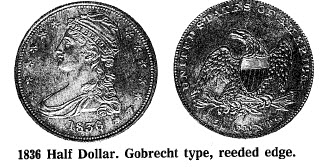
- Reeded Edge. Design of Christian Gobrecht, 50 CENTS. Haseltine 7; Beistle 19-Y, only the single pair of working dies being used for proofs and business strikes. [10+] Ten "Specimens" furnished by the Director of the Mint, Robert Maskell Patterson to Levi Woodbury, Secretary of the Treasury, Nov. 8, 1836, called "The first specimens, executed this afternoon." The enclosing letter continues "The old [half dollar] coins were struck in what we term an open collar; this is struck in a close collar, which makes the edge of pieces thicker, and gives a mathematical equality to the diameters." I know of at least eleven different examples; a few more probably exist. (1) ANS; obv. broad square borders, rev. narrower round borders. (2) Ex Lester Merkin. Cf. LM 10/66:351. (3) Norweb? (4) The former Dr. Judd coin, III. Hist.: 95. (5) MacMurray: 1487, both sides scratched up. (6) A piece formerly in the hands of several vestpocket dealers, deeply toned, probably cleaned in the interim, which has been identified as the stolen Yale University coin. I do not know its present whereabouts. This has minute hairline scratches in field; identifiable by its doubling on rev. border. (7) Seaby, Paramount fixed price list, choice. (8) Lichtenfels I: 2792 (KS 2/61). Compare also Parmelee: 1061, "drift marks" (streaks representing planchet inhomogeneities); Earle:2958; D. S. Wilson:521; Roach - Neil:468; Lichtenfels II: 1314 (KS 3/64); "Terrell" :844. Most of these are probably represented above. I have not verified the Mint - SI example, though it is probably a proof.
The single reverse die has doubling (minute misalignment in hubbing, same principle as the famous 1955 "shift" cents) on bases of 50 CENTS and elsewhere, which fades out; there is a tiny die crack from rim down into field, r. of final S, varying in size. The proofs are from the earliest die state. Any proof showing a larger break would follow the business strikes made the same day and could be identified as a later striking.