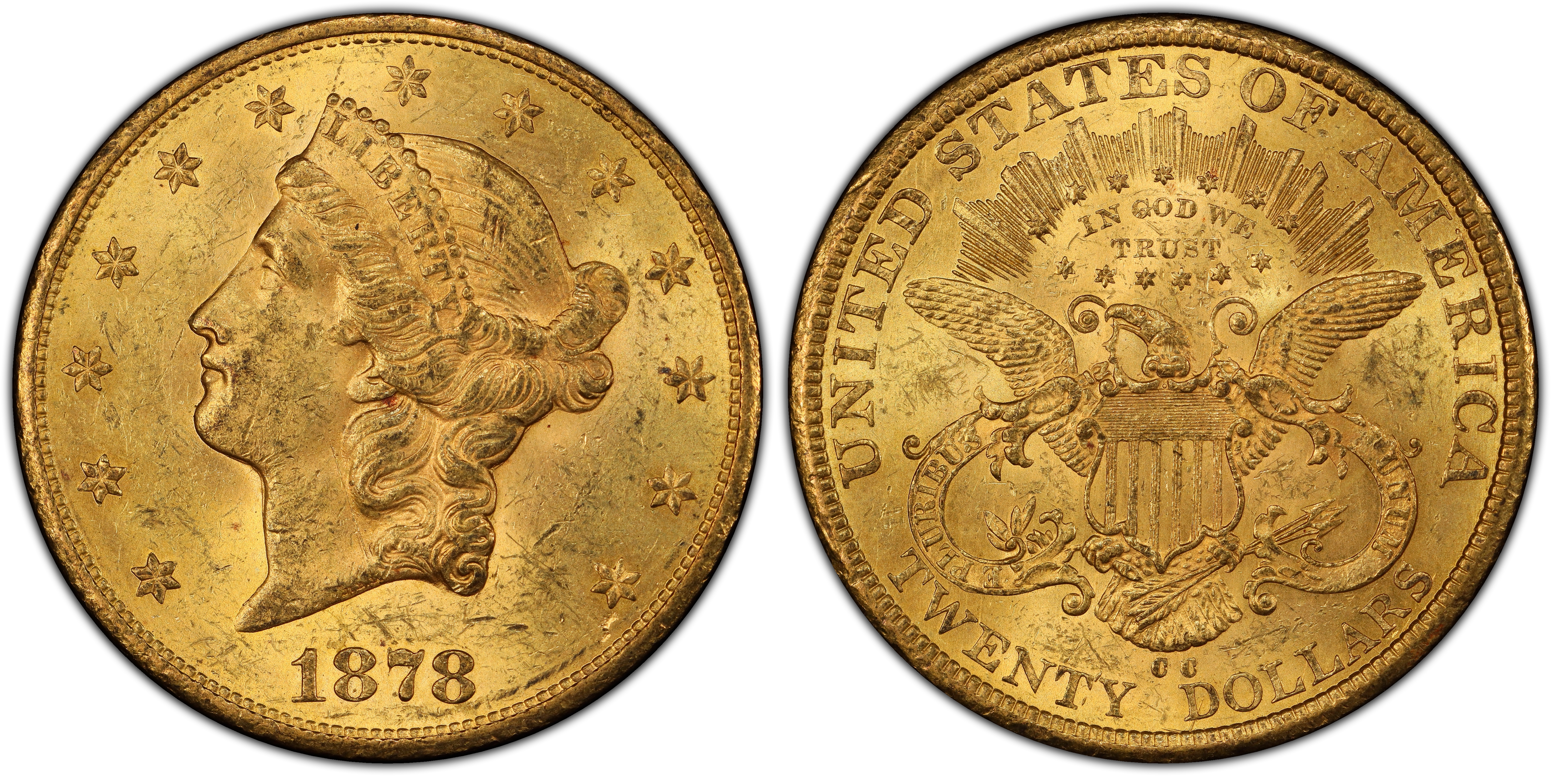
PCGS MS61

PCGS MS61
- PCGS #:
- 8986
- Designer:
- James Barton Longacre
- Edge:
- Reeded
- Diameter:
- 34.00 millimeters
- Weight:
- 33.40 grams
- Mintage:
- 13,180
- Mint:
- Carson City
- Metal:
- 90% Gold, 10% Copper
- Auction Record:
- $120,000 • MS61 • 04-13-2022 • Stack's Bowers
Major Varieties
- 1878-CC $20
Go To Grade
Current Auctions - PCGS Graded
Current Auctions - NGC Graded
For Sale Now at Collectors Corner - PCGS Graded
For Sale Now at Collectors Corner - NGC Graded
Rarity and Survival Estimates Learn More
| Survival Estimate | |
|---|---|
| All Grades | 403 |
| 60 or Better | 9 |
| 65 or Better | |
| Numismatic Rarity | |
|---|---|
| All Grades | R-6.1 |
| 60 or Better | R-9.6 |
| 65 or Better | R-10.1 |
| Relative Rarity By Type All Specs in this Type | |
|---|---|
| All Grades | 10 / 73 |
| 60 or Better | 6 / 73 |
| 65 or Better | 1 / 73 |
| Relative Rarity By Series All Specs in this Series | |
|---|---|
| All Grades | 27 / 148 TIE |
| 60 or Better | 20 / 148 TIE |
| 65 or Better | 1 / 148 |
Condition Census What Is This?
 #1 MS62+ PCGS grade
AWA Collection - Hansen Collection |
| #1 MS62 PCGS grade |
 #3 MS61 PCGS grade
|
|
#3 MS61 PCGS grade
Old West CC Collection |
| #3 MS61 PCGS grade |
| #6 MS60 PCGS grade |
| #7 AU58 PCGS grade |
| #7 AU58 PCGS grade |
| #7 AU58 PCGS grade |
| #7 AU58 PCGS grade |
David Akers (1975/88):
The 1878-CC is a rare date in all grades; in fact, it is the fourth rarest CC-Mint Double Eagle, just nosing out the lower mintage 1879-CC. Virtually all known specimens grade in the F to EF grades and a strictly graded AU is a rarity. In full mint state, the 1878-CC is extremely rare and the few known uncs, with one notable exception, are barely Unc-60. The one exception is a borderline gem that came out of Europe in the 1960's and was sold by Max Humbert to a collector, Milt Kaufman. Kaufman's collection has since been sold and I do not know the present whereabouts of the coin. I have never heard of another 1878-CC near that grade and so the Kaufman specimen may well be the finest 1878-CC in existence. As a further testimonial to its condition rarity, it can be noted that the 1878-CC ranks in the top 10% of the entire Double Eagle series according to rarity by average grade.