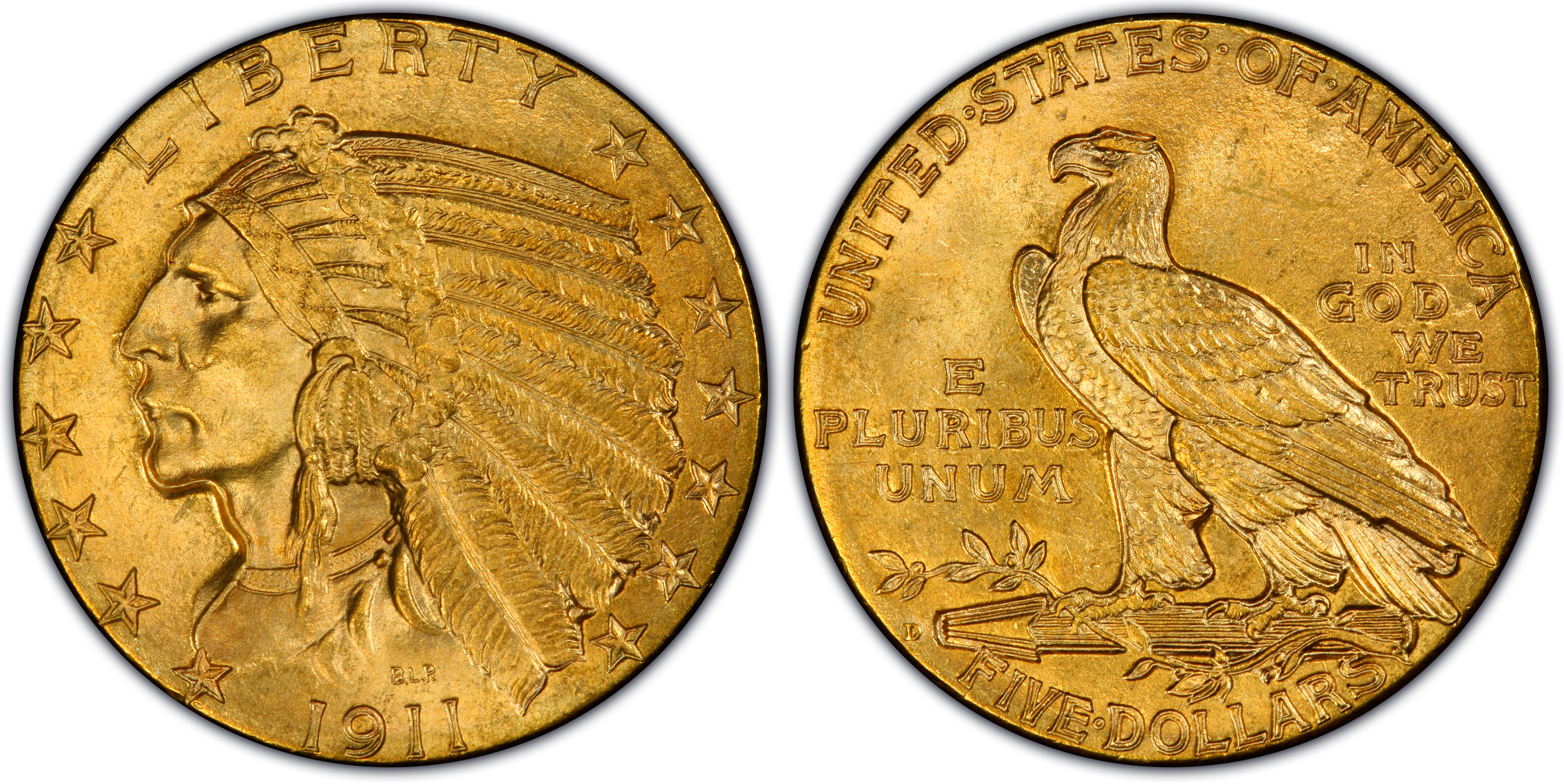
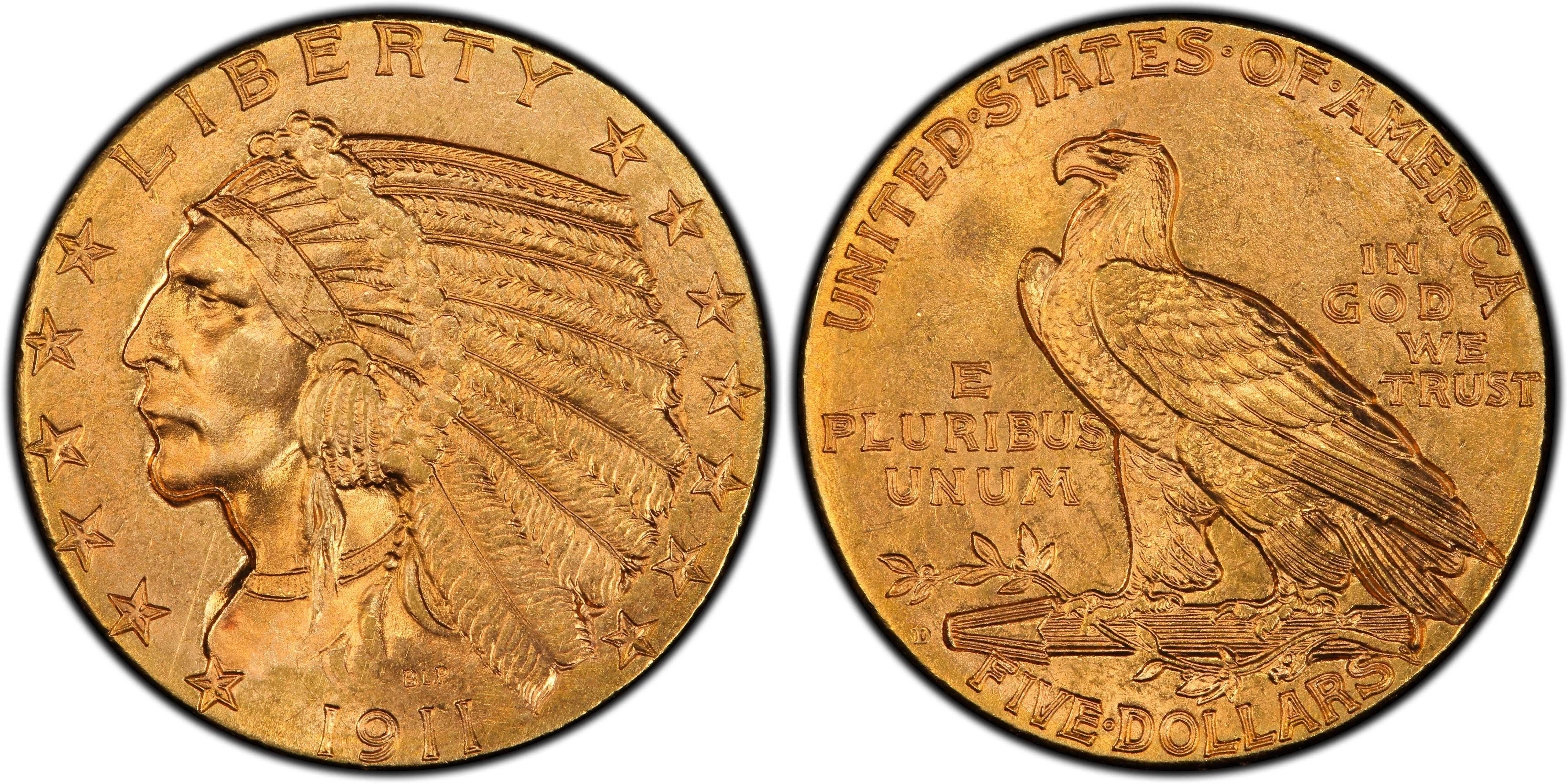
PCGS MS65
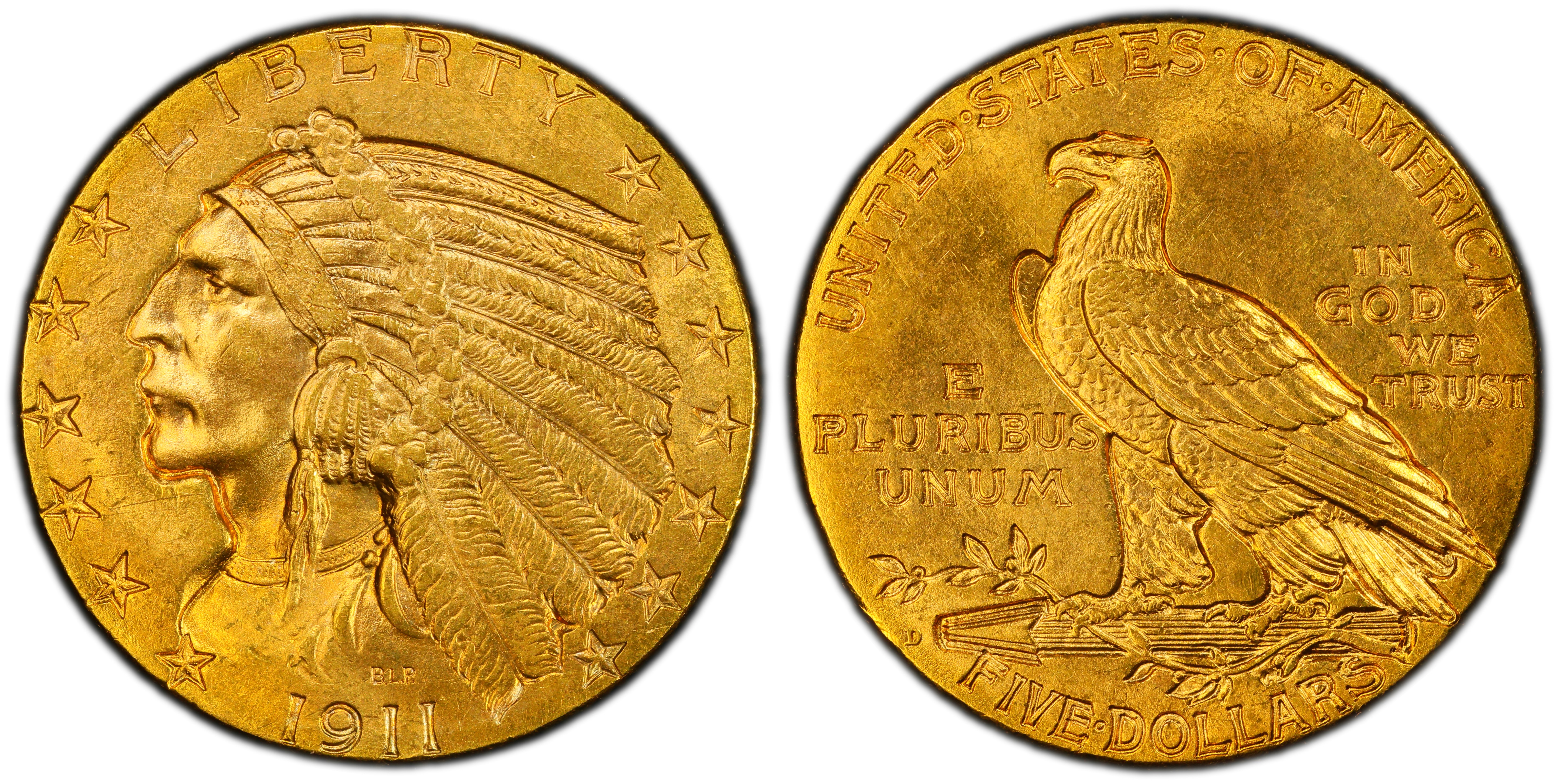
PCGS MS64+
- PCGS #:
- 8521
- Designer:
- Bela Lyon Pratt
- Edge:
- Reeded
- Diameter:
- 21.60 millimeters
- Weight:
- 8.36 grams
- Mintage:
- 72,500
- Mint:
- Denver
- Metal:
- 90% Gold, 10% Copper
- Auction Record:
- $336,000 • MS65 • 08-22-2021 • Heritage Auctions
Major Varieties
- 1911-D $5
Go To Grade
Current Auctions - PCGS Graded
Current Auctions - NGC Graded
For Sale Now at Collectors Corner - PCGS Graded
For Sale Now at Collectors Corner - NGC Graded
Rarity and Survival Estimates Learn More
| Survival Estimate | |
|---|---|
| All Grades | 2,166 |
| 60 or Better | 250 |
| 65 or Better | 4 |
| Numismatic Rarity | |
|---|---|
| All Grades | R-4.5 |
| 60 or Better | R-6.6 |
| 65 or Better | R-9.8 |
| Relative Rarity By Type All Specs in this Type | |
|---|---|
| All Grades | 5 / 24 |
| 60 or Better | 2 / 24 |
| 65 or Better | 4 / 24 TIE |
| Relative Rarity By Series All Specs in this Series | |
|---|---|
| All Grades | 5 / 24 |
| 60 or Better | 2 / 24 |
| 65 or Better | 4 / 24 TIE |
Condition Census What Is This?
 #1 MS65+ PCGS grade
Heritage 8/2004:7386, $166,750 - Jim O'Neal Collection of $5 Indians - Heritage 1/2011:5144, $299,000 |
 #2 MS65 PCGS grade
Bowers & Merena 8/2006:4288, $241,500 - Bob R. Simpson Collection |
|
#3 MS65 estimated grade
National Numismatic Collection at the Smithsonian Institution |
 #4 MS64+ PCGS grade
US Gold from a prominent midwestern family collection - Goldbergs 6/2016:1595, $152,750 - Heritage 4/2017:4285), $164,500 |
 #5 MS64 PCGS grade
|
| #5 MS64 PCGS grade |
| #5 MS64 PCGS grade |
| #5 MS64 PCGS grade |
| #5 MS64 PCGS grade |
| #5 MS64 PCGS grade |
David Akers (1975/88):
This issue may be the prime rarity among all 20th-century United States gold coin issues in MS-64 or better condition. (Only the 1914-S $5 rivals it.) I have seen only one piece, a coin now owned by Dr. Steven Duckor, with any claim to gem status and it is really probably only a high end MS-64 example by today's standards. The Miguel Munoz sale (1978) coin, there graded MS-65, also falls a bit short of gem status. No unconditional MS-65 is known to me and certainly nothing better. Even in MS-63 the issue is extremely rare with only seven or eight pieces known at most. In my opinion, this issue is more rare than any Indian Head $10 or collectible Saint-Gaudens $20 in MS-64 or better! Think about it. There are gem quality examples known of the 1911-D, 1913-S and 1920-S eagles, gems of the 1921 and 1920-S Saints, but nothing of comparable quality known of the 1911-D half eagle. I rest my case.
The 1911-D is always well struck with a well defined and fairly bold mintmark. (The mintmark is more like that on a 1908-D than on a 1910-D, however, in that its relief is not very high.) The surfaces are usually quite granular and the lustre is below average for the series. Overall, the relatively few Mint State examples of this issue look very much like the quarter eagles of the same date and mint. Color is typically a light to medium orange gold, sometimes with a greenish or greenish yellow tint.
The 1911-D is always well struck with a well defined and fairly bold mintmark. (The mintmark is more like that on a 1908-D than on a 1910-D, however, in that its relief is not very high.) The surfaces are usually quite granular and the lustre is below average for the series. Overall, the relatively few Mint State examples of this issue look very much like the quarter eagles of the same date and mint. Color is typically a light to medium orange gold, sometimes with a greenish or greenish yellow tint.