
Image courtesy of the National Numismatic Collection at the Smithsonian Institution
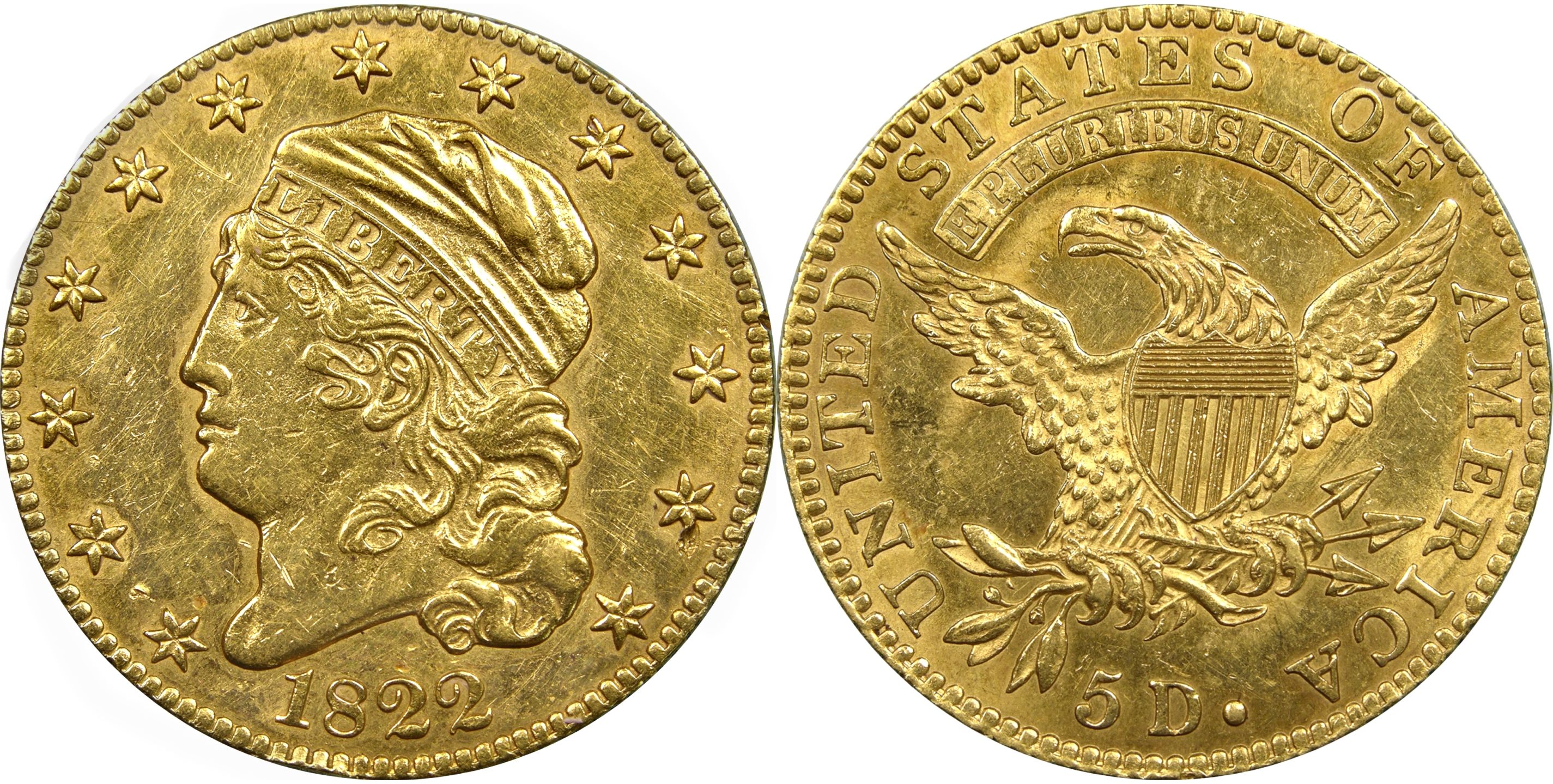
Image courtesy of the National Numismatic Collection at the Smithsonian Institution
- PCGS #:
- 8130
- Designer:
- Robert Scot & John Reich
- Edge:
- Reeded
- Diameter:
- 25.00 millimeters
- Weight:
- 8.75 grams
- Mintage:
- 17,796
- Mint:
- Philadelphia
- Metal:
- 91.7% Gold, 8.3% Copper
- Auction Record:
- $687,500 • AU50 • 10-01-1982 • Bowers & Ruddy
Major Varieties
- 1822 $5
Rarity and Survival Estimates Learn More
| Survival Estimate | |
|---|---|
| All Grades | 3 |
| 60 or Better | |
| 65 or Better | |
| Numismatic Rarity | |
|---|---|
| All Grades | R-9.8 |
| 60 or Better | R-10.1 |
| 65 or Better | R-10.1 |
| Relative Rarity By Type All Specs in this Type | |
|---|---|
| All Grades | 3 / 22 |
| 60 or Better | 1 / 22 |
| 65 or Better | 1 / 22 |
| Relative Rarity By Series All Specs in this Series | |
|---|---|
| All Grades | 3 / 42 |
| 60 or Better | 1 / 42 |
| 65 or Better | 1 / 42 |
Condition Census What Is This?
 #1 AU50 PCGS grade
Moritz David - Virgil Brand Collection - B.G. Johnson, sold privately on 7/19/1945 for $13,250 - Abe Kosoff (Numismatic Gallery) - Louis E. Eliasberg, Sr. Collection - Bowers & Ruddy 10/1982:378, $687,500 - David Akers - D. Brent Pogue Collection - Stack's/Bowers & Sotheby's 5/2016:4026, bought back at a hammer price of $6,400,000 |
 #2 EF40 estimated grade
Harlan Smith-Dunham-Carter-Lilly-Smithsonian |
 #3 VF35 estimated grade
Eckfeldt-Smithsonian |
The legendary 1822 Half Eagle is the most famous and desirable U.S. gold coin. It traded hands at fantastic prices when other great rarities that are now worth six figure prices were bringing mere pittances. There are three known specimens, two permanently impounded in the Smithsonian Institution (one in the Mint Collection, the other in the Lilly Collection) and one in the Louis Eliasberg Collection. The specimen in the Mint Collection has been there since the 1830's. The Lilly specimen was purchased from Amon Carter, Jr. in the early 1960's and is the H. P. Smith-William Dunham specimen. It was offered in the 1890 Parmelee Sale where it had a realized price of $900. In 1906, it sold in the H.P. Smith Collection Sale for $2165 and later brought a record $11,575 at the Dunham Sale. The Eliasberg coin was purchased by Mr. Eliasberg in July, 1945 from Abe Kosoff for $14,000. All three specimens are in the VF to EF range with the Eliasberg specimen being the finest of the three.
Despite a reported mintage of 17,796 pieces, the 1822 Half Eagle is known by only three examples, making it one of the rarest of all regular-issue U.S. coins.
Pedigrees of the three known examples are as follows:
1. National Numismatic Collection at the Smithsonian Institution, reportedly from a collection of coins built by Adam Eckfeldt.
2. National Numismatic Collection. Harlan P. Smith (purchased circa 1884 at a bullion dealer’s coin shop for $6.50)– Lorin G. Parmelee collection sale, June 25-27, 1890, Lot 938, consigned as a stand-in by Harlan P. Smith and bought back by him for $900 – S.H. & H. Chapman, 1906, Lot 210, $2,165 – William Forrester Dunham - B. Max Mehl – Mehl “Dunham” 1941, Lot 2095, $11,575 – Charles M. Williams – Kosoff & Kaplan – B. Max mehl - Amon Carter, Sr. – Amon Carter, Jr. – Josiah K. Lilly – donated by Lilly’s estate to the National Numismatic Collection in exchange for a $5.5 million tax credit. According to Breen, Dunham refused an offer of $35,000 from J.P. Morgan for this coin.
3. Pogue Family Collection. Ex – Joseph J. Mickley (privately) – Wiliam Sumner Appleton – W.E. Woodward - Coin dealer M. David (1899) - Virgil Brand – Horace Brand – Louis Eliasberg, Sr. (via Abe Kosoff for $14,000) - Bowers & Ruddy Galleries “The United States Gold Coin Collection” 1982, Lot 378, $687,500 – David Akers.
According to David Akers, the Eliasberg/Pogue coin is the finest of the three examples.
Lorin G. Parmelee owned an example (ex George F. Seavey Collection, 1873) that was deemed to be counterfeit. Harlan P. Smith substituted his authentic example as a stand-in, but bought it back at the sale. According to Breen, this piece is grossly oversize and crude as is another example shown to him in 1958.
Sources and/or recommended reading: “Three’s Company” by Paul Gilkes, COIN WORLD, May 15, 2000, p. 16
“Walter Breen's Complete Encyclopedia Of U.S. And Colonial Coins” by Walter Breen
When American’s first started collecting coins there was only one U.S. Government Mint, that was in Philadelphia. It was not until the 1838 that three more mints opened in this country. For the vast majority of collectors of that era a collection of coins only needed one coin for each year regardless of its mint origin to be complete. So as we realize this, the 1822 Half Eagle becomes the one coin that would be desired and hardest to find to complete such a collection.
Yet, unlike a few of extremely rare U.S. coins such as the 1804 Silver Dollar and the 1827 Quarter which were known to be the only available coins for the denomination and year and were hard for collectors to acquire, the 1822 half eagle did not have mint made restrikes produced to meet the collector need.
Today the privately owned coin, if it ever comes on the market would most likely break all current records and if sold today (2012) would likely bring in excess of ten million dollars.