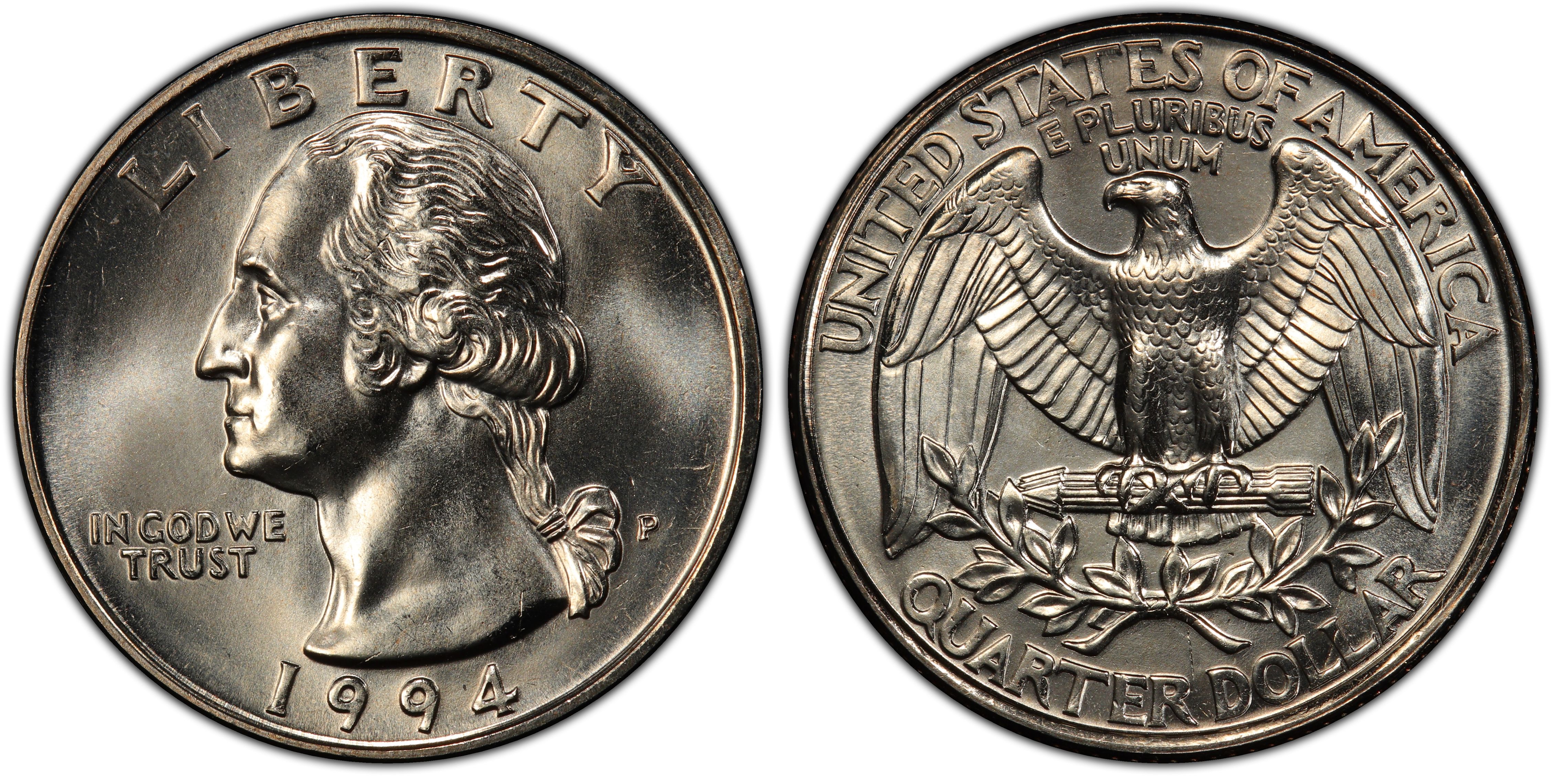
PCGS MS68
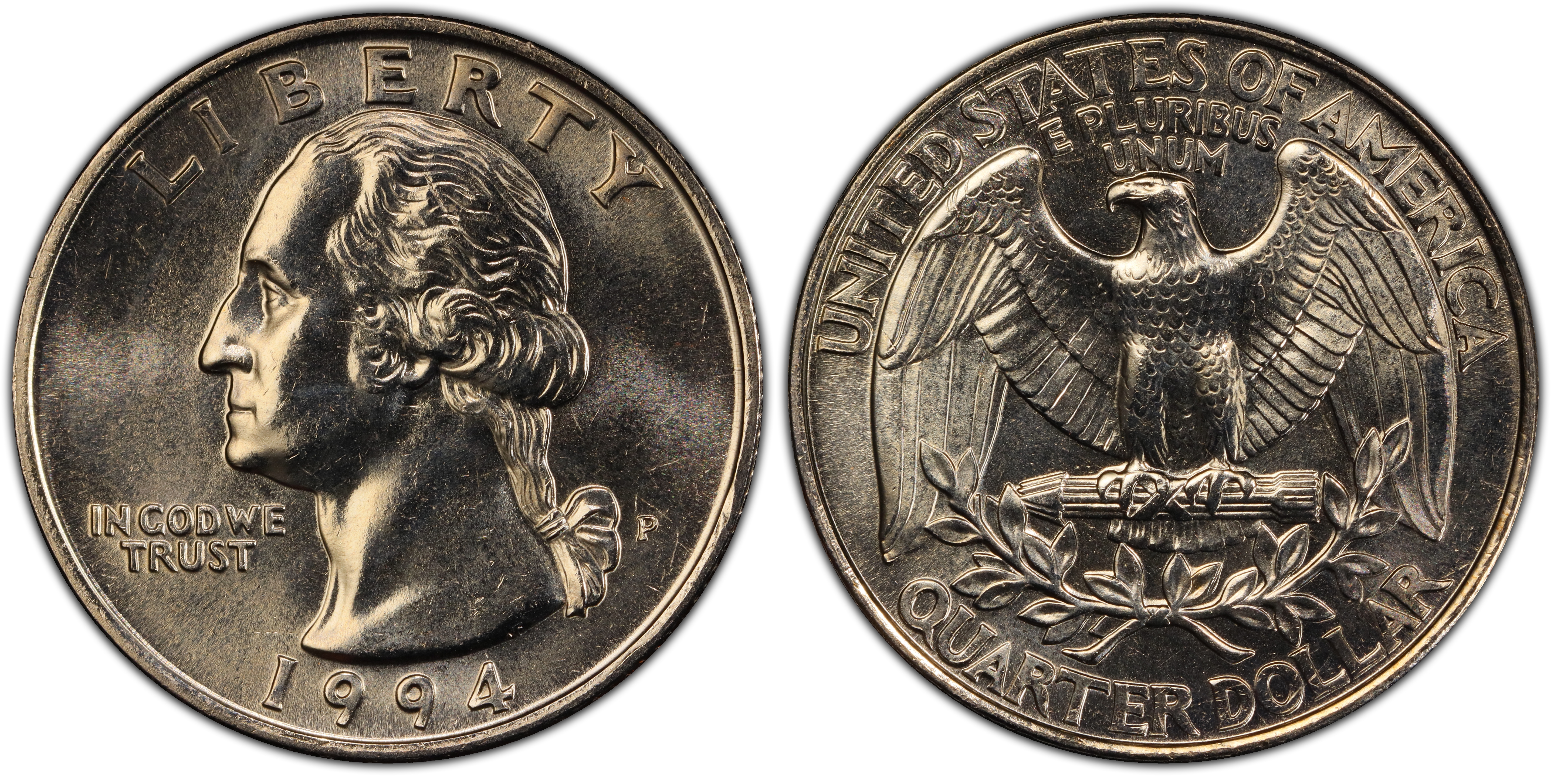
PCGS MS67+
- PCGS #:
- 5936
- Designer:
- John Flanagan
- Edge:
- Reeded
- Diameter:
- 24.30 millimeters
- Weight:
- 5.67 grams
- Mintage:
- 825,600,000
- Mint:
- Philadelphia
- Metal:
- 75% Copper, 25% Nickel over a pure Copper center
- Auction Record:
- $864 • MS63 • 04-26-2006 • Heritage Auctions
Major Varieties
- 1994-P 25C
Rarity and Survival Estimates Learn More
| Survival Estimate | |
|---|---|
| All Grades | 412,800,000 |
| 60 or Better | 123,840,000 |
| 65 or Better | 24,768,000 |
| Numismatic Rarity | |
|---|---|
| All Grades | R-1.0 |
| 60 or Better | R-1.0 |
| 65 or Better | R-1.0 |
| Relative Rarity By Type All Specs in this Type | |
|---|---|
| All Grades | 1 / 61 TIE |
| 60 or Better | 3 / 61 TIE |
| 65 or Better | 6 / 61 TIE |
| Relative Rarity By Series All Specs in this Series | |
|---|---|
| All Grades | 1 / 64 TIE |
| 60 or Better | 4 / 64 TIE |
| 65 or Better | 7 / 64 TIE |
Condition Census What Is This?
|
#1 PCGS MS68
GreatCollections, December 30, 2018, Lot 602245; Dell Loy Hansen; "The D.L. Hansen U.S. Quarters Complete / Major Varieties (1796-Present) Collection" (PCGS Set Registry). Brilliant. Diagonal tick in Washington's hair. Vertical tick at the back of the bust truncation. At the bottom of the reverse, theres is a thin line from steam to between R and D (as struck). First PCGS MS68 graded. |
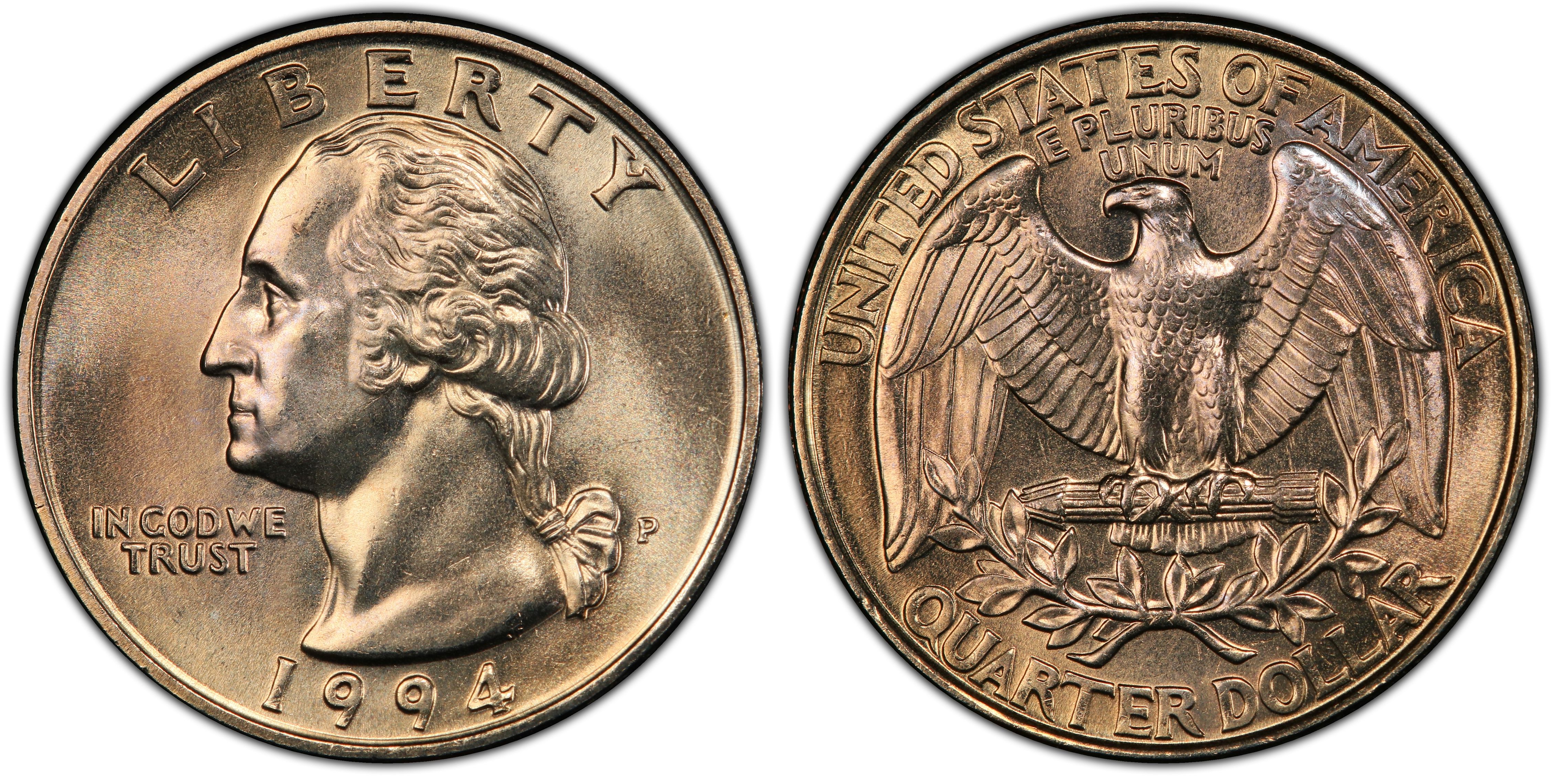 #1 PCGS MS68
|
|
#3 PCGS MS67+
"The long3218 Collection" (PCGS Set Registry). Brilliant. Diagonal mark in hair below ER. |
| #3 PCGS MS67+ |
Throughout the 1990s, the aesthetic quality of the Washington Quarter's portrait detail deteriorated as the United States Mint made a series of adjustments to the design, resulting in the infamous "Spaghetti Hair" quarters.
Starting around 1991, these modifications were gradual but easily discernible. Sculptor John Flanagan’s original portrait of George Washington was formal and lacked particularly realistic hair detail. The later 1990s adjustments, however, sharpened the wavy lines in an increasingly garish manner.
I once inquired about the "Spaghetti Hair" incident with former Chief Engraver John Mercanti, who confirmed he knew the individual responsible but declined to name them. It is generally believed these alterations were not an artistic whim but rather a functional change intended to increase production efficiency, as the Mint was concurrently adjusting the concavity of the design elements during this period.
Production and Availability
The Philadelphia Mint struck 825,600,000 1994-P Washington Quarters (#5936), which was over 54 million fewer than the number produced at the Denver Mint. Given this massive mintage, the entire production entered into circulation within the first year or so, and coins in Mint State (MS) condition were readily available over the counter at most bank locations throughout the Philadelphia facility's service region. Additionally, the 1994-P Washington Quarter was included in the 1994 United States Mint Uncirculated Coin Set. These sets, which have been offered annually since 1968, contain one example of each circulating coin struck at the Philadelphia and Denver mints. Along with the 1994-P Washing Quarter, the Philadelphia coins in the set included the 1994-P Kennedy Half Dollar (#6765), the 1994-P Roosevelt Dime (#5186), the 1994-P Jefferson Nickel (#4132, #84132), and the 1994 Lincoln Cent (#3115). These sets can still be acquired with minimal effort today and typically sell for less than $10 each.
Collecting PCGS Certified 1994-P Washinton Quarters
PCGS certification adds a layer of complexity to the otherwise straightforward collecting of 1994-P Washington Quarters. For certified coins, collectors should look for specimens graded MS65 or finer, noting a significant jump in scarcity and value between the MS66 and MS67 grades (MS68 is current finest). This scarcity is primarily due to the presence of incidental contact marks, especially in focal areas. On Washington's portrait, these marks are typically found on the high-relief areas, such as the forehead and cheek, but they can also be present in the hair and at the bust truncation. Unlike many of their 1980s predecessors, 1994-P quarters often come fully lustrous and well-struck.
* * *