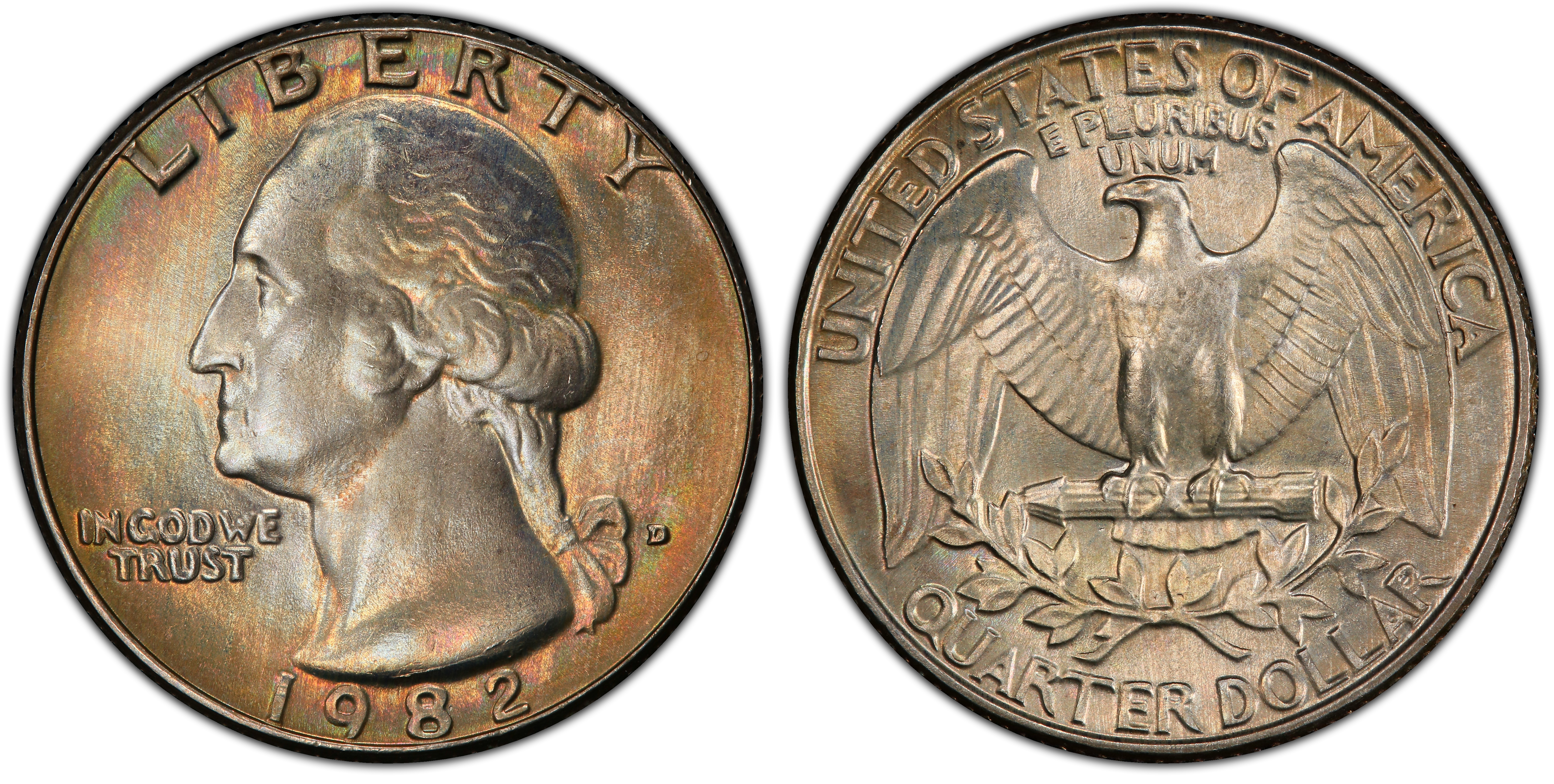

PCGS MS67+

PCGS MS67+
- PCGS #:
- 5913
- Designer:
- John Flanagan
- Edge:
- Reeded
- Diameter:
- 24.30 millimeters
- Weight:
- 5.67 grams
- Mintage:
- 480,042,788
- Mint:
- Denver
- Metal:
- 75% Copper, 25% Nickel over a pure Copper center
- Auction Record:
- $4,320 • MS68 • 11-18-2020 • Stack's Bowers
Major Varieties
- 1982-D 25C
Go To Grade
Current Auctions - PCGS Graded
Current Auctions - NGC Graded
For Sale Now at Collectors Corner - PCGS Graded
For Sale Now at Collectors Corner - NGC Graded
Rarity and Survival Estimates Learn More
| Survival Estimate | |
|---|---|
| All Grades | 168,014,975 |
| 60 or Better | 50,404,492 |
| 65 or Better | 10,080,898 |
| Numismatic Rarity | |
|---|---|
| All Grades | R-1.0 |
| 60 or Better | R-1.0 |
| 65 or Better | R-1.0 |
| Relative Rarity By Type All Specs in this Type | |
|---|---|
| All Grades | 1 / 61 TIE |
| 60 or Better | 3 / 61 TIE |
| 65 or Better | 6 / 61 TIE |
| Relative Rarity By Series All Specs in this Series | |
|---|---|
| All Grades | 1 / 64 TIE |
| 60 or Better | 4 / 64 TIE |
| 65 or Better | 7 / 64 TIE |
Condition Census What Is This?
| #1 MS67 PCGS grade |
| #1 MS67 PCGS grade |
| #1 MS67 PCGS grade |
| #1 MS67 PCGS grade |
| #1 MS67 PCGS grade |
| #1 MS67 PCGS grade |
| #1 MS67 PCGS grade |
| #1 MS67 PCGS grade |
| #1 MS67 PCGS grade |
| #1 MS67 PCGS grade |
Jaime Hernandez:
The 1982-D Washington Quarter is very common as the Mint struck over 480 million examples. circulated examples up to about MS65 are very common. MS66 examples are much more difficult to obtain but for a small premium one can be purchased or even found in rolls, mint sets or bags. In MS67 they are very difficult to find, it is probably easier to buy one than to try and find one. Anything grading higher than MS67 is considered rare.