
PCGS MS67+

PCGS MS67
- PCGS #:
- 4986
- Designer:
- Adolph Alexander Weinman
- Edge:
- Reeded
- Diameter:
- 17.90 millimeters
- Weight:
- 2.50 grams
- Mintage:
- 1,800,000
- Mint:
- San Francisco
- Metal:
- 90% Silver, 10% Copper
- Auction Record:
- $1,763 • MS67 • 01-06-2016 • Heritage Auctions
Rarity and Survival Estimates Learn More
| Survival Estimate | |
|---|---|
| All Grades | 10,000 |
| 60 or Better | 800 |
| 65 or Better | 300 |
| Numismatic Rarity | |
|---|---|
| All Grades | R-3.0 |
| 60 or Better | R-5.4 |
| 65 or Better | R-6.4 |
| Relative Rarity By Type All Specs in this Type | |
|---|---|
| All Grades | 40 / 80 TIE |
| 60 or Better | 42 / 80 |
| 65 or Better | 41 / 80 TIE |
| Relative Rarity By Series All Specs in this Series | |
|---|---|
| All Grades | 40 / 80 TIE |
| 60 or Better | 42 / 80 |
| 65 or Better | 41 / 80 TIE |
Condition Census What Is This?
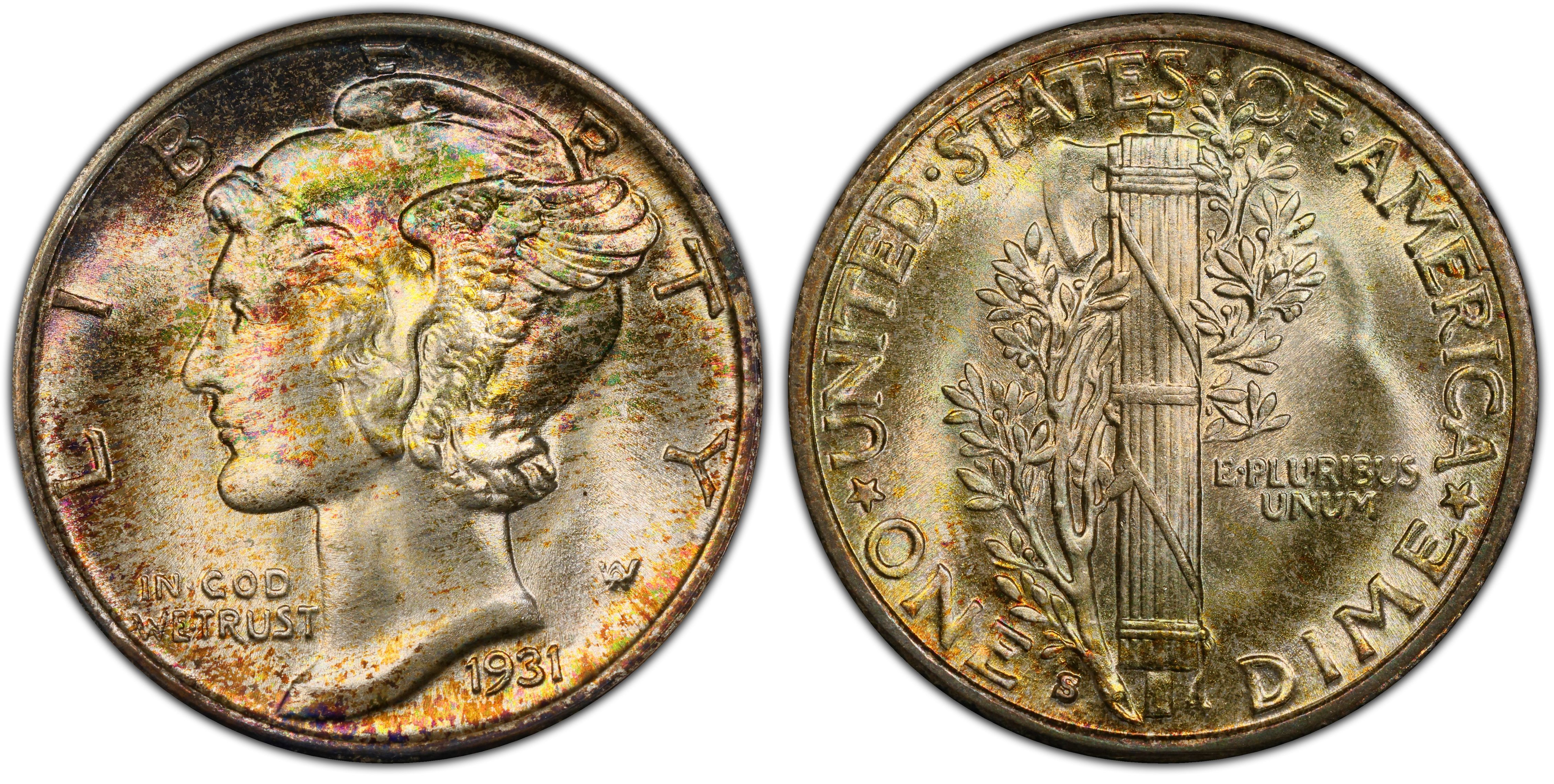 #1 PCGS MS68
MADHATTER's "MERC MADNESS Collection" (PCGS Set Registry). |
|
#2 PCGS MS67+
|
|
#3 PCGS MS67
|
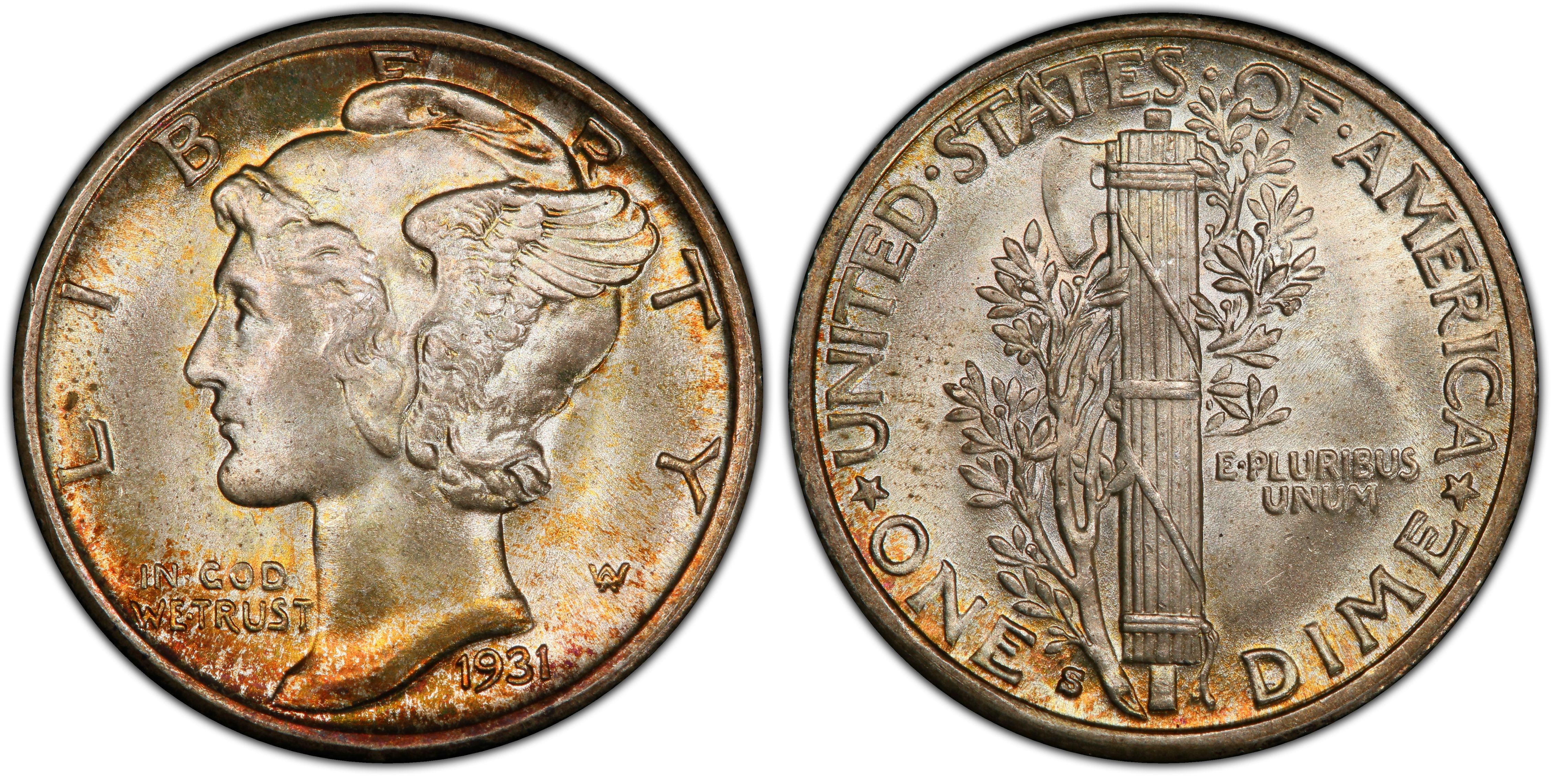 #3 PCGS MS67
Heritage Auctions, October 27, 2020, Lot 27290 - $720. Champagne hue with scattered gold toning. The lower obverse shows a splash of amber and russet toning. |
 #3 PCGS MS67
|
 #3 PCGS MS67
|
The stock market crash of October 1929 wiped out roughly $30 billion in wealth—roughly equivalent to what the U.S. had spent on the entirety of World War I. With it, the "Roaring Twenties" came to a screeching halt. The following year, Republicans in Congress pushed for the passage of the expansive Smoot-Hawley Tariff, which exacerbated the crisis by setting off a global trade war and ensuring the recession would metastasize into the Great Depression.
These economic hardships fundamentally changed how Americans viewed money and drastically reduced the demand for new coinage. Production of Mercury Dimes plummeted by 67% from 1929 to 1930, and by another 47% from 1930 to 1931. Demand for the ten-cent denomination had not been this low since 1896. Following the 1931 mintage, dime production was paused entirely until 1934; furthermore, the San Francisco Mint would not strike dimes again until 1935.
Collecting 1931-S Mercury Dimes
The San Francisco Mint struck 1,800,000 1931-S Mercury Dimes (#4986, #4987), This total is 540,000 more than the 1931-D (#4984, #4985), but 1,350,000 fewer than the 1931 P. (#4982, #4983).
Despite having a higher mintage than the Denver issue, the 1931-S is the scarcest of the three when seeking examples with Full Bands (FB), whereas the 1931-D is the most common in that state. This striking quality disparity, in which San Francisco coins often lack the sharp detail found on Denver or Philadelphia issues, is a recurring theme throughout the Mercury Dime series.
Vintage Market Snippet
A notice in the June 1934 The Numismatist reveals that collectors could obtain Uncirculated 1931-S Mercury Dimes for just ten cents each, requiring only an additional payment to cover first-class shipping charges.
* * *