
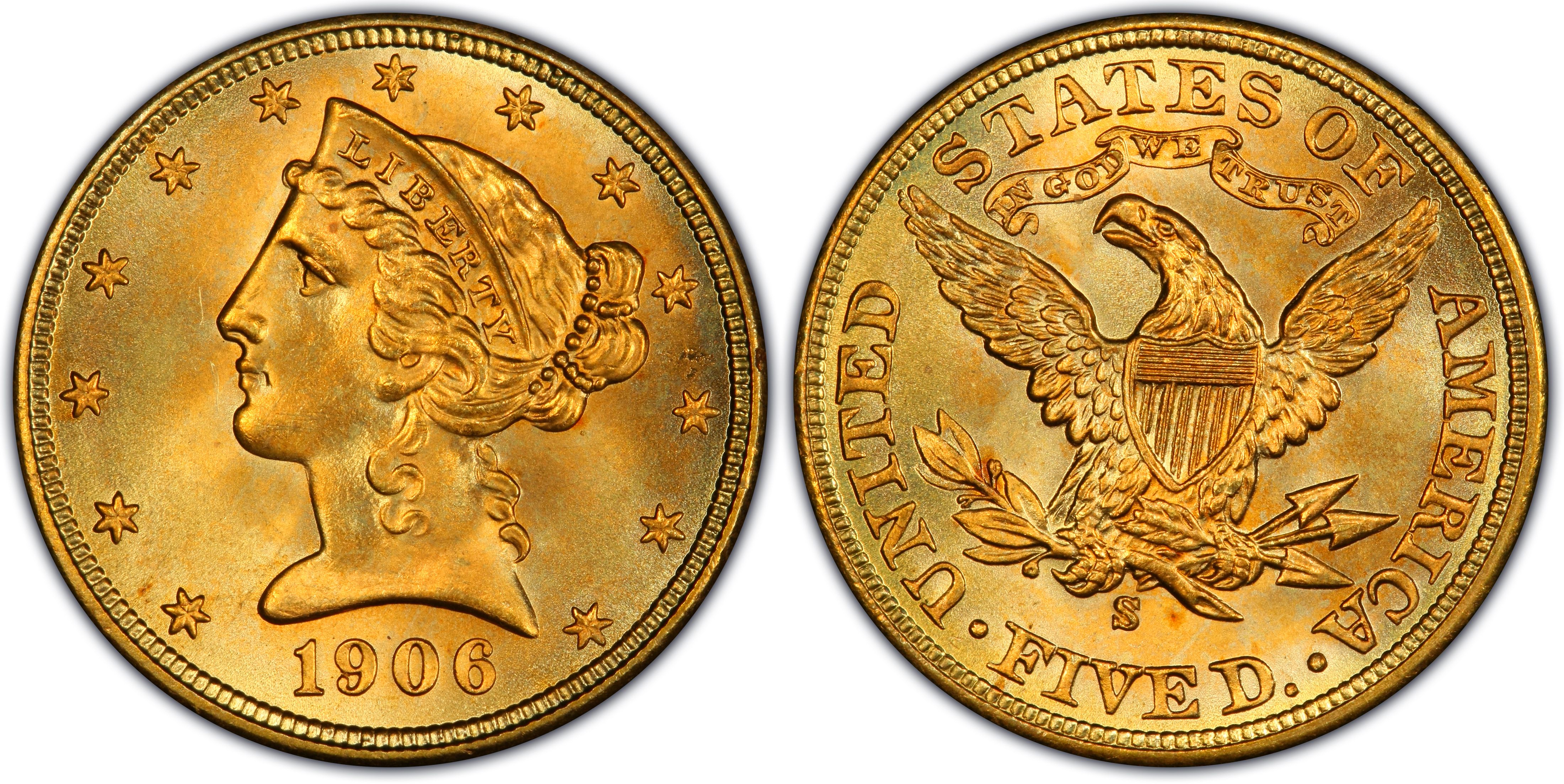
PCGS MS68
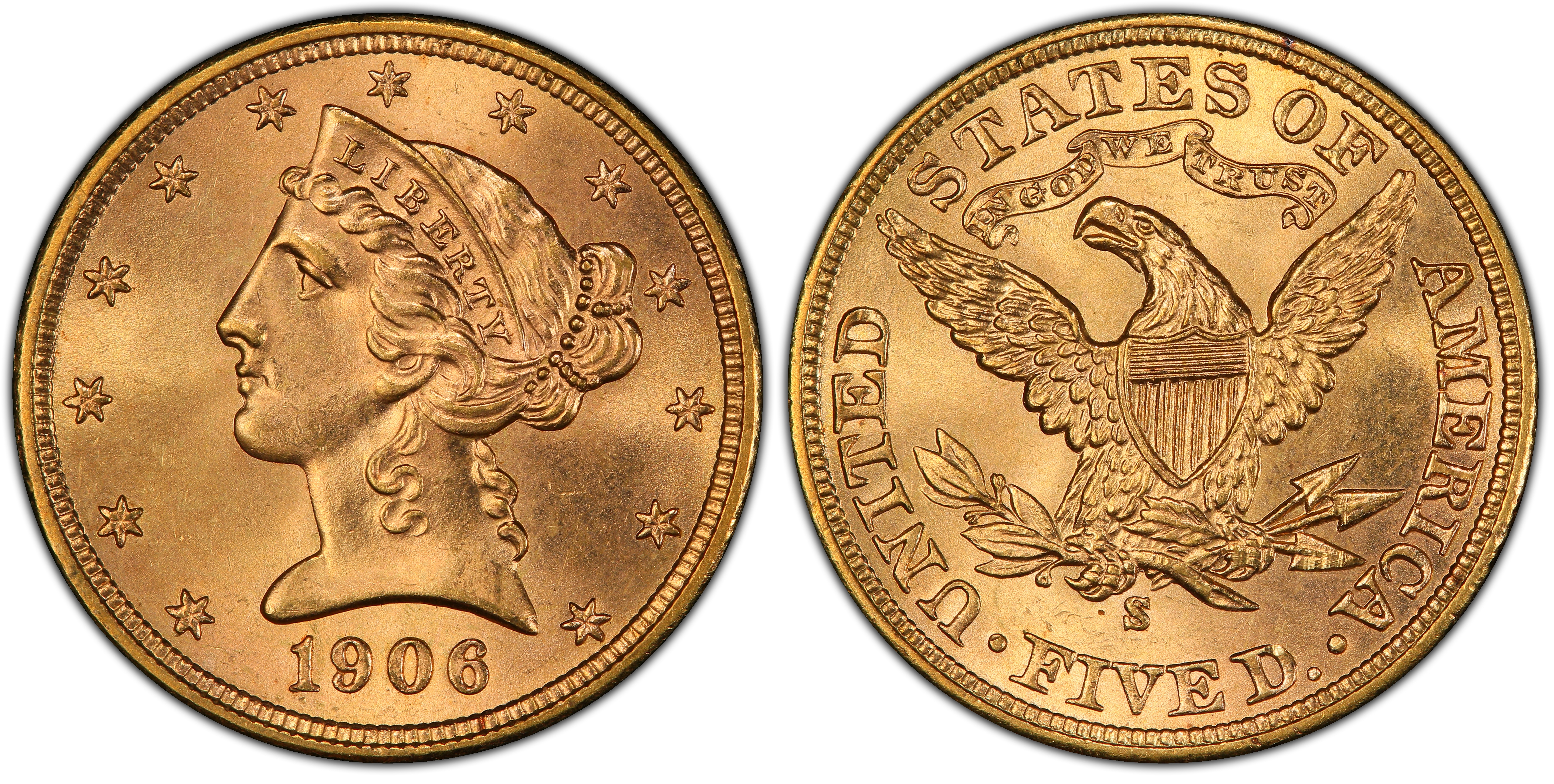
PCGS MS66
- PCGS #:
- 8415
- Designer:
- Christian Gobrecht
- Edge:
- Reeded
- Diameter:
- 21.65 millimeters
- Weight:
- 8.36 grams
- Mintage:
- 598,000
- Mint:
- San Francisco
- Metal:
- 90% Gold, 10% Copper
- Auction Record:
- $55,200 • MS67 • 01-12-2020 • Heritage Auctions
Major Varieties
- 1906-S $5
Go To Grade
Current Auctions - PCGS Graded
Current Auctions - NGC Graded
For Sale Now at Collectors Corner - PCGS Graded
For Sale Now at Collectors Corner - NGC Graded
Rarity and Survival Estimates Learn More
| Survival Estimate | |
|---|---|
| All Grades | 1,750 |
| 60 or Better | 500 |
| 65 or Better | 25 |
| Numismatic Rarity | |
|---|---|
| All Grades | R-4.7 |
| 60 or Better | R-6.0 |
| 65 or Better | R-9.0 |
| Relative Rarity By Type All Specs in this Type | |
|---|---|
| All Grades | 70 / 106 |
| 60 or Better | 64 / 106 TIE |
| 65 or Better | 42 / 106 TIE |
| Relative Rarity By Series All Specs in this Series | |
|---|---|
| All Grades | 182 / 218 |
| 60 or Better | 165 / 218 TIE |
| 65 or Better | 59 / 218 TIE |
Condition Census What Is This?
|
#1 MS68 PCGS grade
Ex-Gordon Wrubel
|
| #2 MS67 PCGS grade |
| #3 MS66 PCGS grade |
| #3 MS66 PCGS grade |
| #3 MS66 PCGS grade |
| #6 MS65 PCGS grade |
| #6 MS65 PCGS grade |
| #6 MS65 PCGS grade |
| #6 MS65 PCGS grade |
| #6 MS65 PCGS grade |
Gordon Wrubel:
The incredible MS68 1906-S $5. Liberty, pictured above, is the finest recorded example. Unlike many other examples seen, it is fully struck, including all the obverse stars. It's pristine surfaces display full blazing mint luster of orange yellow gold. What separates this coin from perfection, and identifies it for posterity, are some small flan flaws between stars 10 and 11. I suspect a coin this choice may have been purchased directly from the San Francisco Mint in the year of issue, like the John Clapp-Eliasberg gold. This example came to the writers attention when it was appeared in the October,1979 sale of the Layton Ott collection in Los Angeles. I attended the auction hoping to buy the coin even if I had to pay a "stupid" price like $3,500. My paddle was still up as the coin crossed the $6,000. mark. When the dust settled, a California dealer prevailed at an astounding $9,000! I was denied a very important coin for my 20th Century $5.Liberty set. Fortunately, I was able to acquire the coin a couple of years later for less than the auction price. In 1988, the coin market was heating up as was California real estate. In order to purchase a home, my almost complete set of gem $5. Libs was sold intact to a savvy professional. The set was broken up and dispersed into the numismatic community. But today, I am happy to report, this outstanding coin is an integral part of a fabulous gold coin collection in California.
David Akers (1975/88):
The 1906-S is moderately scarce as a date and choice uncirculated examples are quite difficult to locate. I rate this date on par with the 1898-S and 1899-S and do not feel it belongs in the "common date gold" category, at least not in uncirculated condition.