- PCGS #:
- 97291
- Designer:
- George T. Morgan
- Edge:
- Reeded
- Diameter:
- 38.10 millimeters
- Weight:
- 26.73 grams
- Mintage:
- 2,788,000
- Mint:
- Philadelphia
- Metal:
- 90% Silver, 10% Copper
- Auction Record:
- $54,625 • MS64 • 07-30-2008 • Heritage Auctions
Die Varieties
- 1904 $1 VAM 1
- 1904 $1 VAM 1, PL
- 1904 $1 VAM 1, DMPL
- 1904 $1 VAM 1A
- 1904 $1 VAM 1A, PL
- 1904 $1 VAM 1A, DMPL
- 1904 $1 VAM 2
- 1904 $1 VAM 2, PL
- 1904 $1 VAM 2, DMPL
- 1904 $1 VAM 3
- 1904 $1 VAM 3, PL
- 1904 $1 VAM 3, DMPL
- 1904 $1 VAM 4
- 1904 $1 VAM 4, PL
- 1904 $1 VAM 4, DMPL
- 1904 $1 VAM 5
- 1904 $1 VAM 5, PL
- 1904 $1 VAM 5, DMPL
Rarity and Survival Estimates Learn More
| Survival Estimate | |
|---|---|
| All Grades | 5 |
| 60 or Better | 5 |
| 65 or Better | 2 |
| Numismatic Rarity | |
|---|---|
| All Grades | R-9.7 |
| 60 or Better | R-9.7 |
| 65 or Better | R-9.9 |
| Relative Rarity By Type All Specs in this Type | |
|---|---|
| All Grades | 9 / 117 TIE |
| 60 or Better | 9 / 117 TIE |
| 65 or Better | 1 / 117 TIE |
| Relative Rarity By Series All Specs in this Series | |
|---|---|
| All Grades | 9 / 117 TIE |
| 60 or Better | 9 / 117 TIE |
| 65 or Better | 1 / 117 TIE |
Condition Census What Is This?
|
#1 PCGS MS65DMPL
Jack Lee; “The Dr. Hoffnagle Collection of Morgan Dollars,” Heritage Auctions, January 12, 2005, Lot 30350 – $37,950; “The Arno Collection,” Heritage Auctions, January 9, 2009, Lot 5070 – $54,625; "The LeviRanchSet" (PCGS Set Registry). Old Green Holder. Blue, green, and gold toning along the periphery. |
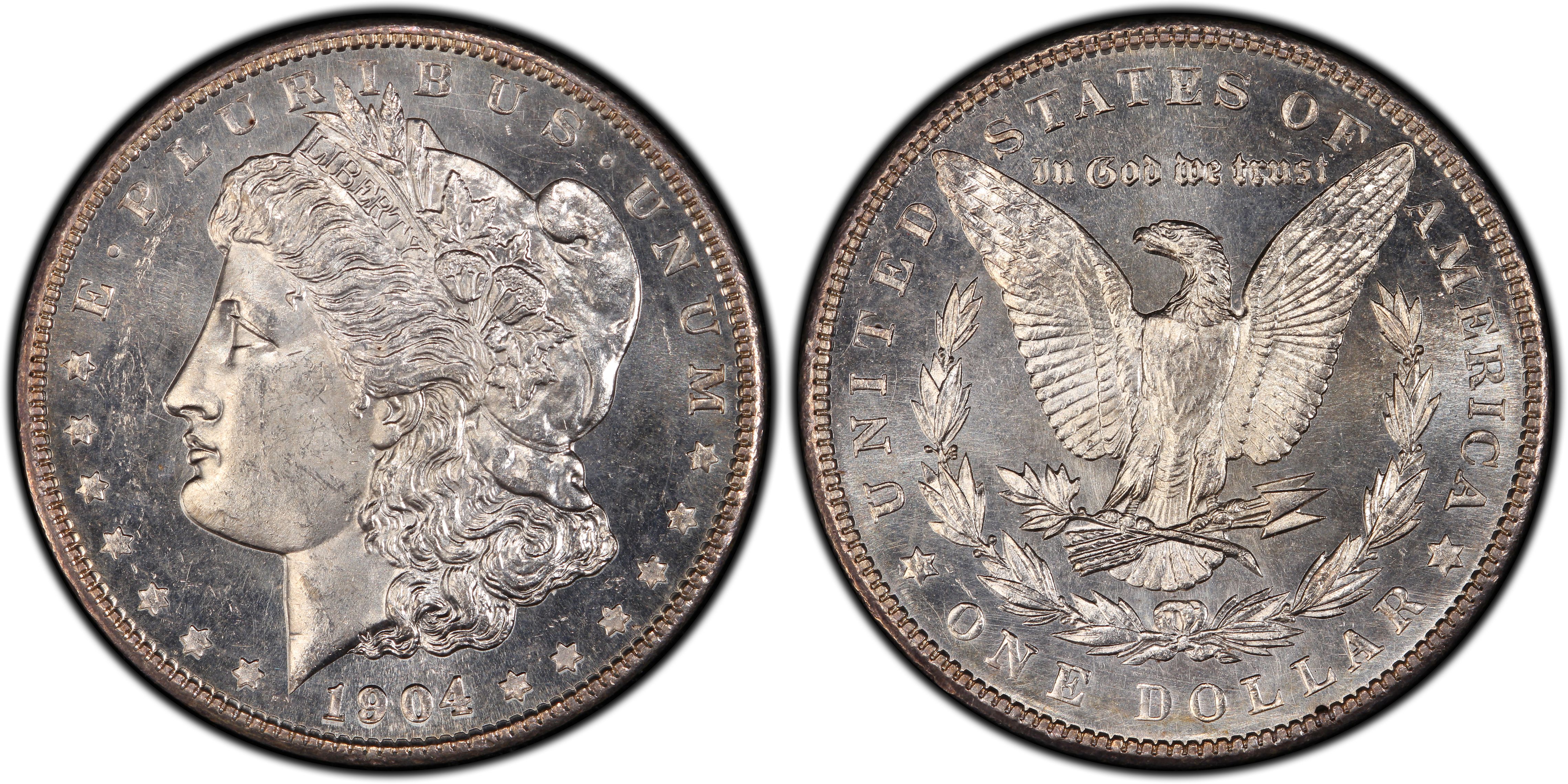 #2 PCGS MS64DMPL
As PCGS MS64DMPL #30044913. “A Gift of Underserved Favor Collection,” Heritage Auctions, August 1, 2008, Lot 2261 – $54,625. As PCGS MS64DMPL #82122325. Dell Loy Hansen; "The D.L. Hansen DMPL/PL Collection" (PCGS Set Registry). Superficial ticks in the left obverse field. Wispy golden toning along the lower reverse. Toning spot at the rim below the second L of DOLLAR |
1904 Morgan Silver Dollar
With the United States Mint’s stockpile of silver bullion earmarked for silver dollar production waning, the Philadelphia Mint struck what would be its final Morgan Dollars over a three-month span in 1904.
|
1904 Morgan Dollar Circulation Strike Production Dates |
|||
| January | 2,200,000 struck | February | 66,000 struck |
| March - May | none struck | June | 522,000 struck |
| July - December | none struck | Total Mintage: | 2,788,000 coins |
After a 17-year hiatus, Congress ultimately approved legislation authorizing the striking of hundreds of millions of new dollar coins, leading to the 1921 Morgan Dollars (P #7296, D #7298, S #7300) and the subsequent Peace Dollar series.
As for the 1904 Morgan Dollar struck at Philadelphia, most of the issue never saw the light of day. Instead, a massive percentage of the mintage was melted under the terms of the Pittman Act of 1918, which converted up to 350 million silver dollars into bullion for sale. Consequently, Great Britain purchased over 250 million ounces of silver, and over 270 million silver dollars were sent to the melting pots.
A Scarcity of Hoards
Unlike other dates that emerged in massive quantities during the Treasury dispersals, only a few bags of 1904 Morgan Dollars materialized between the 1950s and the emptying of Treasury stocks in the 1960s. Since then, only one noteworthy accumulation has appeared: a single bag of typical uncirculated pieces (Choice and below) that surfaced in 1979 and was liquidated at a discount.Instead of a "great reveal," this issue has entered the market like the slow-moving sap of a Douglas Fir.
Because of this trickle-fed supply, fewer than 10,000 pieces have been certified by PCGS, while the "common" 1904-O (#7292) boasts a graded population exceeding 150,000.
Condition and Luster
The survivors are typical Philadelphia Mint products of the era: average strikes with average luster, and few standout examples. In the 1992 edition of Morgan Dollars: An In-Depth Study, Dean Howe wrote:
“...the 1904-P is among the worst coins produced at the Philadelphia Mint. Most 1904-P Dollars have a subdued gray luster that is often dull and unattractive.”
For most examples, this holds true; no amount of dipping will produce a brilliance that wasn't there to begin with. The 1904 is conditionally scarce at PCGS MS65 and remarkably rare in PCGS MS66 and above. Our condition census features notable pieces in PCGS MS66+ and a single, breathtaking PCGS MS67. Prooflikes (PL) and Deep Mirror Prooflikes (DMPL) remain exceedingly rare and are virtually unknown in grades higher than MS65.
Survival Estimates: Charles's Perspective
While the PCGS CoinFacts estimate places the surviving population at 279,000 pieces, that number feels optimistic. Third-party certification can be profitable at the PCGS MS62 level, yet the combined totals from PCGS and other grading services only reaches approximately 15,000 units. If we assume that after 40 years of business, the services have seen roughly one-third of the gradable Mint State population, the total number of Mint State survivors likely does not exceed 45,000. I believe we have probably seen about 40%, however. It is statistically improbable that 225,000 circulated examples survive when less than 1% of them have been submitted for grading. A more realistic estimate based on available data suggests that roughly 2.6 million were melted under the Pittman Act, and the few survivors either escaped selection by luck or entered circulation prior to 1918.
Varieties and Hub Changes
PCGS recognizes six popular VAMs for this date, including:
- VAM-1 (#44974): Closed 9.
- VAM-1A (#44977): Notable for die pitting at the "D" of DOLLAR on the reverse.
- VAM-2 (#44980): Doubled 1 and 4.
- VAM-3 (#44983): Vertical spike extending from the bottom right serif of the 1. Bottom of 4 is doubled.
- VAM-4 (#44986): Doubled 9 and 4.
- VAM-5 (#44989): Features a slightly doubled profile of Liberty.
Vintage Market Snippets
- 1904: The Annual Report of the Director of the Mint noted a drastic staff reduction at the New Orleans Mint—from 219 down to 97—following the exhaustion of silver bullion purchased under the Act of July 14, 1890.
- 1904: By the end of the fiscal year on June 30, 1904, a total of 570,272,300 silver dollars had been coined since 1878. The Treasury’s holdings were massive: 461,138,698 were held against silver certificates, and another 35,343,055 were held in excess of requirements. Only 73,790,547—roughly 13%—were actually in circulation.
- 1948: New York dealer George P. Lang advertised "Uncirculated" examples in The Numismatist for just $3.00.
- 1951: Dealer Harry W. Bason offered "Brilliant Uncirculated (BU)" examples for $3.50 apiece.
- 1979: A bag of "Typical Uncirculated" 1904 Morgan Dollars surfaced in early 1979. Dealer Wayne Miller examined a few hundred coins but found no gems. The bag was disposed of in June 1980 to Jim Halperin's New England Rare Coin Galleries.
- 1986: On February 6, 1986, PCGS grades its first 1904 Morgan Dollar (PCGS MS64 #01083456)
- 2018: The first 1904 Morgan Dollar grades PCGS MS67.
* * *