
PCGS MS65
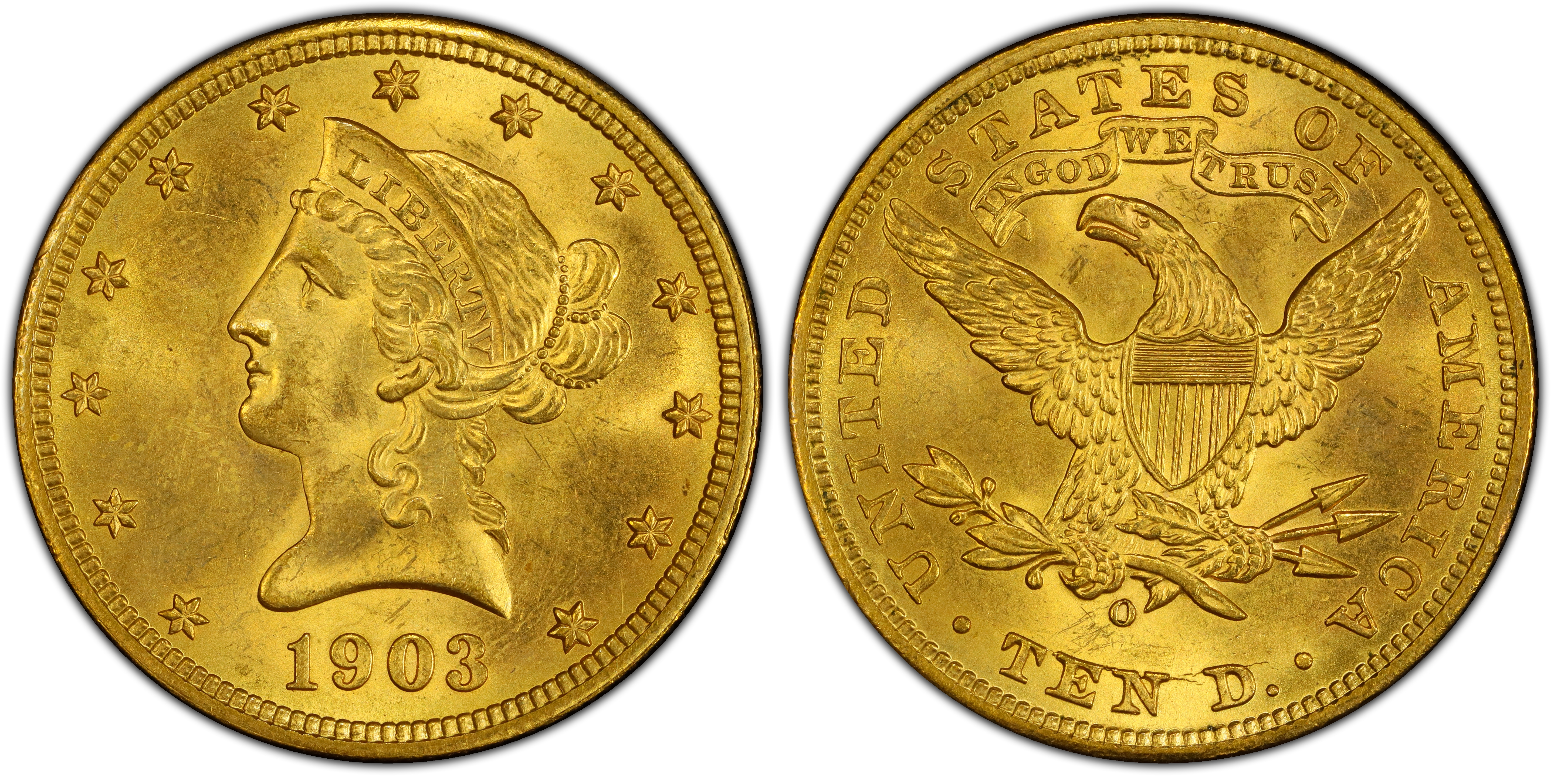
PCGS MS64
- PCGS #:
- 8753
- Designer:
- Christian Gobrecht
- Edge:
- Reeded
- Diameter:
- 26.80 millimeters
- Weight:
- 16.70 grams
- Mintage:
- 112,771
- Mint:
- New Orleans
- Metal:
- 90% Gold, 10% Copper
- Auction Record:
- $16,100 • MS65 • 05-01-2007 • Heritage Auctions
Major Varieties
- 1903-O $10
Go To Grade
Current Auctions - PCGS Graded
Current Auctions - NGC Graded
For Sale Now at Collectors Corner - PCGS Graded
For Sale Now at Collectors Corner - NGC Graded
Rarity and Survival Estimates Learn More
| Survival Estimate | |
|---|---|
| All Grades | 2,050 |
| 60 or Better | 1,075 |
| 65 or Better | 1 |
| Numismatic Rarity | |
|---|---|
| All Grades | R-4.5 |
| 60 or Better | R-4.9 |
| 65 or Better | R-10.0 |
| Relative Rarity By Type All Specs in this Type | |
|---|---|
| All Grades | 88 / 117 TIE |
| 60 or Better | 68 / 117 TIE |
| 65 or Better | 1 / 117 TIE |
| Relative Rarity By Series All Specs in this Series | |
|---|---|
| All Grades | 154 / 183 TIE |
| 60 or Better | 121 / 183 TIE |
| 65 or Better | 1 / 183 TIE |
Condition Census What Is This?
|
#1 MS66 PCGS grade
John Clapp - Eliasberg Collection |
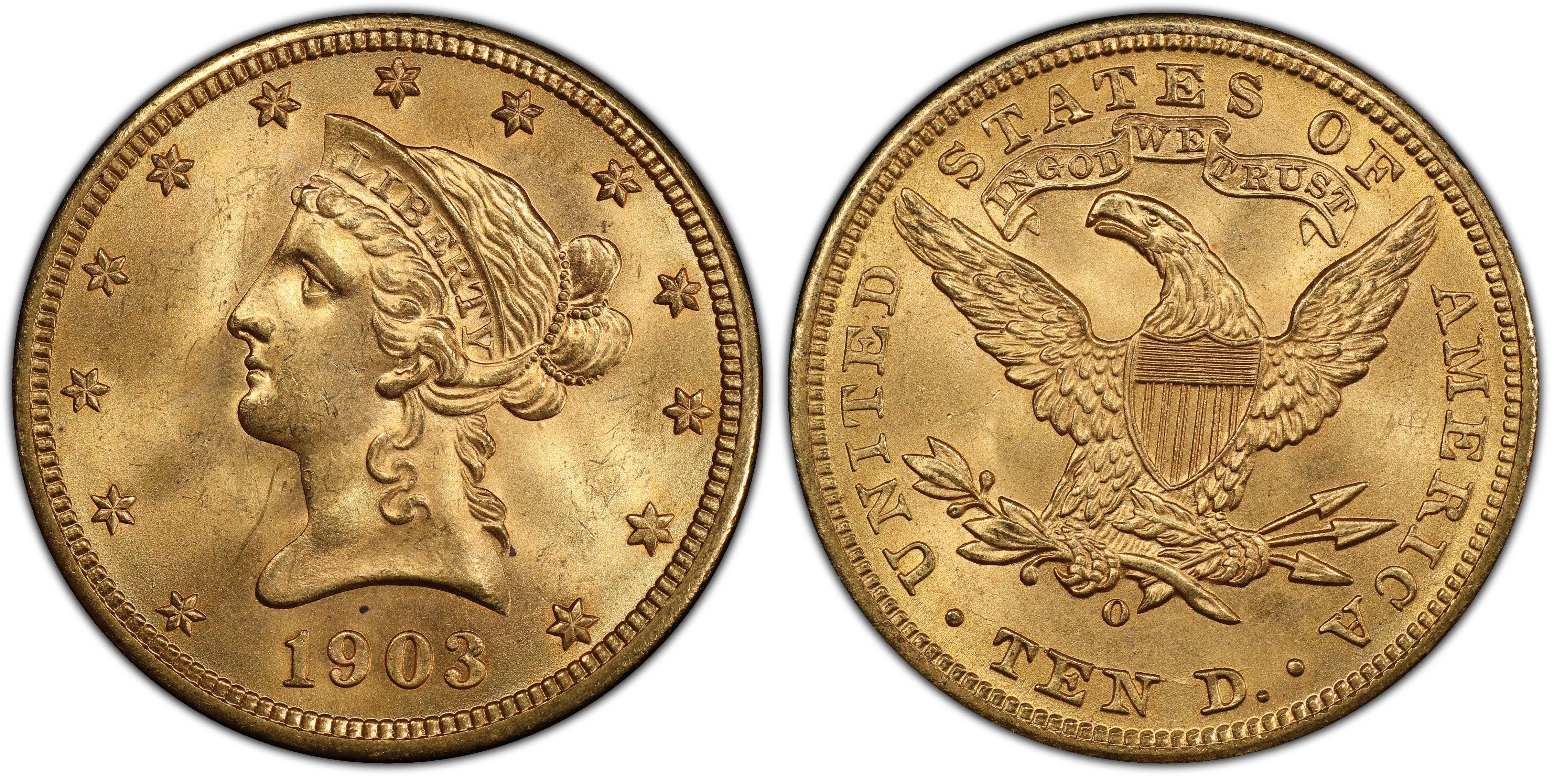 #2 MS65+ PCGS grade
|
 #3 MS64 PCGS grade
|
| #3 MS64 PCGS grade |
| #3 MS64 PCGS grade |
| #3 MS64 PCGS grade |
| #3 MS64 PCGS grade |
| #3 MS64 PCGS grade |
| #3 MS64 PCGS grade |
| #3 MS64 PCGS grade |
Doug Winter:
The 1903-O is the most common New Orleans eagle. Large quantities of relatively high grade pieces have been found overseas in the past decade, making this coin reasonably easy to find in grades up to and including MS63. This makes it a popular issue with type collectors.
It is almost never seen in well-circulated grades and is only moderately scarce in the lower Uncirculated grades. It is somewhat scarce in MS63 but still far more available at this level than any other large size gold coin from this Mint. It is very rare in MS64 and unique in Gem.
STRIKE: This is among the best struck New Orleans eagles. The obverse is sometimes not fully defined on the curls around the face but most 1903-O eagles are sharp on the obverse and reverse.
SURFACES: The surfaces on most pieces are abraded and these marks are, for some reason, more prevalent and deeper on the obverse than on the reverse. It is sometimes possible to find an example that is not excessively abraded.
LUSTER: The luster is above average with most of the higher grade pieces showing a frosty texture. There are some that have a more subdued luster with a grainy texture. Prooflike examples exist but these are usually heavily bagmarked and not appealing as a result.
COLORATION: The natural coloration is most often a rich orange-gold. Some are seen with more of a greenish tint. It is still reasonably easy to locate examples with natural color.
EYE APPEAL: The 1903-O is a good choice for type collectors as most pieces are well struck and lustrous. This date is found with bagmarked surfaces but there are some pieces known that are only moderately abraded.
DIE CHARACTERISTICS: There are no important die characteristics noted on either the obverse or the reverse.
MAJOR VARIETIES: There is a single variety known.
Variety One: The date is evenly spaced between the truncation and the denticles. The reverse is the same as seen on the 1894-O, 1895-O and 1897-O eagles. Some pieces show light repunching on the mintmark.
It is almost never seen in well-circulated grades and is only moderately scarce in the lower Uncirculated grades. It is somewhat scarce in MS63 but still far more available at this level than any other large size gold coin from this Mint. It is very rare in MS64 and unique in Gem.
STRIKE: This is among the best struck New Orleans eagles. The obverse is sometimes not fully defined on the curls around the face but most 1903-O eagles are sharp on the obverse and reverse.
SURFACES: The surfaces on most pieces are abraded and these marks are, for some reason, more prevalent and deeper on the obverse than on the reverse. It is sometimes possible to find an example that is not excessively abraded.
LUSTER: The luster is above average with most of the higher grade pieces showing a frosty texture. There are some that have a more subdued luster with a grainy texture. Prooflike examples exist but these are usually heavily bagmarked and not appealing as a result.
COLORATION: The natural coloration is most often a rich orange-gold. Some are seen with more of a greenish tint. It is still reasonably easy to locate examples with natural color.
EYE APPEAL: The 1903-O is a good choice for type collectors as most pieces are well struck and lustrous. This date is found with bagmarked surfaces but there are some pieces known that are only moderately abraded.
DIE CHARACTERISTICS: There are no important die characteristics noted on either the obverse or the reverse.
MAJOR VARIETIES: There is a single variety known.
Variety One: The date is evenly spaced between the truncation and the denticles. The reverse is the same as seen on the 1894-O, 1895-O and 1897-O eagles. Some pieces show light repunching on the mintmark.