

PCGS MS67
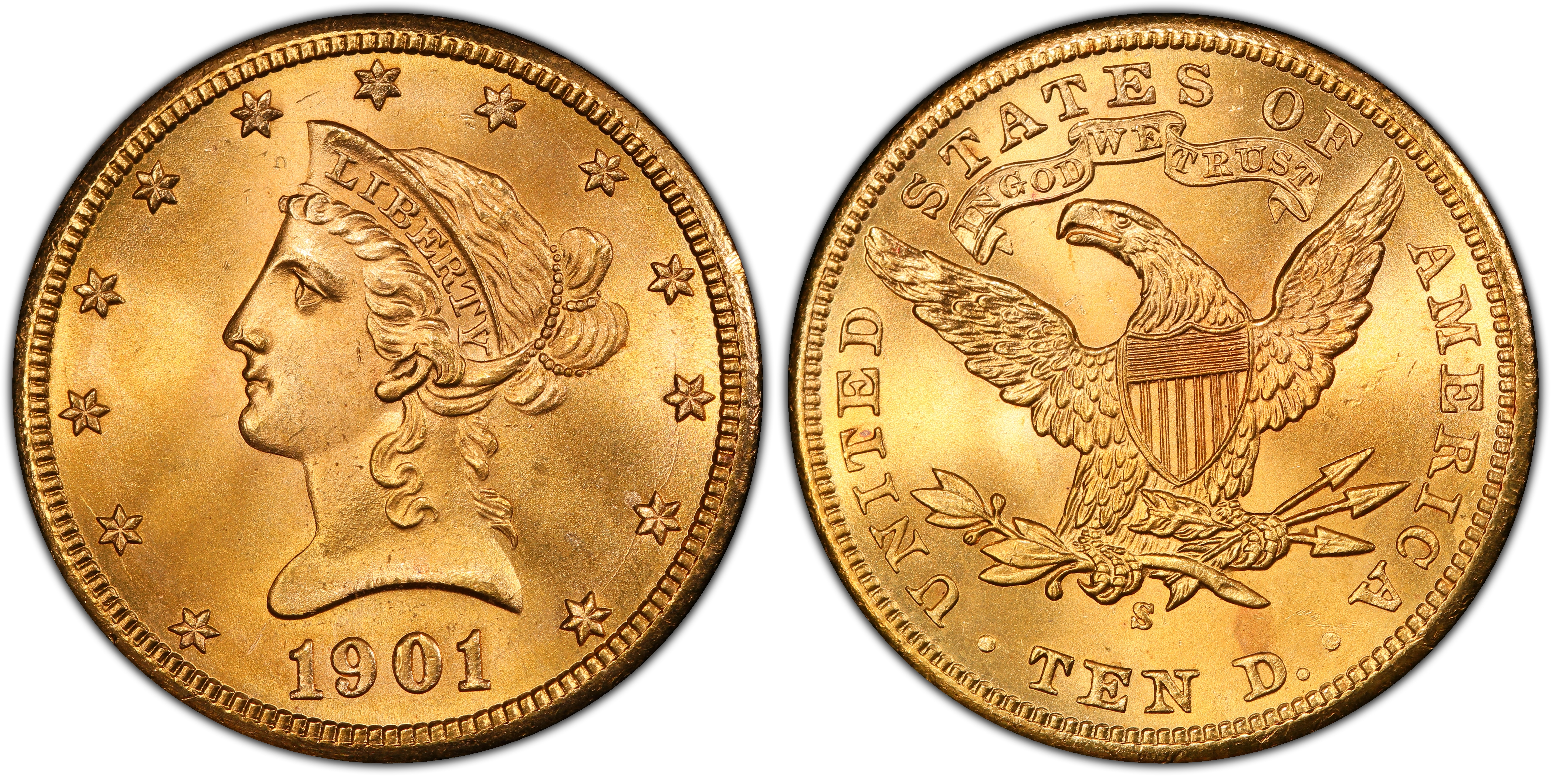
PCGS MS67
- PCGS #:
- 8749
- Designer:
- Christian Gobrecht
- Edge:
- Reeded
- Diameter:
- 26.80 millimeters
- Weight:
- 16.70 grams
- Mintage:
- 2,812,750
- Mint:
- San Francisco
- Metal:
- 90% Gold, 10% Copper
- Auction Record:
- $25,864 • MS67 • 04-04-2017 • Heritage Auctions
Go To Grade
Current Auctions - PCGS Graded
Current Auctions - NGC Graded
For Sale Now at Collectors Corner - PCGS Graded
For Sale Now at Collectors Corner - NGC Graded
Rarity and Survival Estimates Learn More
| Survival Estimate | |
|---|---|
| All Grades | 113,750 |
| 60 or Better | 103,000 |
| 65 or Better | 4,375 |
| Numismatic Rarity | |
|---|---|
| All Grades | R-1.9 |
| 60 or Better | R-1.9 |
| 65 or Better | R-4.1 |
| Relative Rarity By Type All Specs in this Type | |
|---|---|
| All Grades | 117 / 117 |
| 60 or Better | 98 / 117 |
| 65 or Better | 48 / 117 |
| Relative Rarity By Series All Specs in this Series | |
|---|---|
| All Grades | 183 / 183 |
| 60 or Better | 151 / 183 |
| 65 or Better | 57 / 183 |
Condition Census What Is This?
| #1 MS67 PCGS grade |
| #1 MS67 PCGS grade |
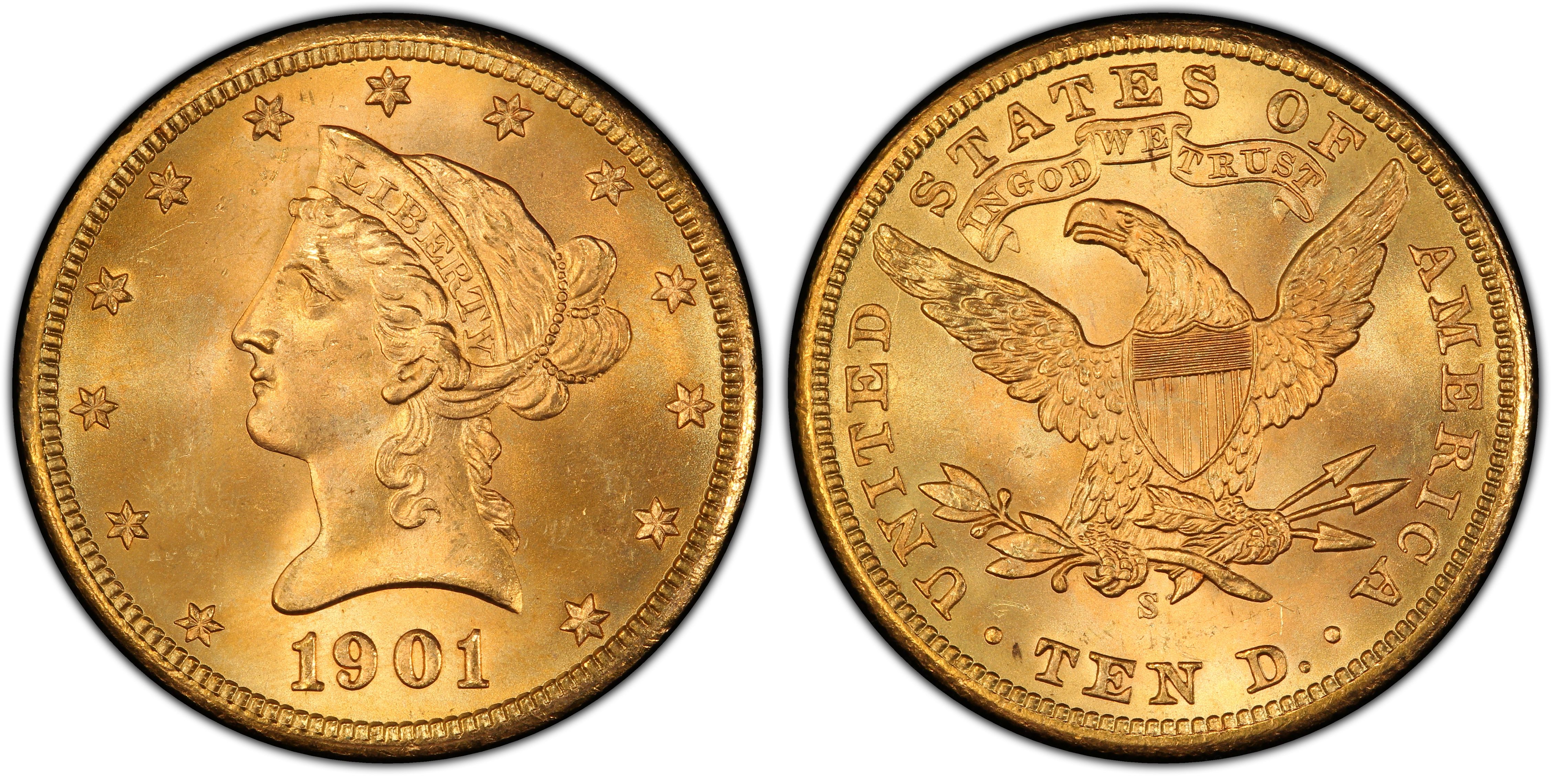 #3 MS66+ PCGS grade
|
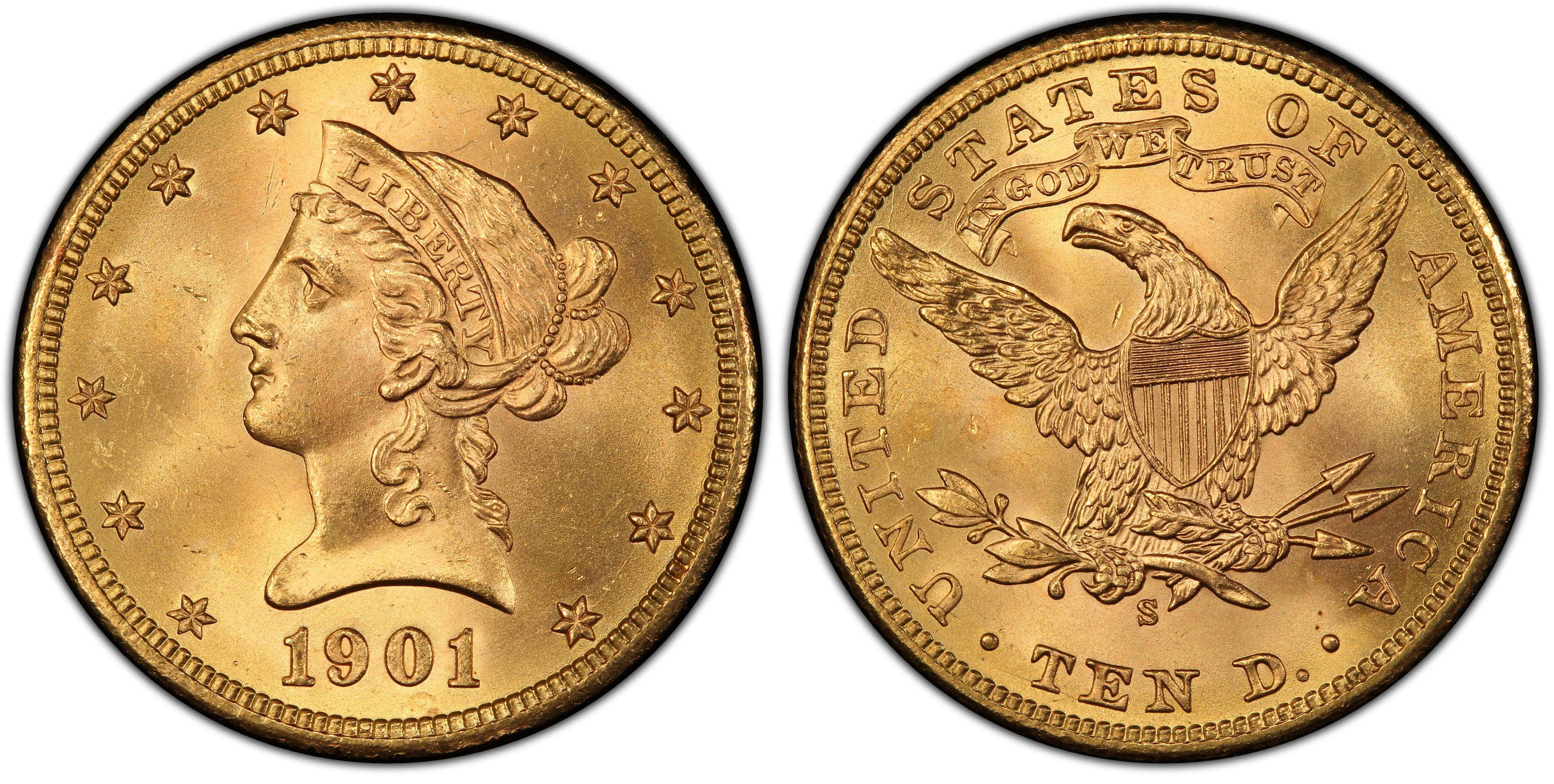 #3 MS66+ PCGS grade
|
 #3 MS66+ PCGS grade
|
 #3 MS66+ PCGS grade
Ellen D Collection (PCGS Set Registry) - Simpson Collection |
| #3 MS66+ PCGS grade |
| #3 MS66+ PCGS grade |
| #3 MS66+ PCGS grade |
| #3 MS66+ PCGS grade |
Ron Gillio:
I believe there are as many as 200,000 1901-S $10 Liberties. I encountered this date on my first trip to Europe to buy coins in 1970. I went to Zurich with fellow coin dealers Mark Teller and Larry Hanks. The first coins we were shown at the bullion department of Credit Suisse was two 500 coin bags of brilliant uncirculated 1901-S $10 Liberties. That's all they were in those days...bullion coins. We told them we were looking for different dates and were then shown mixed date bags from which we picked Carson City mint coins and other rare dates. Unfortunately, the coins in Swiss banks are long gone and the coin departments are closed. But there were a lot of coins and we could have bought as many 1901-S $10 liberties as we could carry.
David Hall:
The 1901-S is the most common $10 Liberty. Some experts feel as many as 200,000 still exist...and I agree with that estimate. Interestingly, about 90% of the survivors are uncirculated. These coins apparently didn't circulate much and were probably used for international banking and trade transactions as most of the survivors came from Swiss banks in the 1960s and 1970s when Swiss banks were the bullion traders and market-makers for the world. And that's what this coin was considered to be at the time...a bullion coin. Remember, at the time there were no American Gold Eagles, Canadian Maple Leafs, Chinese gold Pandas, or any of the other contemporary World bullion coin issues. And prior to 1975, the only "bullion" coins that were legal for American citizens to own were the Mexican 50 Pesos dated 1947 or prior, and the U.S. $20 and $10 gold pieces.