
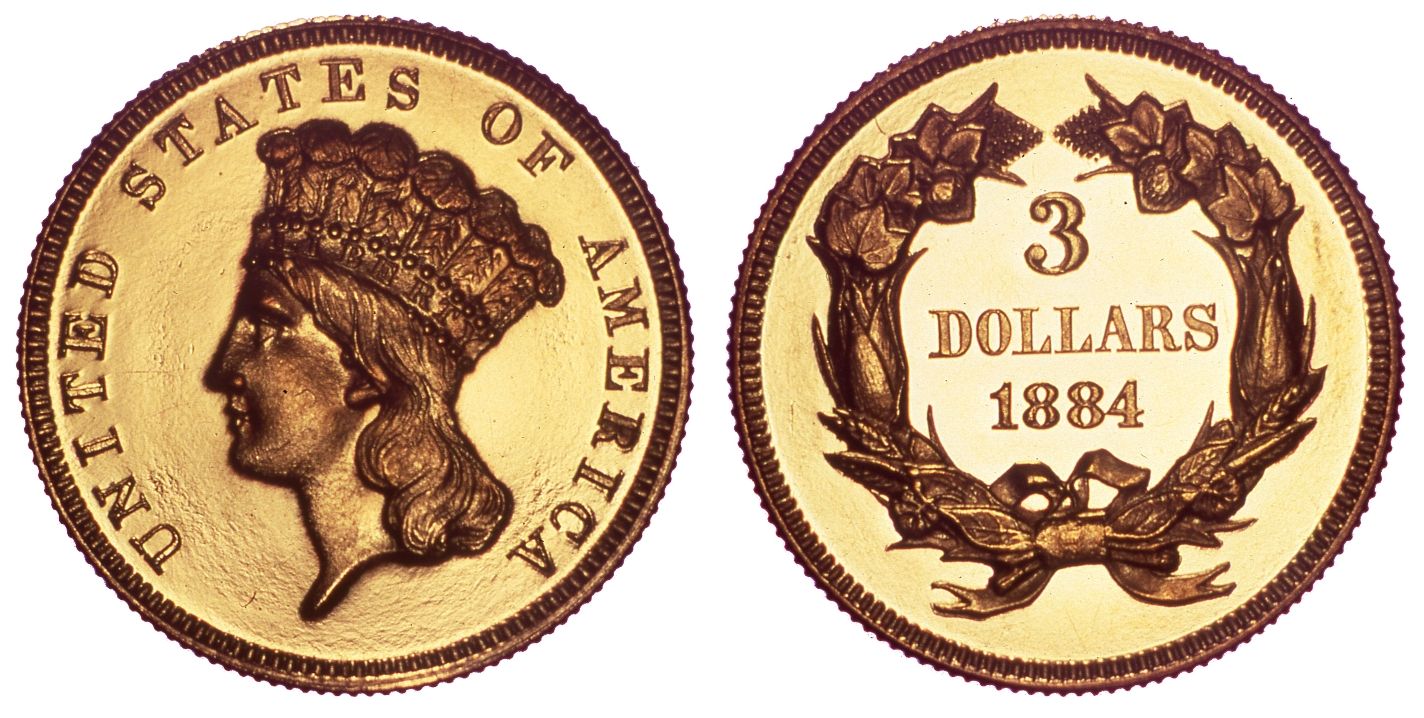
ex Trompeter collection

PCGS PR62
- PCGS #:
- 8048
- Designer:
- James Barton Longacre
- Edge:
- Reeded
- Diameter:
- 20.50 millimeters
- Weight:
- 5.02 grams
- Mintage:
- 106
- Mint:
- Philadelphia
- Metal:
- 90% Gold, 10% Copper
- Auction Record:
- $63,250 • PR68 • 03-02-2000 • Superior Galleries
Go To Grade
Current Auctions - PCGS Graded
Current Auctions - NGC Graded
For Sale Now at Collectors Corner - PCGS Graded
For Sale Now at Collectors Corner - NGC Graded
Rarity and Survival Estimates Learn More
| Survival Estimate | |
|---|---|
| All Grades | 65 |
| 60 or Better | 60 |
| 65 or Better | 25 |
| Numismatic Rarity | |
|---|---|
| All Grades | R-8.3 |
| 60 or Better | R-8.4 |
| 65 or Better | R-9.0 |
| Relative Rarity By Type All Specs in this Type | |
|---|---|
| All Grades | 32 / 37 |
| 60 or Better | 31 / 37 TIE |
| 65 or Better | 32 / 37 TIE |
| Relative Rarity By Series All Specs in this Series | |
|---|---|
| All Grades | 32 / 37 |
| 60 or Better | 31 / 37 TIE |
| 65 or Better | 32 / 37 TIE |
Condition Census What Is This?
| #1 PR67 PCGS grade |
| #2 PR66 PCGS grade |
| #3 PR65 PCGS grade |
| #3 PR65 PCGS grade |
| #3 PR65 PCGS grade |
| #3 PR65 PCGS grade |
| #3 PR65 PCGS grade |
| #3 PR65 PCGS grade |
| #3 PR65 PCGS grade |
| #10 PR64 PCGS grade |
David Akers (1975/88):
Proof-like business strikes are not nearly as decptive of this date as are the first strikes of many other dates. However, to aid those who might not be familiar with the appearance of a proof, I will point out that on all the proofs I have seen, RICA of AMERICA is distinctly recut, whereas it is not on the business strikes. Also, on the reverse of the proofs, there is a faint trace of an outline around the dots of the tassels at the top of the wreath, while I have not noticed such an outline on any business strkes. As I have indicated, howver, business strikes of this date are rarely all that deceptive and they lack the depth of field and "orange peel" surface that are common to a true proof.