
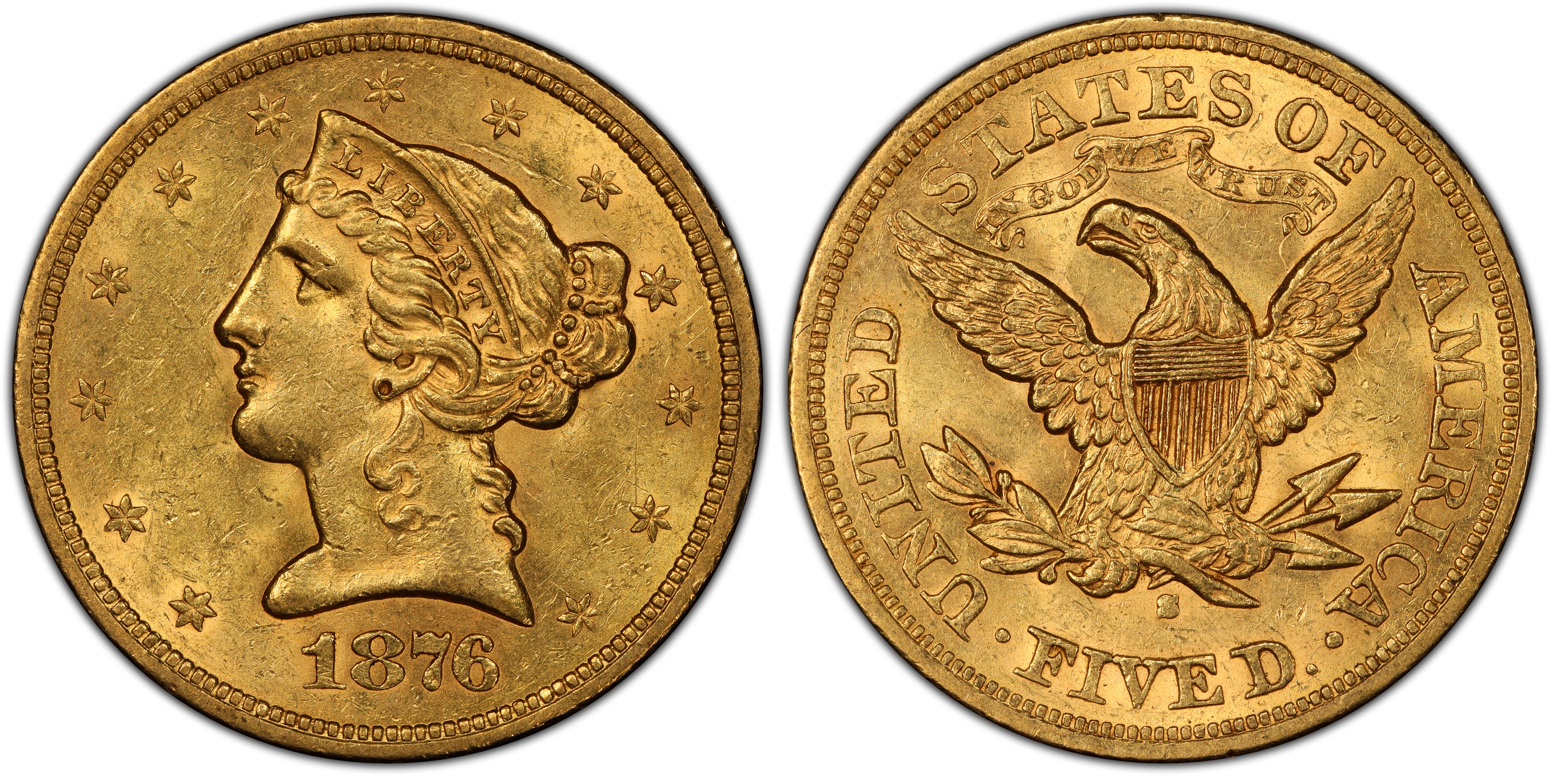
PCGS MS61
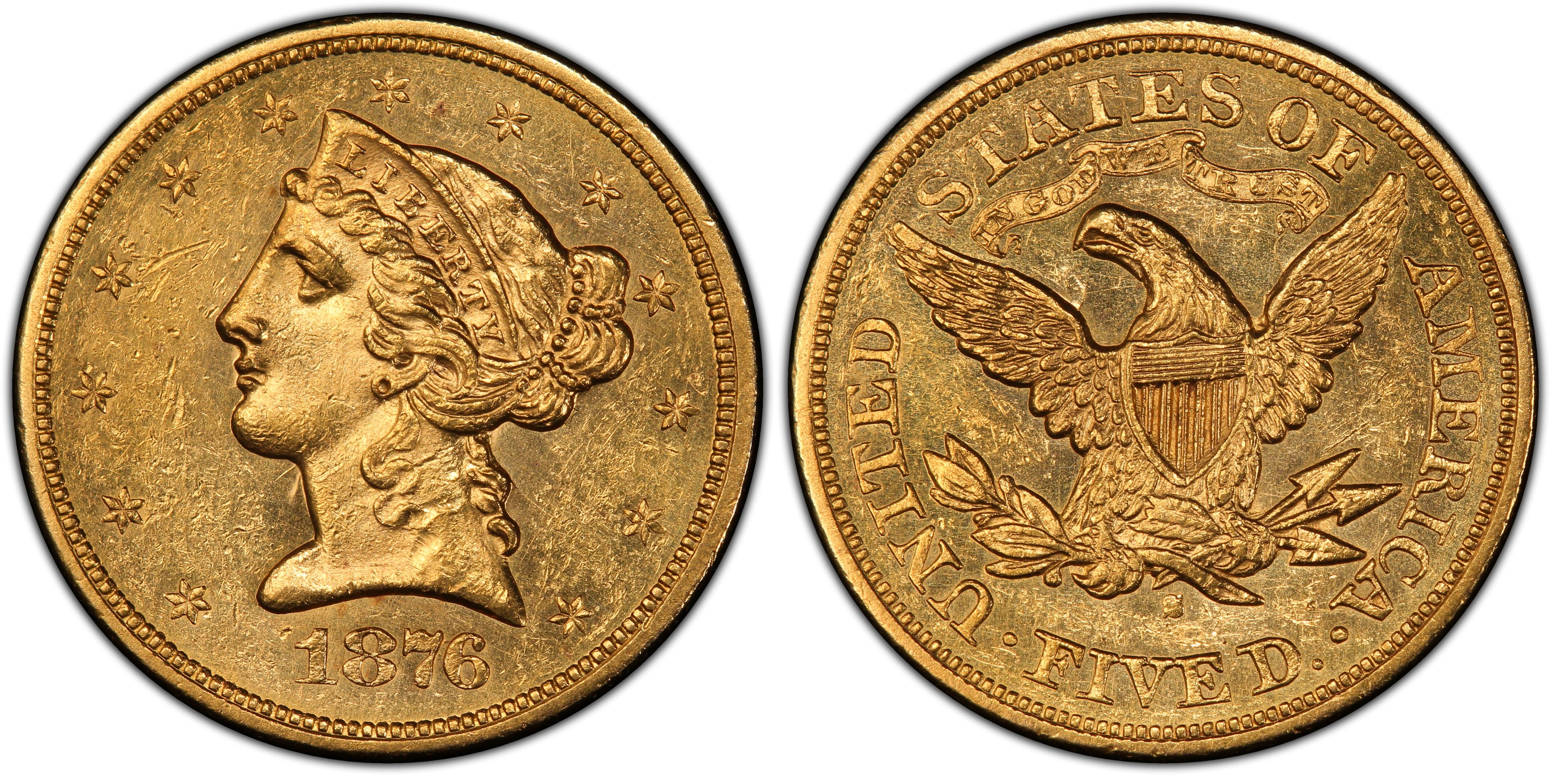
PCGS MS60
- PCGS #:
- 8341
- Designer:
- Christian Gobrecht
- Edge:
- Reeded
- Diameter:
- 21.65 millimeters
- Weight:
- 8.36 grams
- Mintage:
- 4,000
- Mint:
- San Francisco
- Metal:
- 90% Gold, 10% Copper
- Auction Record:
- $336,000 • MS65 • 01-19-2025 • Heritage Auctions
Major Varieties
- 1876-S $5
Go To Grade
Current Auctions - PCGS Graded
Current Auctions - NGC Graded
For Sale Now at Collectors Corner - PCGS Graded
For Sale Now at Collectors Corner - NGC Graded
Rarity and Survival Estimates Learn More
| Survival Estimate | |
|---|---|
| All Grades | 100 |
| 60 or Better | |
| 65 or Better | |
| Numismatic Rarity | |
|---|---|
| All Grades | R-8.0 |
| 60 or Better | R-10.1 |
| 65 or Better | R-10.1 |
| Relative Rarity By Type All Specs in this Type | |
|---|---|
| All Grades | 18 / 106 TIE |
| 60 or Better | 1 / 106 |
| 65 or Better | 1 / 106 |
| Relative Rarity By Series All Specs in this Series | |
|---|---|
| All Grades | 51 / 218 TIE |
| 60 or Better | 1 / 218 |
| 65 or Better | 1 / 218 |
Condition Census What Is This?
|
#1 MS64 estimated grade
Haseltine-Garrett |
|
#2 AU58 PCGS grade
Ex-Bass Collection |
| #3 AU55 PCGS grade |
| #3 AU55 PCGS grade |
| #3 AU55 PCGS grade |
|
#6 AU53 PCGS grade
Shuford-Bass |
| #6 AU53 PCGS grade |
| #6 AU53 estimated grade |
| #6 AU53 estimated grade |
| #6 AU53 estimated grade |
David Akers (1975/88):
The 1876-S has the second lowest mintage of any of the very rare S Mint Half Eagles from 1858-1876 and it had the third fewest number of auction appearances in my survey after the 1864-S and 1862-S, ranking in the top 10% of the entire $5 series in that respect. Most known specimens are well worn, grading VF or less, and I consider this to be one of the rarest and most underrated Half Eagles in any condition. There is one gem uncirculated example in the John Hopkins University Collection (PCGS CoinFacts editor's note: sold in the 1979 Garrett sale.) All 1876-S Half Eagles have a "punchmark" in the earlobe and the tiny mintmark is always very weak.