1876-CC 20C (Regular Strike)
Series: Liberty Seated Twenty Cents 1875-1876

PCGS MS66
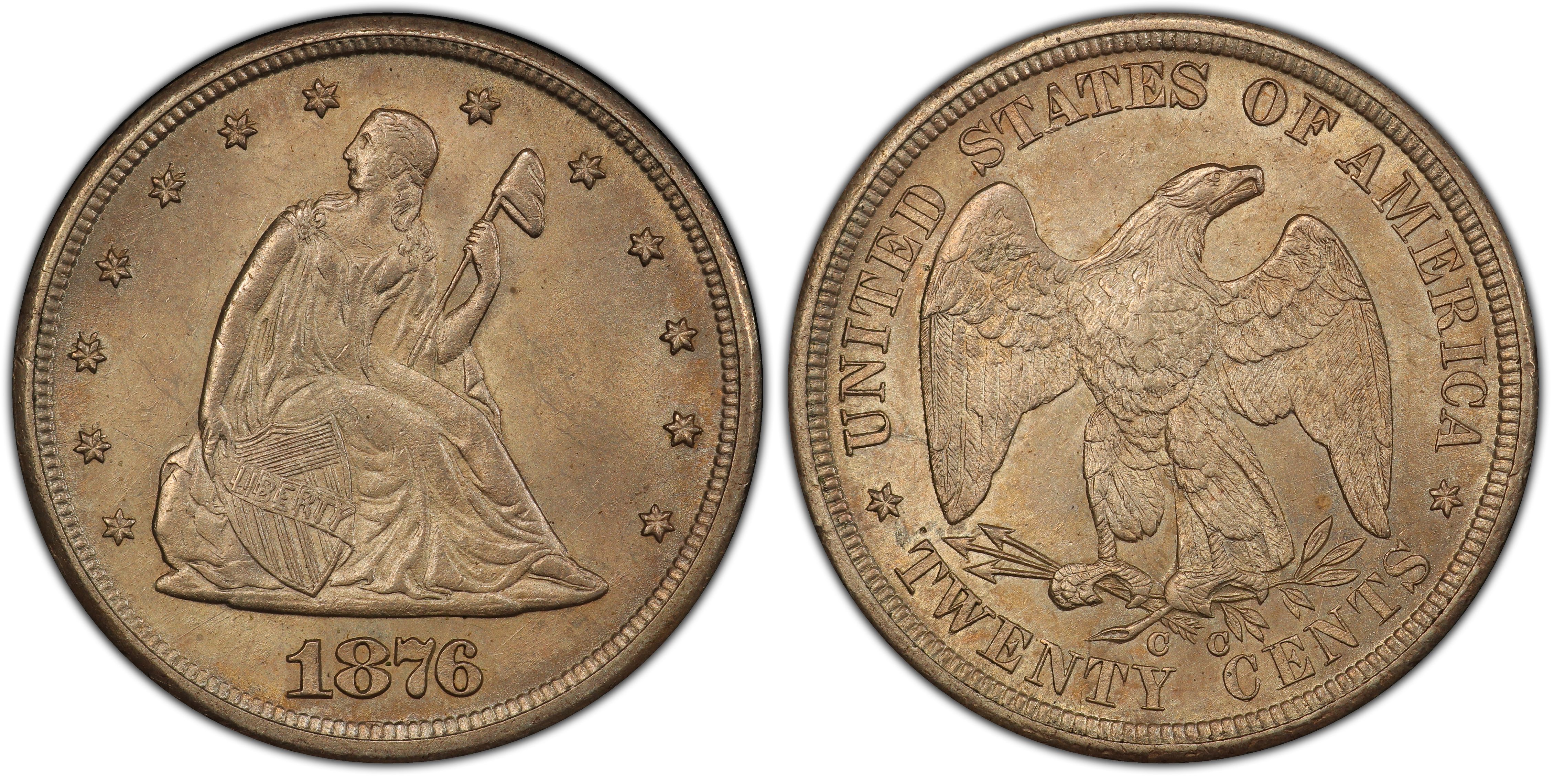
PCGS MS65
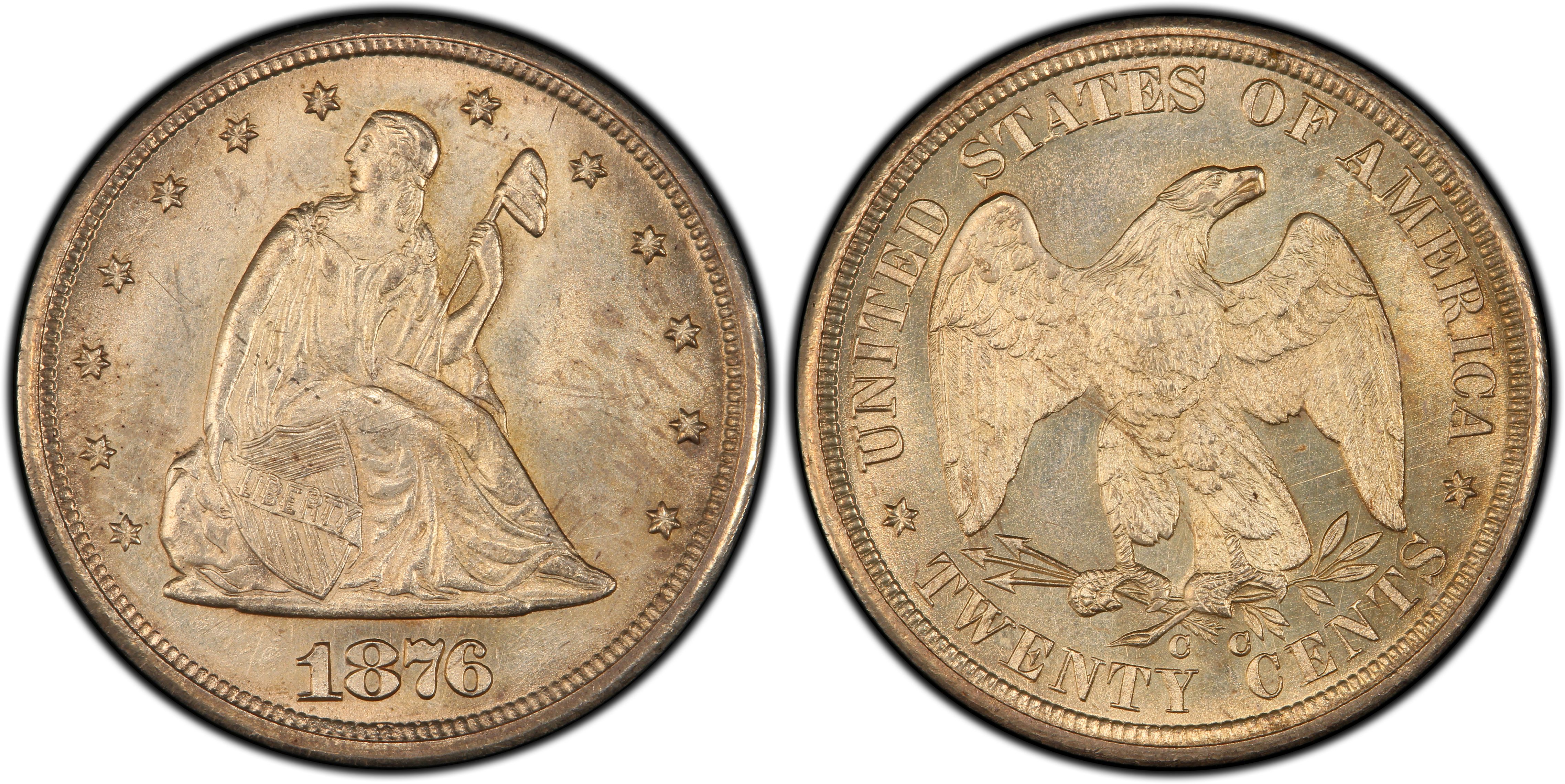
PCGS MS65
- PCGS #:
- 5300
- Designer:
- William Barber
- Edge:
- Plain
- Diameter:
- 22.00 millimeters
- Weight:
- 5.00 grams
- Mintage:
- 10,000
- Mint:
- Carson City
- Metal:
- 90% Silver, 10% Copper
- Auction Record:
- $870,000 • MS65 • 08-28-2022 • Heritage Auctions
Major Varieties
- 1876-CC 20C
Rarity and Survival Estimates Learn More
| Survival Estimate | |
|---|---|
| All Grades | 19 |
| 60 or Better | 19 |
| 65 or Better | 6 |
| Numismatic Rarity | |
|---|---|
| All Grades | R-9.1 |
| 60 or Better | R-9.1 |
| 65 or Better | R-9.7 |
| Relative Rarity By Type All Specs in this Type | |
|---|---|
| All Grades | 1 / 5 |
| 60 or Better | 1 / 5 |
| 65 or Better | 1 / 5 |
| Relative Rarity By Series All Specs in this Series | |
|---|---|
| All Grades | 1 / 5 |
| 60 or Better | 1 / 5 |
| 65 or Better | 1 / 5 |
Condition Census What Is This?
|
#1 PCGS MS66
Ed Frossard, December 1900, Lot 324; unknown intermediaries; S. Benton Emery; Bowers & Merena, November 1984, Lot 482. As NGC MS66 #700000-001. Superior, March 2001, Lot 237 - $161,000. As PCGS MS66. Superior, May 2003, Lot 2433 - bought back at $220,000 hammer. As PCGS MS66 #05226579. "The Joseph C. Thomas Collection," Heritage Auctions, April 2009, Lot 2299 - $460,000. Brilliant. Faint vertical mark on Liberty's left leg, below the knee. A small group of pin-sized contact marks in the right field. |
|
#1 PCGS MS66
Numismatic Gallery, June 1950 – $1,325; Purchased at the preceding sale by Harold M. Budd, Sr.; “The Norweb Collection,” Bowers and Merena, October 1987, Lot 691 – $69,300. Heritage Auctions, October 4, 2001, Lot 6222 – $138,000. Marketed by Jay Parrino (“The Mint”) in an undated (early 2000s) catalog for $300,000; "The Driftwood Twenty Cent Mint Set with 76 CC" (PCGS Set Registry). Old Green Holder. Lavender-copper toning with and gold undertones. |
|
#3 PCGS MS65
Possibly “The Malcolm N. Jackson Collection,” U.S. Coin Company, May 1993, Lot 997 – $250; F.C.C. Boyd; In 1935 Boyd placed an ad in The Numismatist, saying he would sell the coin for $350; “The World’s Greatest Collection, Part II,” Numismatic Gallery, March 1945, Lot 487 – $1,500; “The Jerome David Kern Collection,” B. Max Mehl, May 1950, Lot 1642 – $1,675; “The Edwin M. Hydeman Collection,” Abe Kosoff, March 1961, Lot 405 – $6,900; Joe Flynn, who offered the coin for sale at $23,900 and sold it privately; Julian Leidman; “The Armand Champa Collection,” American Auction Association, May 1972, Lot 791; Ron Winget; Bowers and Ruddy, sold privately; Stephen Tebo; Tebo advertised the coin for sale in the November 1974 Numismatist for $100,000; Superior, August 1975, Lot 349 – $45,000; Quality Sales Corp., November 1976, Lot 349; “The Arnold and Romisa Collections,” Bowers and Merena, September 1984, Lot 2211 – $44,000; “The Reed Hawn Collection,” Stack’s, July 1985, Lot 1653 – $57,750; Stack’s, March 2002, Lot 352 – $115,000. As As PCGS MS65 #25508313. Stack’s Bowers, January 22, 2013, Lot 13170 – $564,000; Heritage Auctions, August 14, 2024, Lot 4132 – $690,000. Champagne toning. Diagonal serrated contact mark across Liberty's right arm and torso. Small cluster of coppery toning spots in the hatching above BE. |
|
#3 PCGS MS65
Bowers and Ruddy’s Fixed Price List of July 1979; Stack’s, January 1988, Lot 1405. As PCGS MS65 #37861676. “The E. Horatio Morgan Collection,” Stack’s Bowers, August 15, 2019, Lot 5182 – $456,000; “The Bender Family Collection, Part I,” Heritage Auctions, August 24, 2022, Lot 3550 – $870,000; "The Elite Collection" (PCGS Set Registry). Goldenrod hue. Spot to the right of Liberty’s upright hand. Scratch to the right of star 2. Diagonal hit on Liberty’s stomach. |
| #3 PCGS MS65 |
| #3 PCGS MS65 |
 #7 PCGS MS64+
“Simon L. Lee Collection,” J.W. Scott & Co., June 12, 1899 – $26.25; John H. Clapp; Clapp Estate to Louis E. Ellsberg, Sr., “The Louis E. Eliasberg, Sr. Collection,” Bowers and Merena, April 1997, Lot 1353 – $148,500. As PCGS MS64 #6566090. “The Eugene H. Gardner Collection of U.S. Coins,” Heritage Auctions, June 23, 2014, Lot 30342 – $470,000. As PCGS MS64+ #56540657. All-over toning in shades of peach and aubergine. Gold and blue-green toning in the protected areas along the periphery. Darker toning on the drapery adjacent to Liberty's right arm. Small diagonal mark to the upper right of Star 2. |
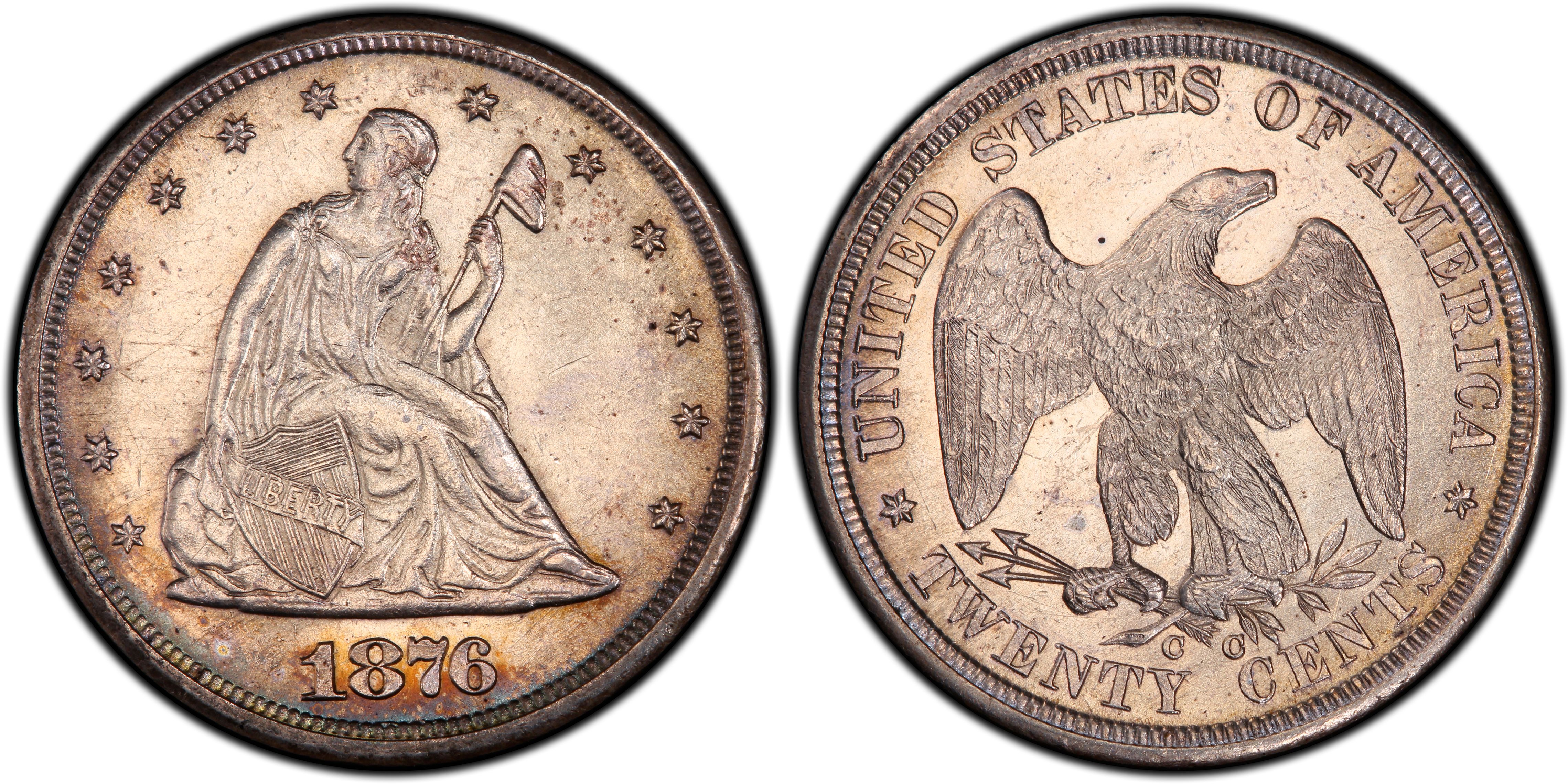 #8 PCGS MS64
Maryland Hoard, discovered in Baltimore area in 1956-1957; unknown intermediaries; unknown collector, who included this coin in a set of 1876 coinage; upon learning that he was terminally ill, that collector sold the set to dealer Mark Mendelson; Mendelson then sold the set intact to Dr. David Litrenta; “The Litrenta Collection,” Heritage Auctions, August 1999, Lot 5518; As NGC MS64. Heritage Auctions, January 5, 2000, Lot 5177 – $69,000; Duncan Lee/Douglas Winter; As PCGS MS64 #20714029. "The Battle Born Collection," Stack’s Bowers, August 7, 2012, Lot 11101 – $470,000; “The Poulos Family Collection, Part II,” Heritage Auction, September 6, 2019, Lot 4716 – $456,000; "The Black Cat - 100 Greatest Coins Collection" (PCGS Set Registry). Russet and blue toning at the base of the date and around the rim of the obverse. Multiple abrasians to the left of Liberty’s ankle. Vertical hit located to the right of the gap between stars 1 and 2. Cluster of toning spots to the right of the cap. |
 #8 PCGS MS64
“The Mendelson Collection," Superior, February 1991, Lot 1297. As PCGS MS64 #13702957. Stack’s, October 16, 2007, Lot 4941 – $350,750. As PCGS MS64 #18397544. Dell Loy Hansen; "The D.L. Hansen Ten Famous Ultra Rarities Collection" (PCGS Set Registry). Rose peach toning. Small gouge touching the denticles just below the 8. Shallow gouge at the base of the loop of 6. A diagonal mark running parallel to Liberty’s ankle. |
| #8 PCGS MS64 |
1876-CC Twenty-Cent Piece
The 1876-CC Twenty-Cent Piece (#5300) is one of the "Great Rarities" of United States numismatics. Despite the denomination's lack of commercial success, the Carson City Mint struck 10,000 pieces in 1876, with the entire mintage believed to have been produced during the first week of May.
The denomination’s introduction was a "sop" to Nevada Senator and mining tycoon John Percival Jones, who introduced the legislation in February 1874. While ostensibly created to facilitate Western trade, the coin was widely derided as commercially unnecessary and a "subsidy" for the silver interests of the Comstock Lode. Like other domestic silver coinage of the era, it featured Christian Gobrecht’s Liberty Seated design. Despite efforts to differentiate it from the quarter—including a plain edge and a Trade Dollar-style eagle—its similar size caused persistent public confusion.
Despite these predictable issues, U.S. Mint Director Henry R. Linderman remained sensitive to political pressure to monetize Nevada’s silver. He directed Carson City Superintendent James Crawford to maintain a robust inventory. Following the distribution of 133,290 pieces in 1875, Crawford authorized an additional 10,000 coins in 1876. These coins languished in the Mint’s vaults for a year, never officially entering circulation.
A single die pair was used to strike all known examples. The obverse die, spectacularly bungled by the Philadelphia Mint, exhibits pronounced doubling most visible on the word LIBERTY. This doubling is a diagnostic feature present on every genuine 1876-CC Twenty-Cent Piece.
In July 1876, Congress introduced a bill to repeal the Mint’s authority to strike the denomination. President Ulysses S. Grant signed it into law in January 1877. On January 20—just days after the abolition—the 1876-CC dies were destroyed at the Carson City Mint. On May 19, 1877, Director Linderman issued the final order to Crawford:
"You are hereby authorized and directed to melt all 20-cent pieces you have on hand, and you will debit 'Silver Profit Fund' with any loss thereon."
It appears only a small number of coins were either paid out before the melt order or, more likely, saved for the Annual Assay and later passed into private hands. Today, fewer than 20 examples are known to survive. While virtually unknown to 19th-century collectors, pieces slowly trickled into the market over the next century. The most significant source was a hoard of ten (some say five to eight) uncirculated examples discovered near Baltimore, Maryland, and unveiled by dealer Tom Warfield in 1957.
The first public offering occurred in January 1890 at the Robert Coulton Davis sale. Listed as lot 1506, the cataloguer noted with prescience:
"1876 CC mint: sharp, brilliant, uncirc. We know of no duplicate of this mintage."
The census of known examples grew slowly, reaching only four by the time Edgar H. Adams remarked about an example exhibited by Elmer Sears. Today, PCGS has certified the majority of surviving examples, with two grading MS66 and nine falling in the MS64–MS65 range. With MS65 specimens now approaching the million-dollar mark, the 1876-CC has seen an extraordinary trajectory from its humble $7.00 auction debut.
* * *
Breen cited a "Maryland estate" in the pedigrees of four of the 16 1876-CC Twenty Cents he listed. According to Breen, "The Maryland estate (1957) reportedly contained 10 in all, of which I examined four..." The cataloguer of the October 2003 Stack's sale explains, "In the late 1950s, five to eight were discovered in Baltimore by Tom Warfield of the Mason-Dixon Coin Exchange, an early mentor of the late Walter Breen. These ``Maryland Hoard' pieces were all high grade, Very Choice to Gem Uncirculated..."