

PCGS MS63
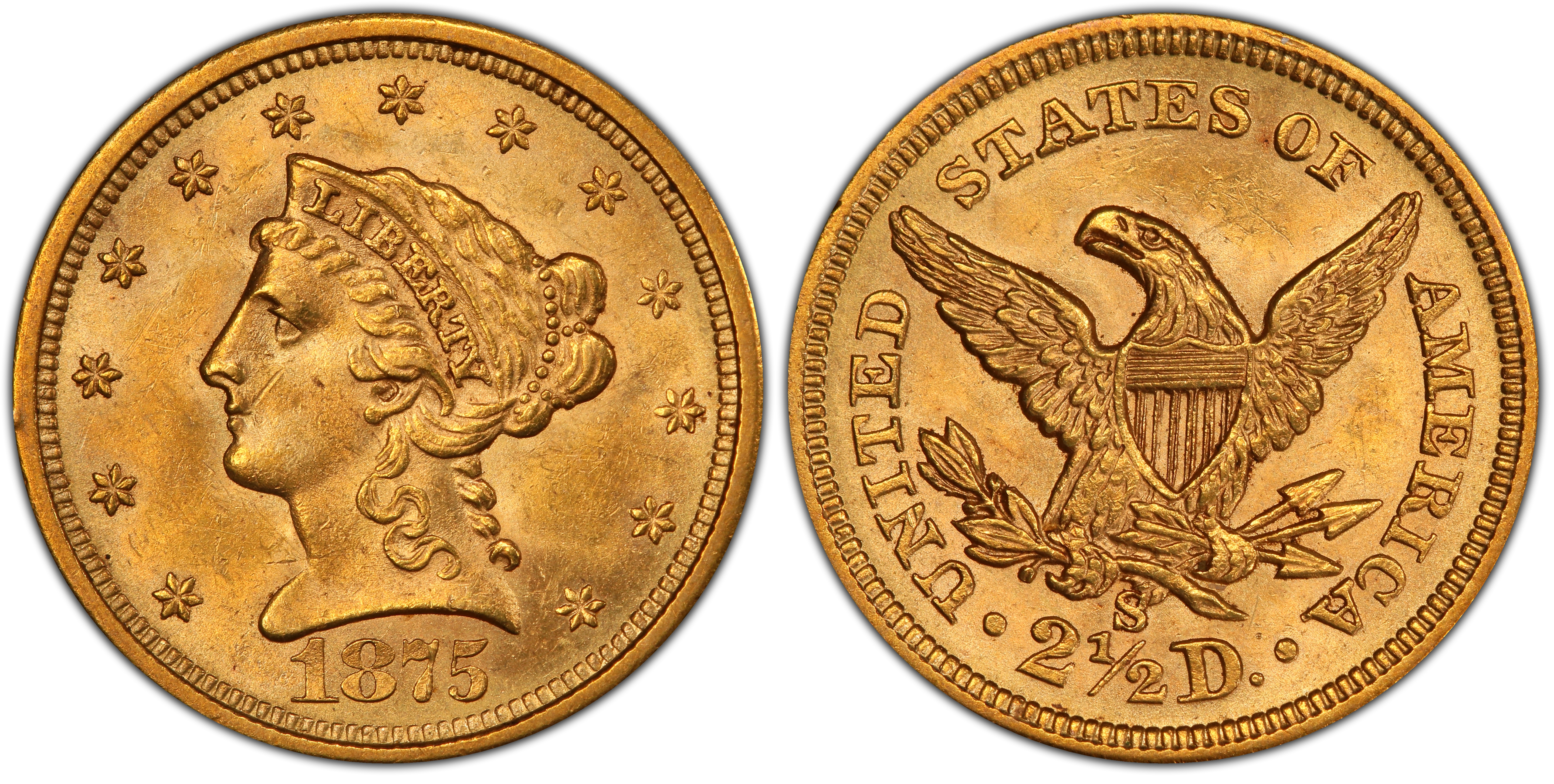
PCGS MS63
- PCGS #:
- 7823
- Designer:
- Christian Gobrecht
- Edge:
- Reeded
- Diameter:
- 18.00 millimeters
- Weight:
- 4.18 grams
- Mintage:
- 11,600
- Mint:
- San Francisco
- Metal:
- 90% Gold, 10% Copper
- Auction Record:
- $13,225 • MS65 • 08-08-2001 • Heritage Auctions
Major Varieties
- 1875-S $2.50
Go To Grade
Current Auctions - PCGS Graded
Current Auctions - NGC Graded
For Sale Now at Collectors Corner - PCGS Graded
For Sale Now at Collectors Corner - NGC Graded
Rarity and Survival Estimates Learn More
| Survival Estimate | |
|---|---|
| All Grades | 500 |
| 60 or Better | 15 |
| 65 or Better | 1 |
| Numismatic Rarity | |
|---|---|
| All Grades | R-6.0 |
| 60 or Better | R-9.3 |
| 65 or Better | R-10.0 |
| Relative Rarity By Type All Specs in this Type | |
|---|---|
| All Grades | 109 / 147 TIE |
| 60 or Better | 78 / 147 TIE |
| 65 or Better | 1 / 147 TIE |
| Relative Rarity By Series All Specs in this Series | |
|---|---|
| All Grades | 109 / 147 TIE |
| 60 or Better | 78 / 147 TIE |
| 65 or Better | 1 / 147 TIE |
Condition Census What Is This?
| #1 MS65 PCGS grade |
| #2 MS64 estimated grade |
| #3 MS63 PCGS grade |
| #3 MS63 PCGS grade |
| #3 MS63 PCGS grade |
| #3 MS63 PCGS grade |
| #7 MS62 PCGS grade |
| #7 MS62 PCGS grade |
| #7 MS62 PCGS grade |
| #10 MS61 PCGS grade |
Ron Guth:
Most (perhaps all) examples of this date utilize an Old Reverse ("Hub of 1840-1858"). Please report any New Reverse examples.
David Akers (1975/88):
Like most S Mint quarter eagles, the 1875-S is very difficult to obtain above EF. I have seen a number of AU's and three or four strictly uncirculated pieces, but the typically available specimen only grades VF or so. Most of the specimens that I have seen are weakly struck, although not as noticeably so as many of the earlier S Mint quarter eagles. A few, however, are nearly as sharply struck as their Philadelphis Mint counterparts. This is an underrated and undervalued date, particularly in high grade.