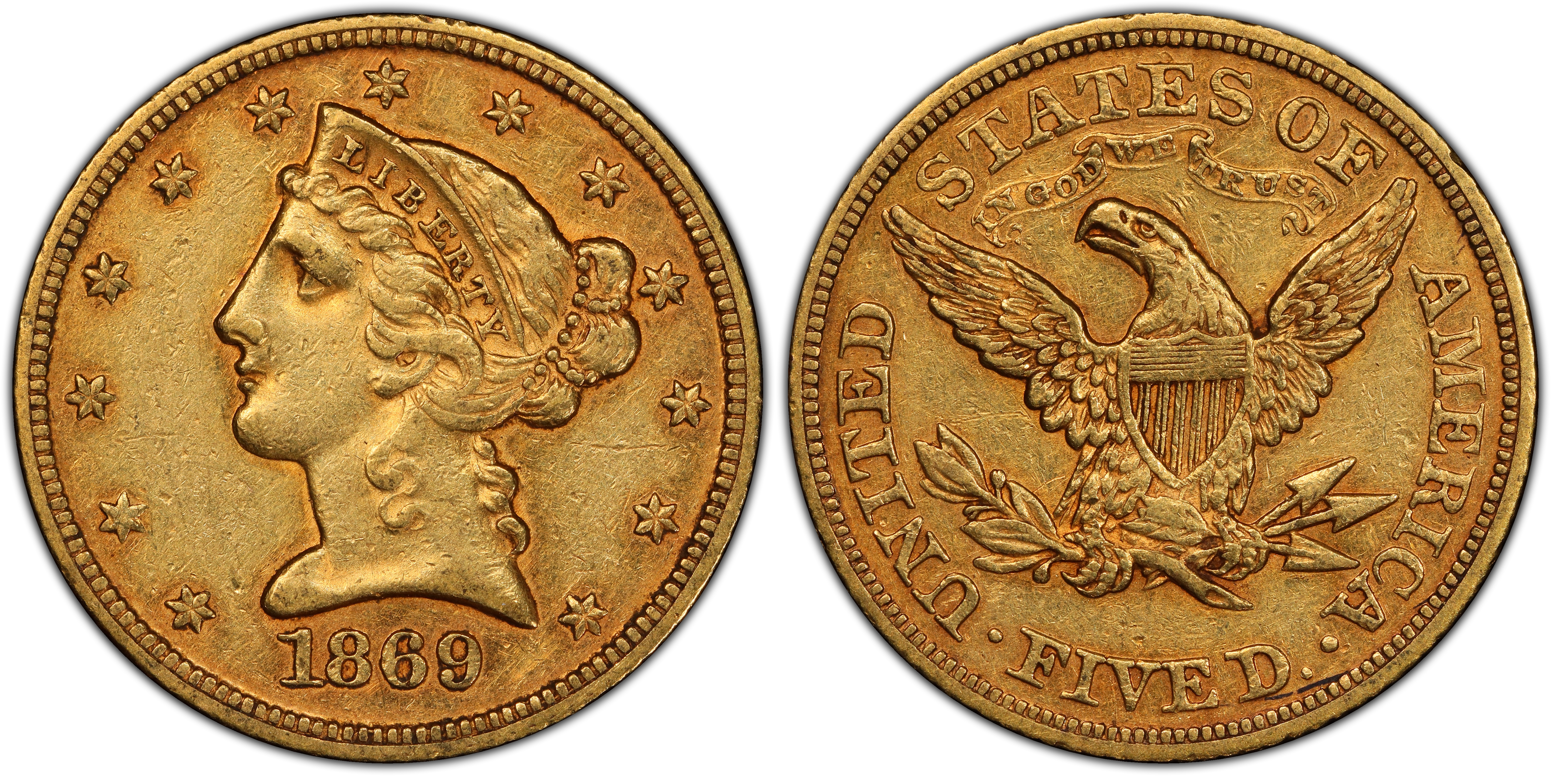
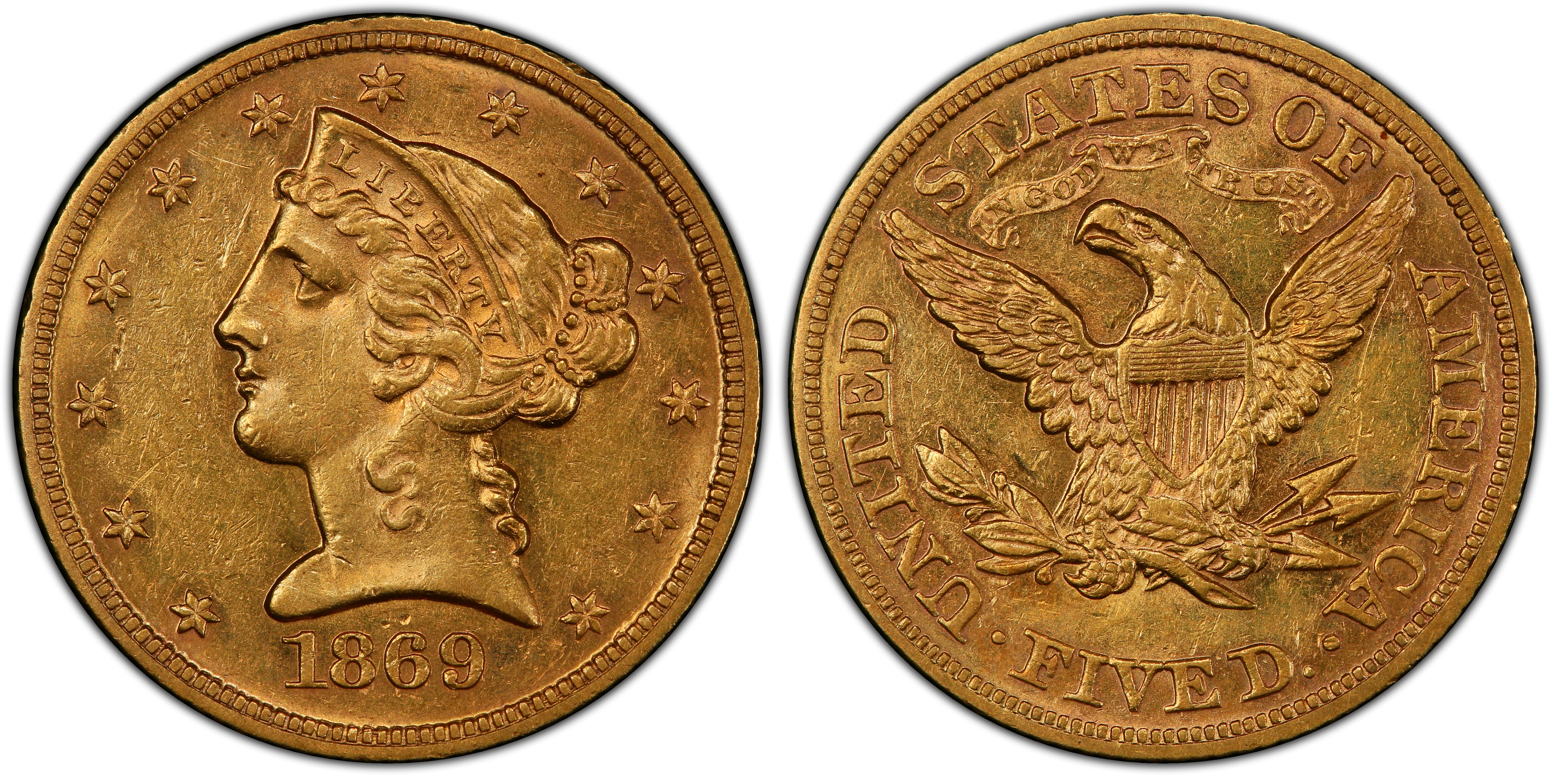
PCGS AU58

PCGS AU58
- PCGS #:
- 8317
- Designer:
- Christian Gobrecht
- Edge:
- Reeded
- Diameter:
- 21.65 millimeters
- Weight:
- 8.36 grams
- Mintage:
- 1,760
- Mint:
- Philadelphia
- Metal:
- 90% Gold, 10% Copper
- Auction Record:
- $33,350 • MS64 • 10-01-1999 • Bowers & Merena
Major Varieties
- 1869 $5
Go To Grade
Current Auctions - PCGS Graded
Current Auctions - NGC Graded
For Sale Now at Collectors Corner - PCGS Graded
For Sale Now at Collectors Corner - NGC Graded
Rarity and Survival Estimates Learn More
| Survival Estimate | |
|---|---|
| All Grades | 55 |
| 60 or Better | 1 |
| 65 or Better | |
| Numismatic Rarity | |
|---|---|
| All Grades | R-8.4 |
| 60 or Better | R-10.0 |
| 65 or Better | R-10.1 |
| Relative Rarity By Type All Specs in this Type | |
|---|---|
| All Grades | 4 / 106 TIE |
| 60 or Better | 1 / 106 TIE |
| 65 or Better | 1 / 106 |
| Relative Rarity By Series All Specs in this Series | |
|---|---|
| All Grades | 21 / 218 TIE |
| 60 or Better | 1 / 218 TIE |
| 65 or Better | 1 / 218 |
Condition Census What Is This?
| #1 MS63 estimated grade |
| #1 MS63 estimated grade |
| #1 MS63 estimated grade |
 #4 AU58 PCGS grade
|
| #4 AU58 PCGS grade |
| #4 AU58 estimated grade |
| #7 AU55 PCGS grade |
| #7 AU55 PCGS grade |
| #7 AU55 PCGS grade |
| #7 AU55 PCGS grade |
David Akers (1975/88):
The 1869 has one of the lowest mintages in the series and the date is just as rare as that low mintage implies. There are not all that many specimens known in any condition, but the typically available 1869 is EF or AU with proof-like or partially proof-like surfaces. I have not seen a strictly uncirculated 1869 and the Kern specimen is the only one ever catalogued as such (Editors note: as of 1980).