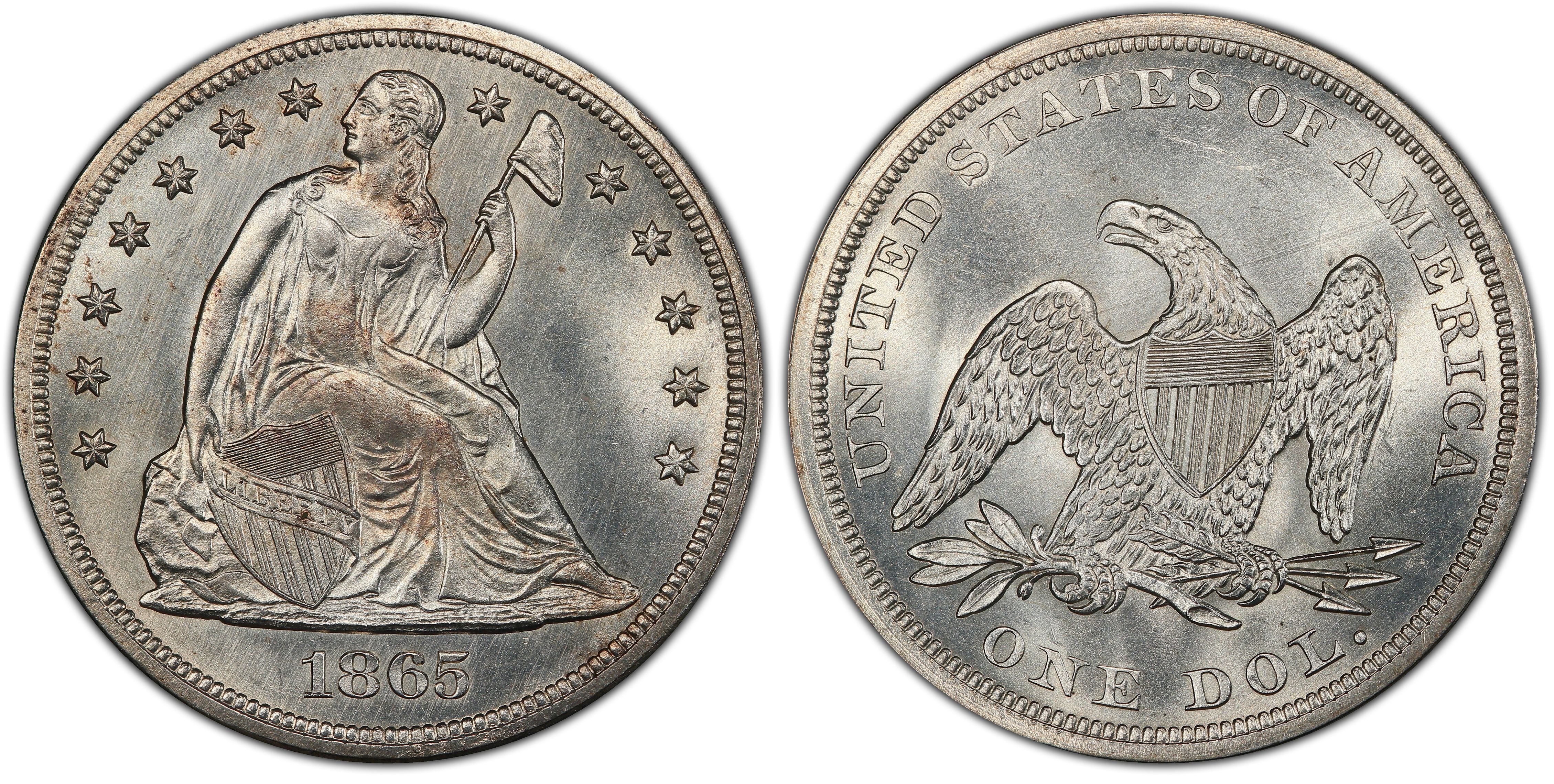
PCGS MS65
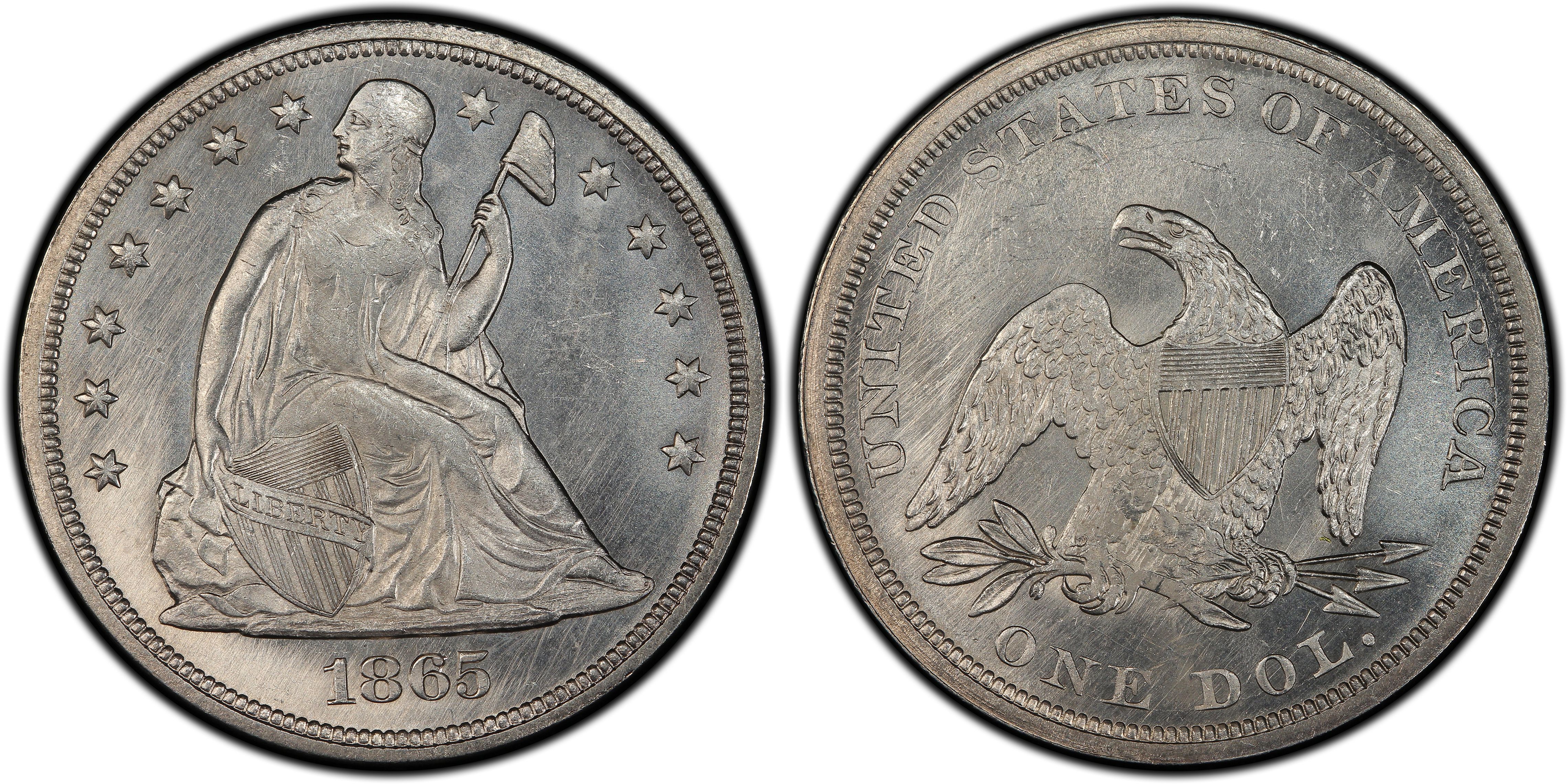
PCGS MS64
- PCGS #:
- 6955
- Designer:
- Christian Gobrecht
- Edge:
- Reeded
- Diameter:
- 38.10 millimeters
- Weight:
- 26.73 grams
- Mintage:
- 46,500
- Mint:
- Philadelphia
- Metal:
- 90% Silver, 10% Copper
- Auction Record:
- $57,500 • MS65 • 07-01-2008 • Heritage Auctions
Major Varieties
- 1865 $1
Rarity and Survival Estimates Learn More
| Survival Estimate | |
|---|---|
| All Grades | 1,200 |
| 60 or Better | 55 |
| 65 or Better | 1 |
| Numismatic Rarity | |
|---|---|
| All Grades | R-4.9 |
| 60 or Better | R-8.4 |
| 65 or Better | R-10.0 |
| Relative Rarity By Type All Specs in this Type | |
|---|---|
| All Grades | 5 / 30 TIE |
| 60 or Better | 13 / 30 TIE |
| 65 or Better | 1 / 30 TIE |
| Relative Rarity By Series All Specs in this Series | |
|---|---|
| All Grades | 12 / 45 TIE |
| 60 or Better | 20 / 45 TIE |
| 65 or Better | 1 / 45 TIE |
Condition Census What Is This?
|
#1 PCGS MS65
"The L.K. Rudolf Collection," Stack's, May 2003, Lot 2127 - $20,700; Bruce Morelan; "The Legend Collection (Morelan)"; The Legend Collection sold en bloc to Dell Loy Hansen; "The D.L. Hansen Seated Dollars Complete Set (1836-1873)" (PCGS Set Registry). Brilliant with splashes of copper across the obverse. |
 #1 PCGS MS65
|
 #3 PCGS MS64
"The Delexa Collection," Heritage Auctions, January 11, 2024, Lot 4112 - $21,600; Legend Rare Coin Auctions, July 28, 2022, Lot 256 - $23,500. "The CRB Family Collection 1865" (PCGS Set Registry). OC-2. Die State b/d. Ivory-gold toning. Rim contact mark to the left of cap. Faint olive-colored toning stripe across the lower portion of the reverse. Scartch below "TA" of STATES. |
|
#3 PCGS MS64
As NGC MS64. Stack’s Bowers, March 21, 2012, Lot 4130 – $8,625. As PCGS MS64 #30358624. Stack’s Bowers, August 2015, Lot 10138 – Passed. Brown toning at the chief of Liberty's shield. Mark above eagle’s head. Small crescent-shaped mark below eagle’s left wing tip. Weakness in Liberty's blouse, eagle’s leg, fletching, and branch. |
|
#3 PCGS MS64
“The Franklinton Collection, Part II,” Stack’s, January 7, 2008, Lot 625 – $21,850; Bill Nagle, February 2008; "The Eugene H. Gardner Collection, Part I," Heritage Auctions, June 2014, Lot 30603 - $25,850; "The MW12 Collection" (PCGS Set Registry); "The American Girls Collection" (PCGS Set Registry). Repunched U. FS-801. Pale olive and cream color throughout. Shield and eagle detail soft at center. |
|
#3 PCGS MS64
"The Arkansas Collection" (PCGS Set Registry). |
1865 Liberty Seated Dollar
Originally intended as the cornerstone of the U.S. monetary system, the silver dollar faced an uphill battle from its inception. By the mid-19th century, the denomination was plagued by three primary issues: it was physically cumbersome, frequently exported for its bullion value, and—after the Coinage Act of 1853—valued at a premium that made it too expensive for domestic use.
Following a lenghty production suspension that began in 1804, the silver dollar returned to full-scale production in 1840, though mintages remained modest. Leading up to the Civil War, gold remained the preferred medium for domestic banks and financial institutions, while the public relied on base-metal cents and fractional silver (dimes through half dollars) for daily commerce.
Domestic demand for the silver dollar was virtually non-existent; instead. Instead, it functioned almost exclusively as an export vehicle. Struck primarily on demand for bullion dealers and merchants, these heavy silver pieces were shipped overseas to satisfy international trade requirements—particularly in the Far East—where their intrinsic value far outweighed its domestic utility, though it struggled to unseat Mexican Silver 8 Reales as the preferred medium of exchange.
The Impact of the Civil War on Dollar Production
The Civil War pushed the United States Mint to its breaking point. The Confederacy seized the branch mints in Charlotte, Dahlonega, and New Orleans; while the first two never reopened, New Orleans did not resume federal coinage until 1879. This left only Philadelphia and San Francisco to carry the load for the fractured nation. In 1865, Philadelphia was the sole facility to strike silver dollars, producing a meager: 46,500 Business strikes (the majority produced over just three days in September) and 500 Proofs (#7008).
|
1865 Liberty Seated Dollar Production |
|||
| March 3, 1865 | 3,800 struck | May 31, 1865 | 14,000 struck |
| September 8, 1865 | 9,700 struck | September 13, 1865 | 7,000 struck |
| September 27, 1865 | 12,000 struck | Uncertain Date | 500 struck (Proofs) |
| Total Mintage: 47,000 coins (inc. Proofs). | |||
High Attrition and Market Reality
While the Liberty Seated Dollar was generally used as a vehicle for Eastern trade, the 1865 issue was struck primarily for export to Central and South America. These coins were seldom seen in domestic channels; consequently, the vast majority of surviving specimens are found in heavily circulated or impaired condition.
The PCGS Population Report paints a compelling picture, though it requires nuance to interpret accurately. PCGS has certified fewer than 300 total examples, with a heavy concentration in the Very Fine (VF) to About Uncirculated (AU) range. Interestingly, the population for low grade examples is significantly smaller. This suggests one of two things: either a perceived lack of market justification for submission, or—more likely, given that even low-grade examples command a $1,000 minimum—the inherent difficulty of securing a straight grade for coins at this level. Given the intense demand for Civil War-era coinage, the latter is the more likely culprit.
At the top of the grading scale, Mint State coins present the opposite problem: overreporting. In constructing a true condition census, I analyzed examples graded PCGS MS64 and above. I was only able to physically locate six unique examples that have either traded publicly at a major auction house since 2000 or are currently claimed in the PCGS Set Registry. To maintain the integrity of this census, I excluded several older MS64 listings—mostly coins graded before 2000 that lack a traceable public sales history. While the census is always a moving target, the astute collector will recognize a clear pattern: the 1865 Liberty Seated Dollar is significantly scarcer than the raw population figures suggest.
* * *