
PCGS MS65
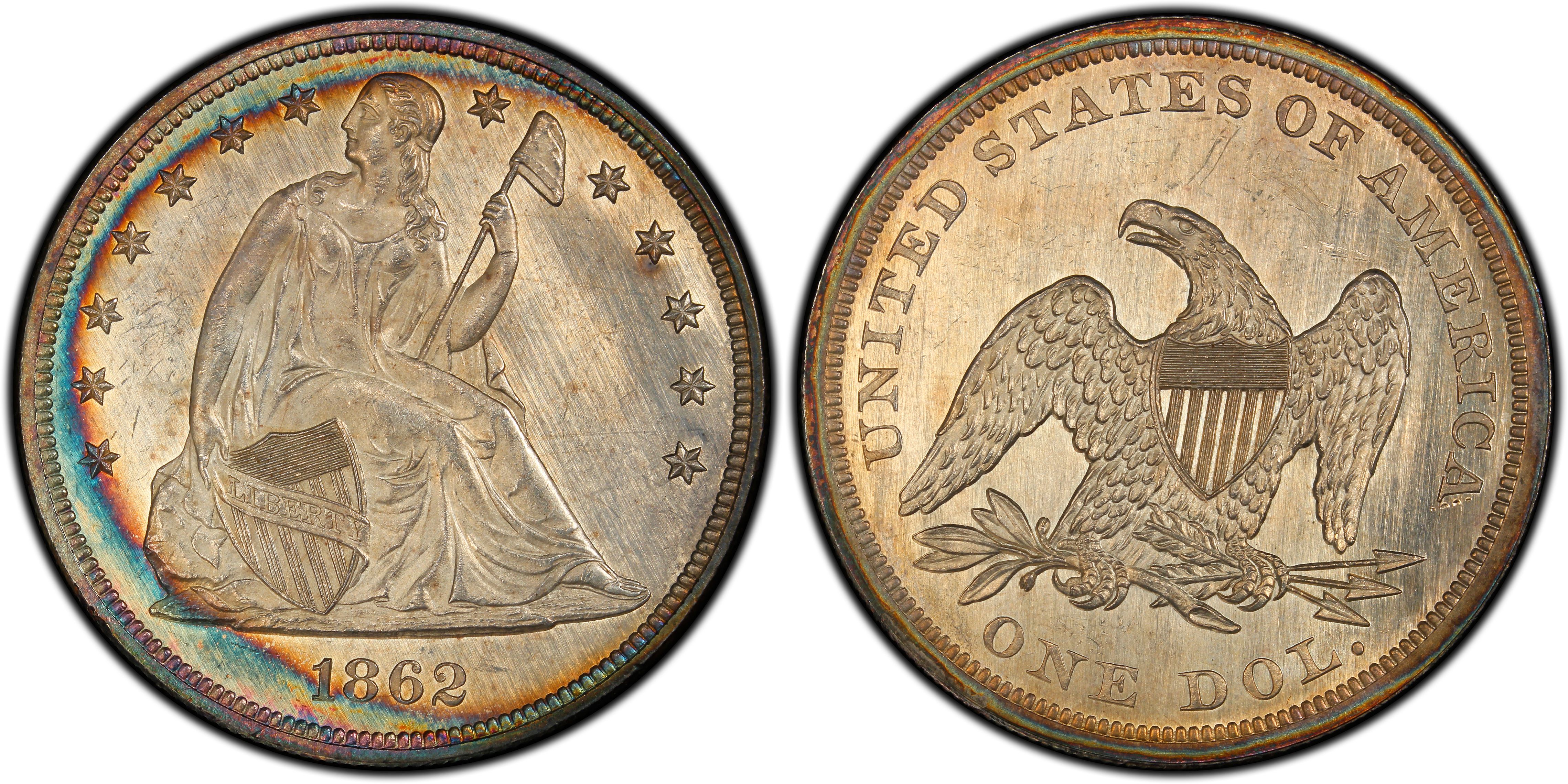
PCGS MS64+
- PCGS #:
- 6952
- Designer:
- Christian Gobrecht
- Edge:
- Reeded
- Diameter:
- 38.10 millimeters
- Weight:
- 26.73 grams
- Mintage:
- 11,540
- Mint:
- Philadelphia
- Metal:
- 90% Silver, 10% Copper
- Auction Record:
- $52,875 • MS65 • 01-06-2016 • Heritage Auctions
Major Varieties
- 1862 $1
Rarity and Survival Estimates Learn More
| Survival Estimate | |
|---|---|
| All Grades | 1,100 |
| 60 or Better | 100 |
| 65 or Better | 3 |
| Numismatic Rarity | |
|---|---|
| All Grades | R-4.9 |
| 60 or Better | R-8.0 |
| 65 or Better | R-9.8 |
| Relative Rarity By Type All Specs in this Type | |
|---|---|
| All Grades | 5 / 30 TIE |
| 60 or Better | 19 / 30 TIE |
| 65 or Better | 13 / 30 TIE |
| Relative Rarity By Series All Specs in this Series | |
|---|---|
| All Grades | 12 / 45 TIE |
| 60 or Better | 28 / 45 TIE |
| 65 or Better | 15 / 45 TIE |
Condition Census What Is This?
|
#1 PCGS MS65
Bruce Morelan; "The Legend Collection (Morelan)"; The Legend Collection sold en bloc to Dell Loy Hansen; "D.L. Hansen Seated Dollars Complete Set (1836-1873)" (PCGS Set Registry). Target toning with aubergine centers and Cerulean blue and green in the outer areas. |
 #1 PCGS MS65
“The Bob R. Simpson Collection,” Heritage Auctions, January 7, 2016, Lot 5460 – $52,875; "American Girls" (PCGS Set Registry). Pale cream color. Toning spot at 12 o’clock touching denticles. Minute diagonal toning streak at 1 o’clock touching denticles. Pin-sized toning spot between "N" and "E" of ONE. Rim hit to the right of the eagle's neck. |
| #1 PCGS MS65 |
|
#4 PCGS MS64+
"The Malibu Collection," Stack’s Bowers, November 4, 2010, Lot 2278 – $21,850; Legend Numismatics to Eugene H. Gardner, via sale; “The Eugene H. Gardner Collection,” Heritage Auctions, June 23, 2014, Lot 30602 – $31,725; "The M & S Petty Collection," Legend Rare Coin Auctions, July 28, 2022, Lot 253 – $35,250. Crescent-shaped toning in green and red on the left side of the obverse. Champagne all over obverse and reverse. |
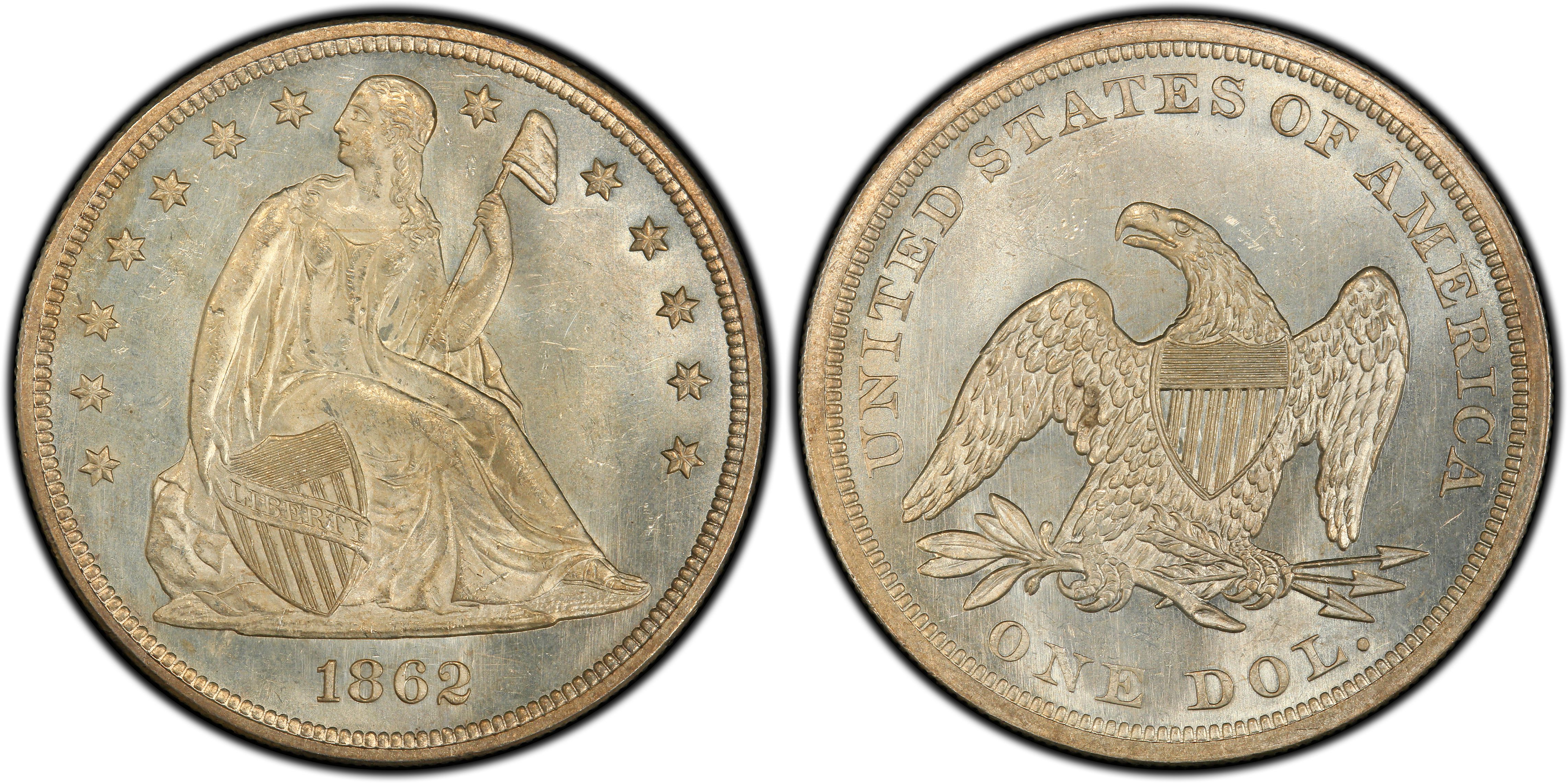 #4 PCGS MS64+
As PCGS MS64 #16090456. “The Christmas Lake Collection,” Heritage Auctions, October 13, 2011, Lot – $12,650. As PCGS MS64+ #16090456. "The Bigmo Civil War Collection," Legend Rare Coin Auctions, July 16, 2020, Lot 30 – $27,025; "The American Girl 2 Collection" (PCGS Set Registry). Creamy. light russet toning from stars 3 to 5 to the rim. Rim hit on Liberty’s left elbow. |
 #6 MS64 PCGS grade
Stack's Bowers, March 31, 2021, Lot 4119 - $7,800. Bronze and violent patina. Toning spot above Liberty's right knee. |
|
#6 MS64 PCGS grade
Goldberg Auctioneers, January 28, 2004, Lot 2561 - $9,200; "The Joseph C. Thomas Collection, Part One," Heritage Auctions, April 1, 2009, Lot 898 - $7,475; Heritage Auctions, September 11, 2009, Lot 931 - $7,475. Orange-gold and toning with accents in green and blue. "Zebra" toning in the right obverse field. |
 #6 MS64 PCGS grade
Peach-gold toning. Olive and red toning along the perophery. Faint horizontal hairline marks in the right obverse field. |
| #6 MS64 PCGS grade |
| #6 MS64 PCGS grade |
| #6 MS64 PCGS grade |
| #6 MS64 PCGS grade |
| #6 MS64 PCGS grade |
| #6 MS64 PCGS grade |
| #6 MS64 PCGS grade |
| #6 MS64 PCGS grade |
| #6 MS64 PCGS grade |
| #6 MS64 PCGS grade |
The 1862 Liberty Seated Dollar
The production of the 1862 Liberty Seated Dollar (#6952) took place under the immense strain of a fracturing Union. A series of early Confederate victories, combined with the perceived hesitation of Union General George B. McClellan to aggressively prosecute the war, signaled that the conflict would endure for years.
The Evolution of the Silver Dollar
While reintroduced at scale in 1840, the silver dollar struggled to find a foothold in domestic commerce. Following the 1848 California Gold Rush, the Treasury introduced a more portable Gold Dollar, further sidelining its silver counterpart. By the early 1850s, the intrinsic bullion value of the silver dollar began to exceed its face value.
The Coinage Act of 1853 addressed this by reducing the weight of fractional silver (dimes through half dollars) to keep them from being melted, but the weight of the silver dollar remained unchanged. Consequently, the Mint began charging a premium over face value—often as high as 108 cents—for the "cartwheels." Merchants found that the only viable use for the silver dollar was in the export trade, where they were often melted down upon arrival. It was not until the introduction of the heavier Trade Dollar in 1873 that American silver gained better standing in Asia, though Chinese merchants still utilized professional "shroffs" to apply chopmarks to verify the silver's purity.
The Rise of Greenbacks and Fiat Money
As the Civil War intensified, the federal government struggled to keep coinage in circulation. In 1862, emergency financial measures led to the creation of "Greenbacks"—fiat paper currency. By mandating this currency as legal tender, the government financed the war effort, though it quickly traded at significant discounts compared to "hard" gold and silver.
During this period, the Mint’s limited output of precious metal coins served primarily as a hedge against inflation or to settle international debts. Silver was exported to Canada, China, and South America, while the majority of U.S. gold flowed to Britain and France. This specie drain was necessary to fund the Union's massive wartime imports— most notably vast quantities of European wool for uniforms and hundreds of thousands of Pattern 1853 Enfield rifles. Though the Springfield Model 1861 was the preferred domestic arm, production could not meet demand, leaving the imported Enfield as a staple of the Federal infantry throughout the conflict.
British dependence on Southern cotton initially fostered warmer relations with the Confederacy than might have been expected from a nation that had abolished slavery nearly three decades prior. However, as the Union naval blockade tightened, the resulting "Cotton Famine" forced the British textile industry to pivot, eventually sourcing its raw materials from India and Egypt.
Production and Mintage of the 1862 Issue
|
1862 Liberty Seated Dollar Production |
|||
| January 27, 1862 | 500 struck (Proofs) | February 4, 1862 | 700 struck |
| June 14, 1862 | 500 struck | July 30, 1862 | 5,000 struck |
| August 5, 1862 | 5,340 struck | Total Mintage: 11,540 coins | |
By December 1861, banks had suspended specie payments. As 1862 began, the nation’s future was deeply uncertain. It was in this volatile environment that the 1862 Liberty Seated Dollar was struck.
- January 27, 1862: Just three days before the launch of the Union’s first ironclad, the USS Monitor, the Philadelphia Mint struck 500 Proofs (#7005).
- February 4, 1862: The first 700 business-strike coins were delivered.
- June 14, 1862: Two weeks after Robert E. Lee took command of the Army of Northern Virginia, another 500 business-strike coins were produced.
- Summer 1862: The bulk of production occurred on July 30 and August 5, with deliveries of 5,000 and 5,340 coins, respectively. These two summer batches account for nearly 90% of the total mintage.
Survival and Physical Characteristics
The total mintage of the 1862 Liberty Seated Dollar was struck at the behest of private depositors. Today, business-strike survivors are remarkably scarce, as they did not circulate during the war. Many were held in vaults or overseas until the late 1870s, when a crash in silver prices finally allowed them to enter general circulation.
Series specialists often note prominent die striations in the fields of Mint State examples, which can be mistaken for cleaning by the uninitiated. These are diagnostic of the issue:
- Obverse: Striations are typically diagonal, oriented in a line with the top of Liberty's lower left leg.
- Reverse: Striations are generally vertical.
Despite the wide discrepancy in mintage, Proofs likely survive in higher numbers than business strikes. For the latter, the highest concentration of coins enumerated in the PCGS Population Report falls within the About Uncirculated (AU) to Mint State grade range. While intuition suggests the AU segment is more resistant to 'crackouts' than Uncirculated examples, one must account for the fact that collectors reholder coins for various reasons beyond simple upgrade attempts.
At the Condition Census level of PCGS MS64 to PCGS MS65, the scarcity is startling: only three PCGS MS64 examples have been traced to a PCGS TrueView image or a 21st-century auction appearance. Many of the coins currently listed in the 'pop' were graded 25 to 35 years ago. While these holders may still exist in private collections, a buyer looking for a top-tier 1862 Liberty Seated Dollar should not hold their breath; as submitters often don't bother to return labels, the database populations likely far exceed the actual number of extant high-grade specimens.
* * *