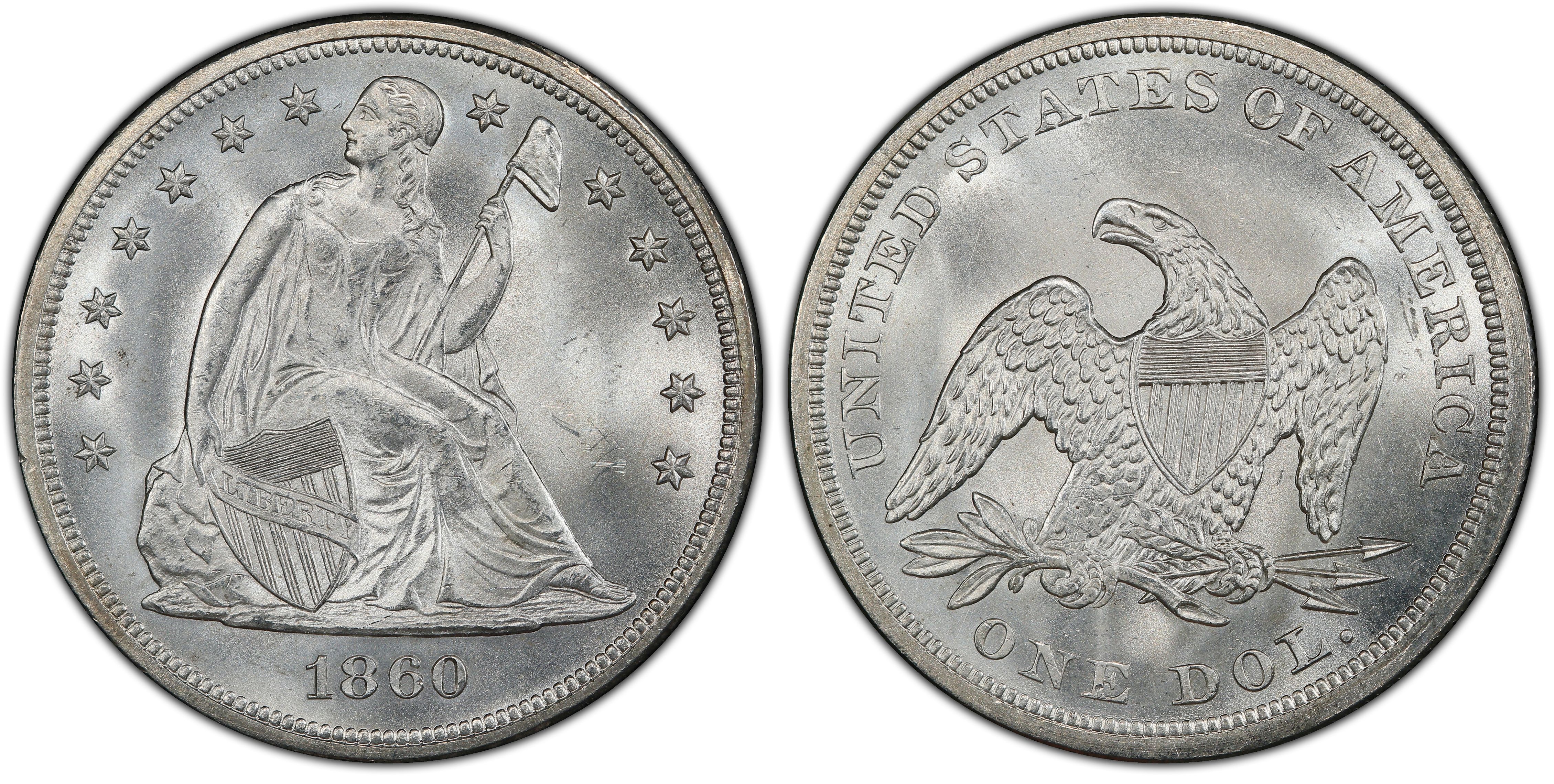
PCGS MS66+

PCGS MS65
- PCGS #:
- 6949
- Designer:
- Christian Gobrecht
- Edge:
- Reeded
- Diameter:
- 38.10 millimeters
- Weight:
- 26.73 grams
- Mintage:
- 217,600
- Mint:
- Philadelphia
- Metal:
- 90% Silver, 10% Copper
- Auction Record:
- $156,000 • MS66+ • 05-07-2023 • Heritage Auctions
Major Varieties
- 1860 $1
Rarity and Survival Estimates Learn More
| Survival Estimate | |
|---|---|
| All Grades | 1,500 |
| 60 or Better | 140 |
| 65 or Better | 6 |
| Numismatic Rarity | |
|---|---|
| All Grades | R-4.8 |
| 60 or Better | R-7.6 |
| 65 or Better | R-9.7 |
| Relative Rarity By Type All Specs in this Type | |
|---|---|
| All Grades | 13 / 30 TIE |
| 60 or Better | 26 / 30 TIE |
| 65 or Better | 16 / 30 TIE |
| Relative Rarity By Series All Specs in this Series | |
|---|---|
| All Grades | 21 / 45 TIE |
| 60 or Better | 36 / 45 TIE |
| 65 or Better | 21 / 45 TIE |
Condition Census What Is This?
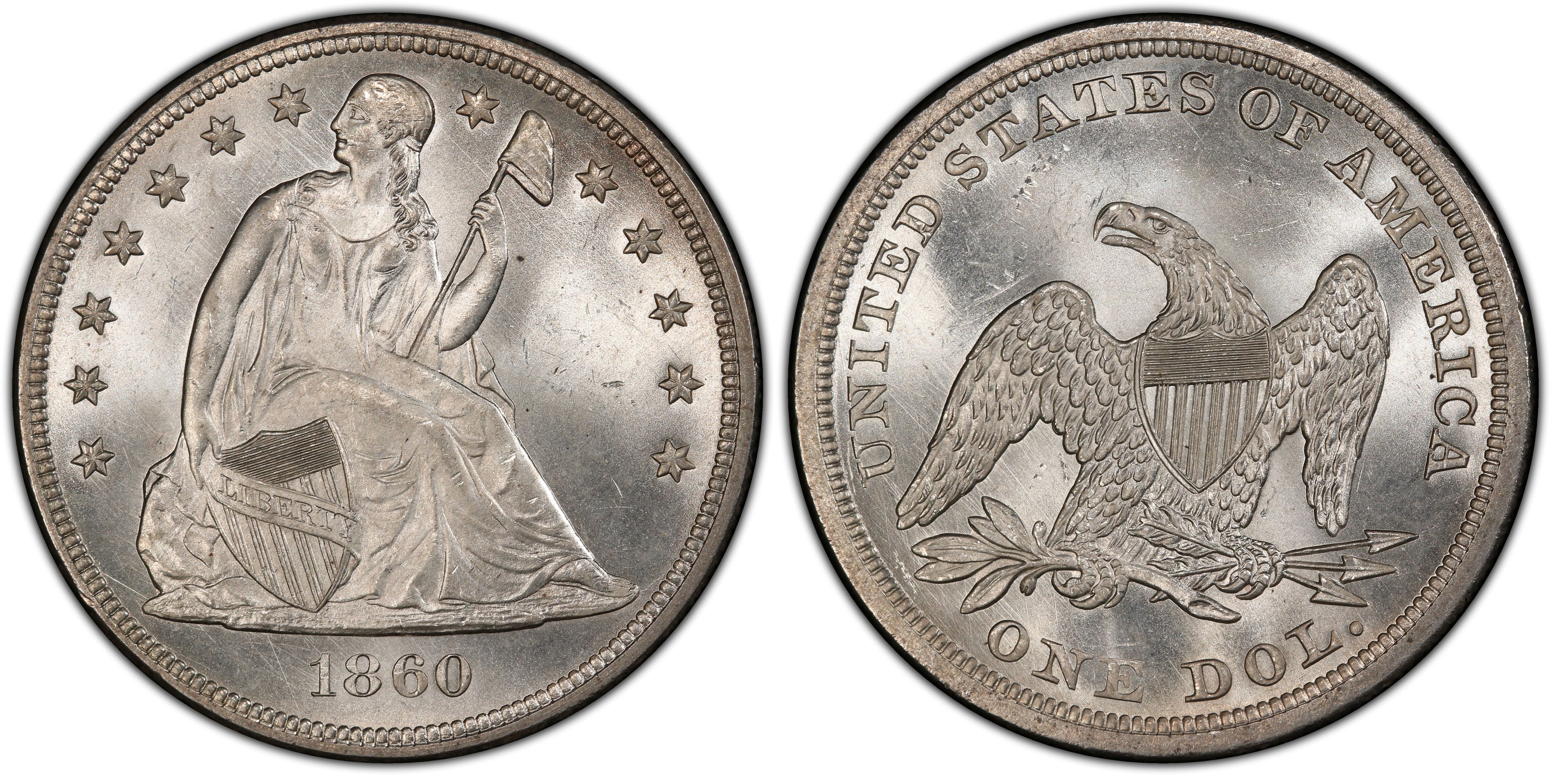 #1 PCGS MS66+
As PCGS MS65 #3144089. “The Dr. Young Collection,” Heritage Auctions, March 4, 2016, Lot 4962 – $50,525. As PCGS MS66+ #36468184. Heritage Auctions, May 3, 2023, Lot 3131 – $156,000. OC-5. Brilliant. Pin-sized toning spot to the right of Liberty’s left wrist. Horizontal tick to the left of star 12. Two tiny hits on the right forearm. Large deep rim hit below TA of STATES. Overlapping reed marks below "STA" of STATES. Contact marks under the eagle’s right wing. |
|
#1 PCGS MS66+
Possibly (per Heritage Auctions) “The Fairfield Collection,” Bowers and Ruddy, October 6-8, 1977, Lot 1093 - $2,100. As NGC MS67 #1727946-040. Bowers and Ruddy, Heritage Auctions, July 27, 2003, Lot 8251 – $69,000. As PCGS MS66+ #81226670. Dell Loy Hansen; "The D.L. Hansen Seated Dollars Complete Set (1836-1873)" (PCGS Set Registry). Frosty and brilliant. Light bag marks to the left of Star 13. |
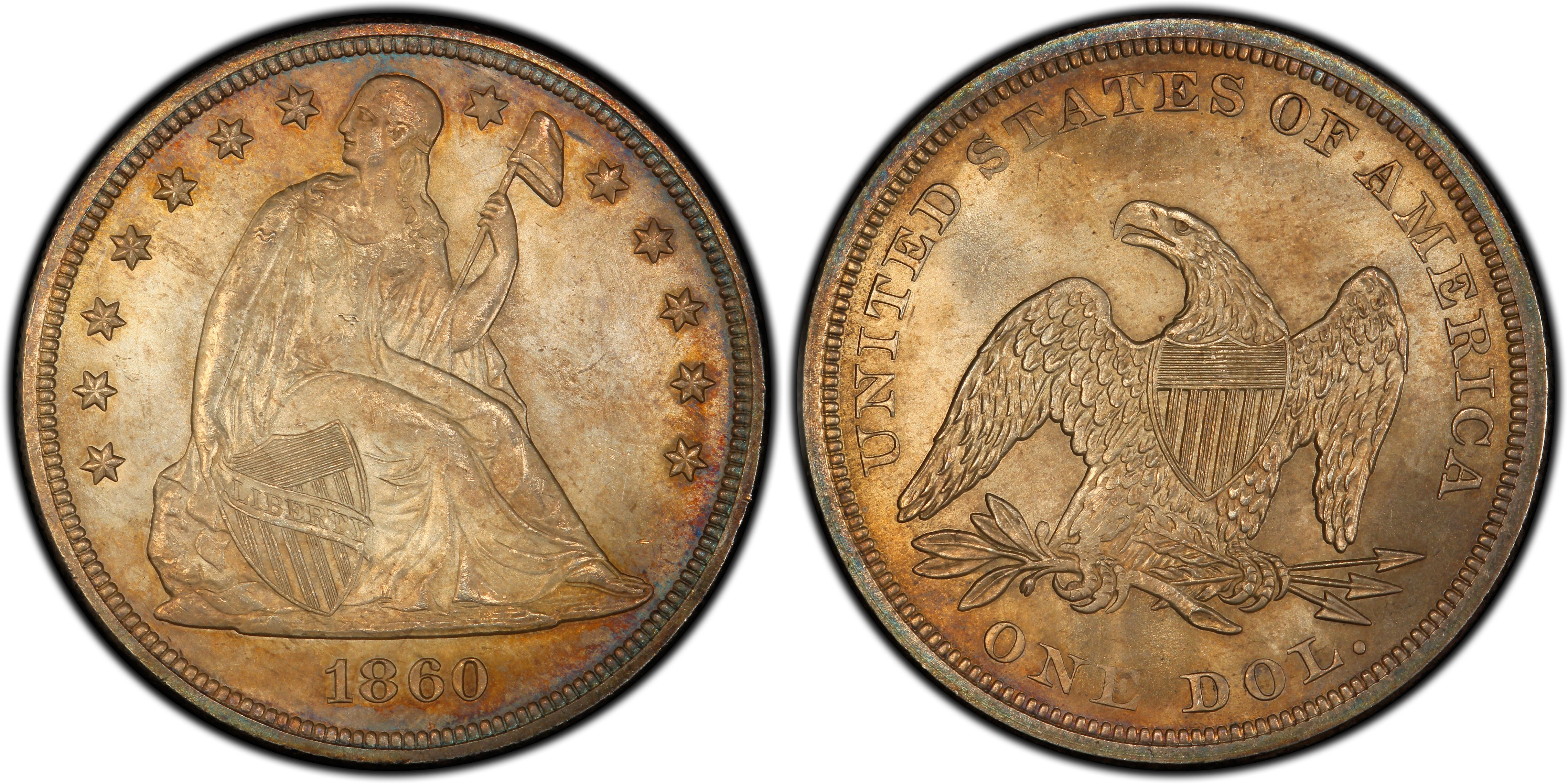 #3 PCGS MS65
Stack's Bowers, August 13, 2011, Lot 7415 - Passed. Pearlescent grey and orange gold throughout with blue and green toning at the rims. |
|
#3 PCGS MS65
Brilliant. Diagonal die polish lines on the obverse. Light contact mark to the left of the "1" in the date. Two hits below the "D" and "S" of UNITED STATES. |
 #5 PCGS MS64+
As PCGS MS64 #05991304. Bill Nagle to Eugene H. Gardner, March 2007; "The Eugene H. Gardner Collection, Part II," Heritage Auctions, October 2014, Lot 98595 - $8,225; unknown intermediaries; "The Osprey Collection," December 2021; "The Narva River & Lake Balaton Collection," March 2022. As PCGS MS64+ #40750998. Stack's Bowers, June 17, 2022, Lot 1374 - $13,800; Heritage Auctions, September 14, 2023, Lot 3037 – $9,300. OC-1. Even lavender-grey and olive-green toning. Gold highlights. Faint reed marks to the left of Star 10. Small tick below Star 12. |
 #5 PCGS MS64+
"The Prufrock322 Collection" (PCGS Set Registry). Champagne toning with flashes of gold along the periphery. Tiny toning spot to the left of the "1" of the date. Tiny diagonal mark to the left of the cap. Light marks in the upper reverse field. |
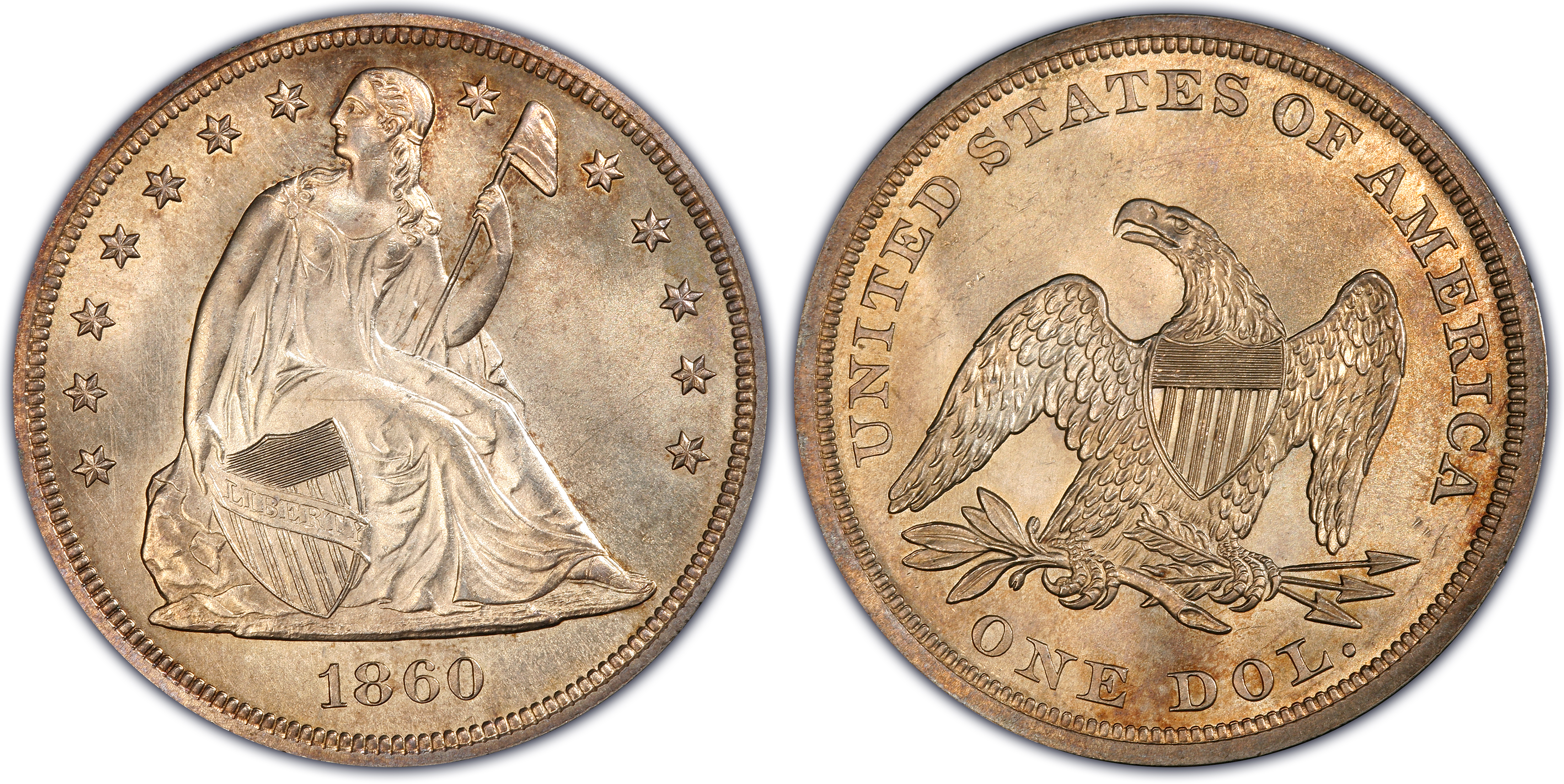 #7 PCGS MS64
Legend Rare Coin Auctions, May 16, 2019, Lot 20 - $12,925; "American Girls" (PCGS Set Registry). Lustrous champagne toning. Isolated areas of golden toning. Faint contact mark above the eagle's right wing. |
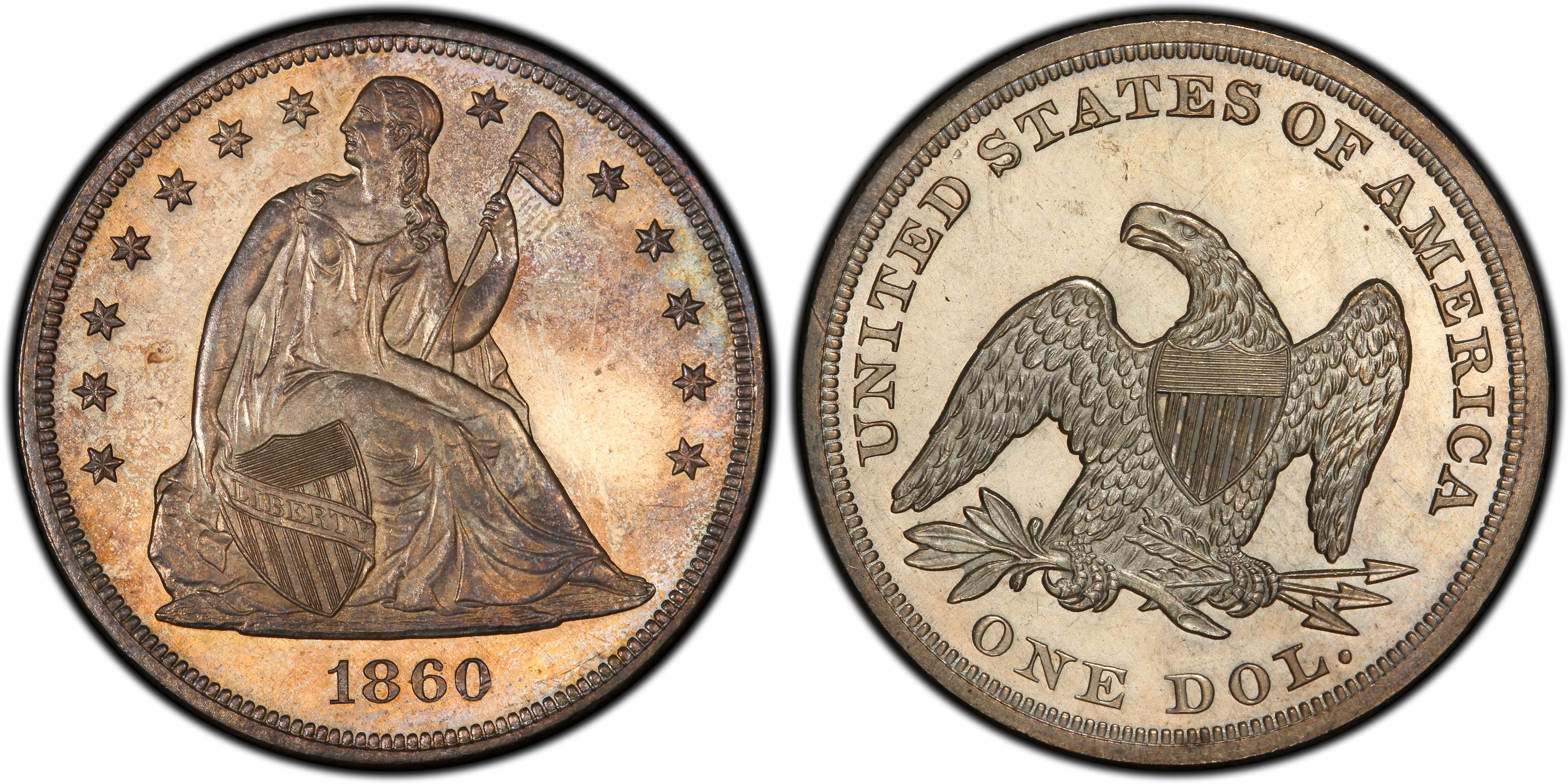 #7 PCGS MS64
Apricot toning on the obverse; slightly darker in the upper right. Pale gold toning on the reverse. |
The 1860 Liberty Seated Dollar
As the 1860 general election unfolded, the Democratic Party fractured under the weight of sectional tension. Unable to unite on a single candidate, the party splintered: Northern Democrats nominated Illinois Senator Stephen A. Douglas, while Southern Democrats backed Vice President John C. Breckinridge. Though Breckinridge was well-regarded in Washington, his relationship with President James Buchanan was notoriously icy.
The fledgling Republican Party, competing in only its second presidential cycle, nominated former Illinois Congressman Abraham Lincoln. A fourth faction—the Constitutional Union Party—emerged from the remnants of the Whigs, nominating John Bell in a desperate attempt to avoid secession.
Decades of moral compromise over slavery had already poisoned the national landscape. The "repellent" 1857 Dred Scott decision and the astroturfed guerilla warfare of "Bleeding Kansas" made large-scale conflict feel inevitable. While Lincoln did not receive a single vote in nine soon-to-be-seceding states, his dominance in the populous North secured an Electoral College victory—a result that set the South ablaze.
Sabotage and Secession
The Republican victory triggered immediate betrayal within Buchanan’s own cabinet. Secretary of War John B. Floyd actively undermined the Union by diverting federal arms and supplies to Southern arsenals before resigning in late December. Treasury Secretary Howell Cobb resigned on December 8, writing to Buchanan that "the evil has now passed beyond control."
Cobb would go on to help found the Confederacy and serve as president of its provisional government. In a poetic turn of historical irony, four years later, Union General William Tecumseh Sherman would dine in the slave quarters of Cobb’s Georgia plantation before ordering his troops to burn the estate to the ground.
Silver, Gold, and the Mints
In 1860, the United States Mint operated three Southern branches: New Orleans (which converted Mexican coin into federal silver and gold), Charlotte, and Dahlonega (both of which processed local gold). All three would fall into Confederate hands by early 1861.
The year was also marked by the 1859 discovery of the Comstock Lode. Because New Orleans sat 500 miles closer to the transit routes for this silver than Philadelphia, it received a massive influx of bullion. However, Liberty Seated Dollars were rarely seen in domestic pockets; because they retained a heavy pre-1853 weight standard, they were expensive to produce and were primarily used for international trade.
|
1860 Liberty Seated Dollar Production |
|||
| March 3, 1860 | 14,000 struck | March 8, 1860 | 1,330 struck (Proofs) |
| March 13, 1860 | 12,000 struck | March 14, 1860 | 14,000 struck |
| March 19, 1860 | 12,000 struck | March 26, 1860 | 15,000 struck |
| March 27, 1860 | 5,000 struck | March 30, 1860 | 13,000 struck |
| May 11, 1860 | 20,000 struck | May 25, 1860 | 12,200 struck |
| June 18, 1860 | 14,000 struck | September 27, 1860 | 23,000 struck |
| September 28, 1860 | 13,000 struck | October 26, 1860 | 17,000 struck |
| October 31, 1860 | 4,000 struck | November 5, 1860 | 8,000 struck |
| November 8, 1860 | 5,000 struck | November 19, 1860 | 1,000 struck |
| December 27, 1860 | 15,400 struck | Total Mintage: 218,930 coins | |
The 19th-Century Trade Deficit
Contrary to modern belief, the trade imbalance with China is not a new phenomenon. In the mid-19th century, American demand for silk, spices, and tea far outpaced the Chinese demand for American ginseng and cotton. To settle this annual deficit—often exceeding $5 million—American merchants were forced to use silver. Because the U.S. silver dollar was still unfamiliar in Asia, merchants often relied on Mexican 8 Reales, which were traded as "good silver." American coins were often "chopmarked" by Chinese traders to verify purity.
The Chilling Final Emissions
The coinage production of late 1860 provides a haunting timeline of a nation collapsing. Production began in March, while the nation was on a knife's edge. The last emission took place as the country was falling apart:
- November 8: Five thousand silver dollars are struck, just two days after Lincoln’s victory.
- November 10: South Carolina calls for a secession convention.
- November 19: 1,000 dollars struck.
- December 10: As Secretary Cobb resigns his post, 1861-D Gold Dollar (#7559) dies are shipped to the Dahlonega Mint; they arrive just weeks before state troops seize the facility.
- December 20: South Carolina secedes. Within days, state officials inform New Orleans Mint workers and administrators that the branch now fell under state control.
- December 27: The final 15,400 1860 Dollars are struck.
Despite the chaos, the New Orleans Mint outproduced Philadelphia in silver dollars that year (515,000 to 217,600). Interestingly, the 1860-O issue is far more common in Mint State today—surviving at a rate of 10:1 over its Philadelphia counterpart—thanks to the discovery of original, uncirculated bags found in Treasury vaults a century later.
* * *