

1850 $10 Date Comparison
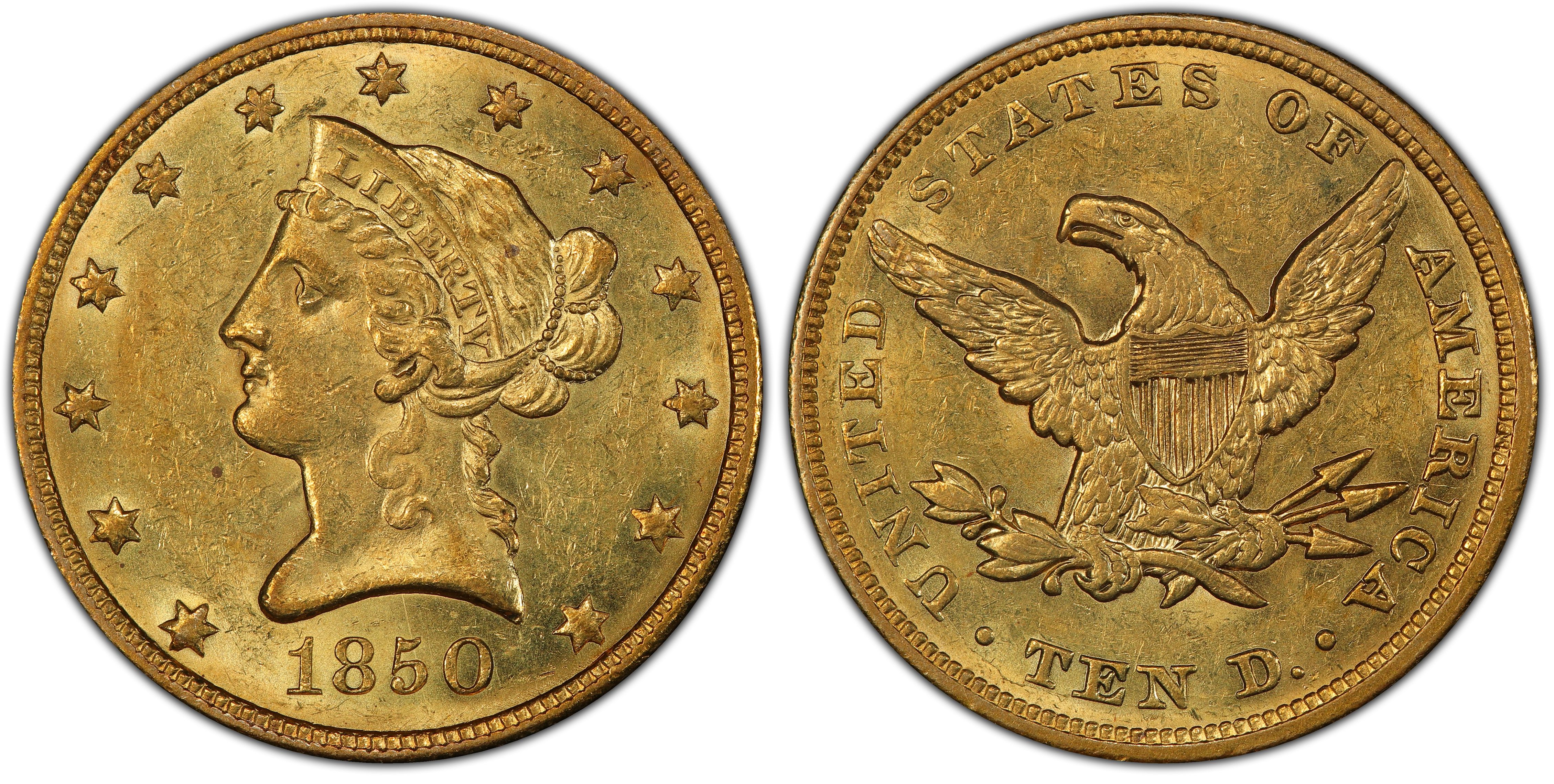
PCGS MS61
- PCGS #:
- 8604
- Designer:
- Christian Gobrecht
- Edge:
- Reeded
- Diameter:
- 26.80 millimeters
- Weight:
- 16.70 grams
- Mintage:
- 291,451
- Mint:
- Philadelphia
- Metal:
- 90% Gold, 10% Copper
- Auction Record:
- $38,400 • MS63 • 02-22-2018 • Heritage Auctions
Go To Grade
Current Auctions - PCGS Graded
Current Auctions - NGC Graded
For Sale Now at Collectors Corner - PCGS Graded
For Sale Now at Collectors Corner - NGC Graded
Rarity and Survival Estimates Learn More
| Survival Estimate | |
|---|---|
| All Grades | 137 |
| 60 or Better | 6 |
| 65 or Better | |
| Numismatic Rarity | |
|---|---|
| All Grades | R-7.6 |
| 60 or Better | R-9.7 |
| 65 or Better | R-10.1 |
| Relative Rarity By Type All Specs in this Type | |
|---|---|
| All Grades | 30 / 64 TIE |
| 60 or Better | 26 / 64 TIE |
| 65 or Better | 1 / 64 |
| Relative Rarity By Series All Specs in this Series | |
|---|---|
| All Grades | 60 / 183 TIE |
| 60 or Better | 44 / 183 TIE |
| 65 or Better | 1 / 183 |
Condition Census What Is This?
| #1 PCGS MS63 |
| #2 PCGS MS61 |
| #2 PCGS MS61 |
| #2 PCGS MS61 |
| #5 PCGS MS60 |
Gordon Wrubel:
Quickfinder Notes: The Small Date utilizes the smaller logotype intended for the $5. denomination. The point of the 1 is well right of the point of the bust and its tip is about 3X more distant from the truncation than the Large Date 1. The flag stand of the 5 is rather blunt at its base and NEARLY TOUCHES THE BALL giving it a "closed" appearance. The Large Date has tall numerals. The flag stand of the 5 comes to a very sharp point that is rather close to the ball and in line with its left edge. The point of the 1 lines up with the point of the bust and its tip is close to the truncation. The Small Date is about 2 1/2 times rarer than the Large Date. Both varieties are rare in Mint State. Not even a whisper of a Gem has been heard.