

PCGS PR64
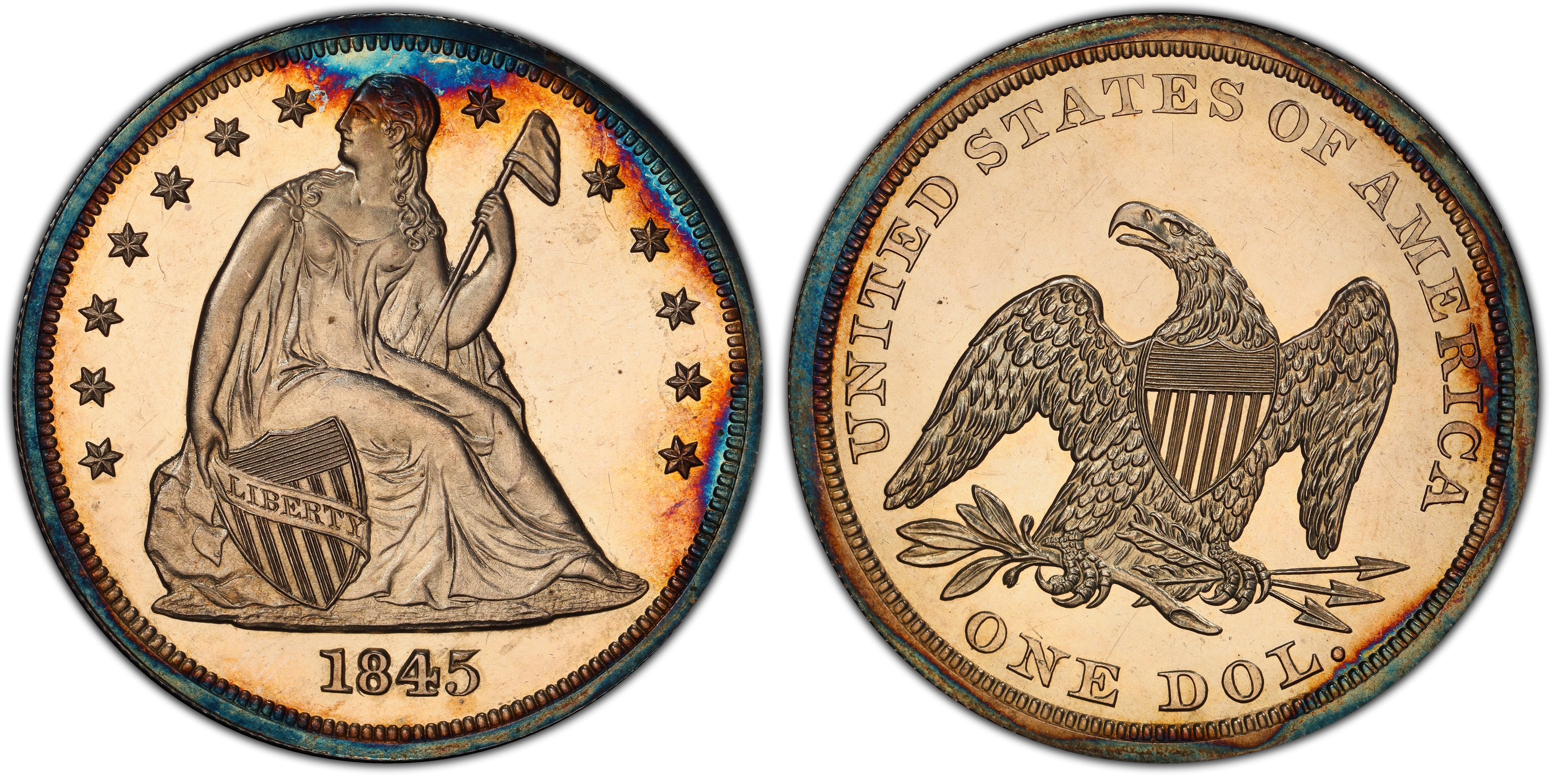
PCGS PR64
- PCGS #:
- 6986
- Designer:
- Christian Gobrecht
- Edge:
- Reeded
- Diameter:
- 38.10 millimeters
- Weight:
- 26.73 grams
- Mintage:
- 15
- Mint:
- Philadelphia
- Metal:
- 90% Silver, 10% Copper
- Auction Record:
- $207,000 • PR67 • 01-01-2008 • Heritage Auctions
Go To Grade
Current Auctions - PCGS Graded
Current Auctions - NGC Graded
For Sale Now at Collectors Corner - PCGS Graded
For Sale Now at Collectors Corner - NGC Graded
Rarity and Survival Estimates Learn More
| Survival Estimate | |
|---|---|
| All Grades | 15 |
| 60 or Better | 13 |
| 65 or Better | 2 |
| Numismatic Rarity | |
|---|---|
| All Grades | R-9.3 |
| 60 or Better | R-9.4 |
| 65 or Better | R-9.9 |
| Relative Rarity By Type All Specs in this Type | |
|---|---|
| All Grades | 10 / 27 TIE |
| 60 or Better | 10 / 27 TIE |
| 65 or Better | 4 / 27 TIE |
| Relative Rarity By Series All Specs in this Series | |
|---|---|
| All Grades | 10 / 38 TIE |
| 60 or Better | 10 / 38 TIE |
| 65 or Better | 4 / 38 TIE |
Condition Census What Is This?
| #1 PR66 estimated grade |
| #2 PR65 PCGS grade |
| #2 PR65 estimated grade |
| #2 PR65 estimated grade |
| #5 PR64 PCGS grade |
|
#5 PR64 estimated grade
Eric P. Newman Numismatic Education Society |
| #5 PR64 estimated grade |
| #5 PR64 estimated grade |
| #9 PR63 PCGS grade |
| #9 PR63 PCGS grade |
Ron Guth:
Proof 1845 Silver Dollars are very rare, with perhaps just over a dozen known. Most examples are of average quality, often with hairlines and other signs of improper handling. However, a couple of high-quality examples exist, most notably the NGC PR67 from the Newcomer, Boyd, Pittman, and Kaufman collections that sold in 2008 for a record $207,000 (it sold subsequently in 2013 for a much lower $141,000). At least one circulated Proof example exists of this date.
Two obverse dies were used to strike 1845 Proof Dollars; both varieties share the same reverse (which was first used in 1840).