

PCGS AU58
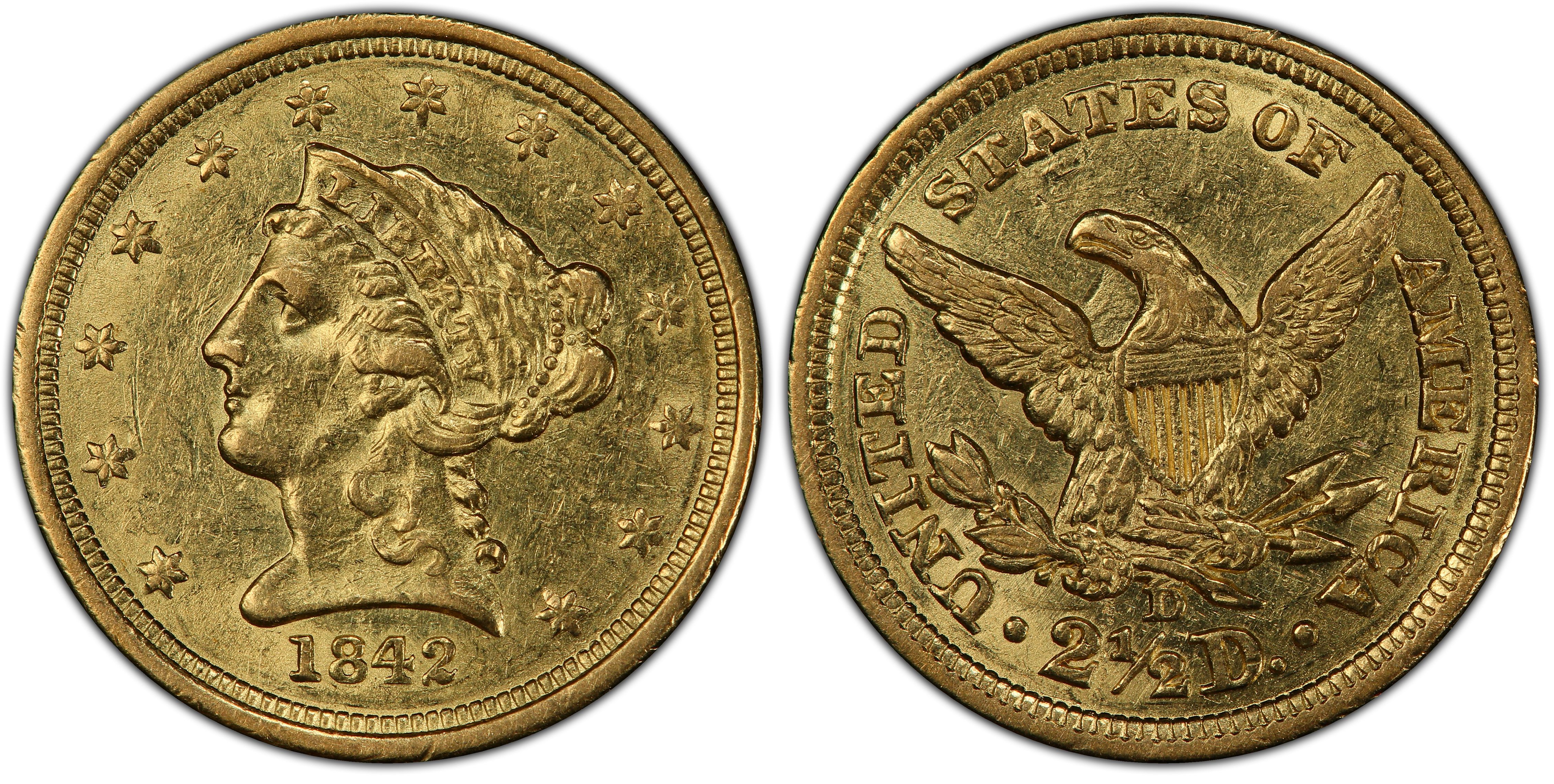
PCGS AU58
- PCGS #:
- 7725
- Designer:
- Christian Gobrecht
- Edge:
- Reeded
- Diameter:
- 18.00 millimeters
- Weight:
- 4.18 grams
- Mintage:
- 4,643
- Mint:
- Dahlonega
- Metal:
- 90% Gold, 10% Copper
- Auction Record:
- $57,500 • MS62 • 04-06-2006 • Heritage Auctions
Major Varieties
- 1842-D $2.50
Go To Grade
Current Auctions - PCGS Graded
Current Auctions - NGC Graded
For Sale Now at Collectors Corner - PCGS Graded
For Sale Now at Collectors Corner - NGC Graded
Rarity and Survival Estimates Learn More
| Survival Estimate | |
|---|---|
| All Grades | 80 |
| 60 or Better | |
| 65 or Better | |
| Numismatic Rarity | |
|---|---|
| All Grades | R-8.2 |
| 60 or Better | R-10.1 |
| 65 or Better | R-10.1 |
| Relative Rarity By Type All Specs in this Type | |
|---|---|
| All Grades | 19 / 147 TIE |
| 60 or Better | 1 / 147 |
| 65 or Better | 1 / 147 |
| Relative Rarity By Series All Specs in this Series | |
|---|---|
| All Grades | 19 / 147 TIE |
| 60 or Better | 1 / 147 |
| 65 or Better | 1 / 147 |
Condition Census What Is This?
| #1 AU58 PCGS grade |
| #1 AU58 PCGS grade |
| #1 AU58 PCGS grade |
| #1 AU58 PCGS grade |
| #1 AU58 estimated grade |
| #1 AU58 estimated grade |
| #1 AU58 estimated grade |
| #1 AU58 estimated grade |
| #1 AU58 estimated grade |
| #10 AU55 PCGS grade |
David Akers (1975/88):
Very rare in all grades and almost impossible to obtain better than EF. From the standpoint of total number of appearances at auction, the 1842-D is the 14th rarest quarter eagle and also has the 12th lowest average grade. Like so many quarter eagles of the early 1840's, the 1842-D is generally unappreciated for its real rarity. It is every bit as rare as the 1854-D, 1855-D, and 1856-D and certainly more rare than the latter two in grades better than EF.
Doug Winter:
The 1842-D quarter eagle is rare in all grades. It narrowly trails the 1840-D as the rarest Dahlonega quarter eagle struck prior to 1853.
The 1842-D quarter eagle is rare in all grades. It is usually found well worn and nice Extremely Fine specimens are very hard to find. This date is extremely rare in About Uncirculated and it is unknown in Mint State.
STRIKE: This date does not come with as good a strike as the 1841-D quarter eagle. The obverse is strongest at the center where the hair is well-defined. The curls and the bun are also sharp but the letters RTY in LIBERTY are sometimes weak. The stars are flat and few of them show their radial lines at the centers. The reverse is always weak at the center with softness noted on the neck of the eagle, the shield and the right leg. On both sides, the borders are sharp and the milling is complete.
SURFACES: A number of examples display small mint-made imperfections on their surfaces. Others suffer from an overabundance of abrasions. I have seen some pieces with a mint-made depression on the cheek of Liberty (cf. Stack’s 10/94: 870). This flaw can make the cheek appear as if it has been repaired but it should not be viewed as such.
LUSTER: Many are worn to the point that they retain little if any mint luster. The few higher grade 1842-D quarter eagles which exist have inferior dull, grainy texture.
COLORATION: Original, uncleaned 1842-D quarter eagles have color which ranges from green-gold to orange-gold. As recently as a few years ago, it was not that hard to find one that had original color. Today, most have been cleaned or dipped and original pieces are now very rare.
EYE APPEAL: There are just a handful which have good eye appeal. An 1842-D quarter eagle with a good strike, clean surfaces and evident luster is almost impossible to find.
PERSONAL OBSERVATIONS: As mentioned above, there are some 1842-D quarter eagles with a mint-made depression on the cheek. It appears that a foreign object (possibly a piece of wood or metal) adhered to the obverse die and was struck into the planchet. This is really only visible on higher grade coins, although certain lower grade pieces may have this feature as well. Interestingly, most 1842-D quarter eagles lack this depression, which means that during the minting process this foreign object was discovered and subsequently removed.
DIE VARIETIES: Only one die variety is known.
Variety 3-F: On the obverse, the 1 in the date is somewhat close to the bust while the 2 is equally space between the bust and the denticles. Early die states show sharply doubled bases of the 18 in the date and lighter doubling on the cross bar of the 4. On later die states, this doubling can be seen only at the base of the 8. On the reverse, which was used in 1842 and again in 1843, the shaft of the arrow is joined to the upper serif of the mintmark. The fraction bar extends to the left of the opening in the mintmark. The feather enters only through the upper edge of the opening of the mintmark. The 1 in the fraction is entirely to the left of the mintmark.
The 1842-D quarter eagle is rare in all grades. It is usually found well worn and nice Extremely Fine specimens are very hard to find. This date is extremely rare in About Uncirculated and it is unknown in Mint State.
STRIKE: This date does not come with as good a strike as the 1841-D quarter eagle. The obverse is strongest at the center where the hair is well-defined. The curls and the bun are also sharp but the letters RTY in LIBERTY are sometimes weak. The stars are flat and few of them show their radial lines at the centers. The reverse is always weak at the center with softness noted on the neck of the eagle, the shield and the right leg. On both sides, the borders are sharp and the milling is complete.
SURFACES: A number of examples display small mint-made imperfections on their surfaces. Others suffer from an overabundance of abrasions. I have seen some pieces with a mint-made depression on the cheek of Liberty (cf. Stack’s 10/94: 870). This flaw can make the cheek appear as if it has been repaired but it should not be viewed as such.
LUSTER: Many are worn to the point that they retain little if any mint luster. The few higher grade 1842-D quarter eagles which exist have inferior dull, grainy texture.
COLORATION: Original, uncleaned 1842-D quarter eagles have color which ranges from green-gold to orange-gold. As recently as a few years ago, it was not that hard to find one that had original color. Today, most have been cleaned or dipped and original pieces are now very rare.
EYE APPEAL: There are just a handful which have good eye appeal. An 1842-D quarter eagle with a good strike, clean surfaces and evident luster is almost impossible to find.
PERSONAL OBSERVATIONS: As mentioned above, there are some 1842-D quarter eagles with a mint-made depression on the cheek. It appears that a foreign object (possibly a piece of wood or metal) adhered to the obverse die and was struck into the planchet. This is really only visible on higher grade coins, although certain lower grade pieces may have this feature as well. Interestingly, most 1842-D quarter eagles lack this depression, which means that during the minting process this foreign object was discovered and subsequently removed.
DIE VARIETIES: Only one die variety is known.
Variety 3-F: On the obverse, the 1 in the date is somewhat close to the bust while the 2 is equally space between the bust and the denticles. Early die states show sharply doubled bases of the 18 in the date and lighter doubling on the cross bar of the 4. On later die states, this doubling can be seen only at the base of the 8. On the reverse, which was used in 1842 and again in 1843, the shaft of the arrow is joined to the upper serif of the mintmark. The fraction bar extends to the left of the opening in the mintmark. The feather enters only through the upper edge of the opening of the mintmark. The 1 in the fraction is entirely to the left of the mintmark.