
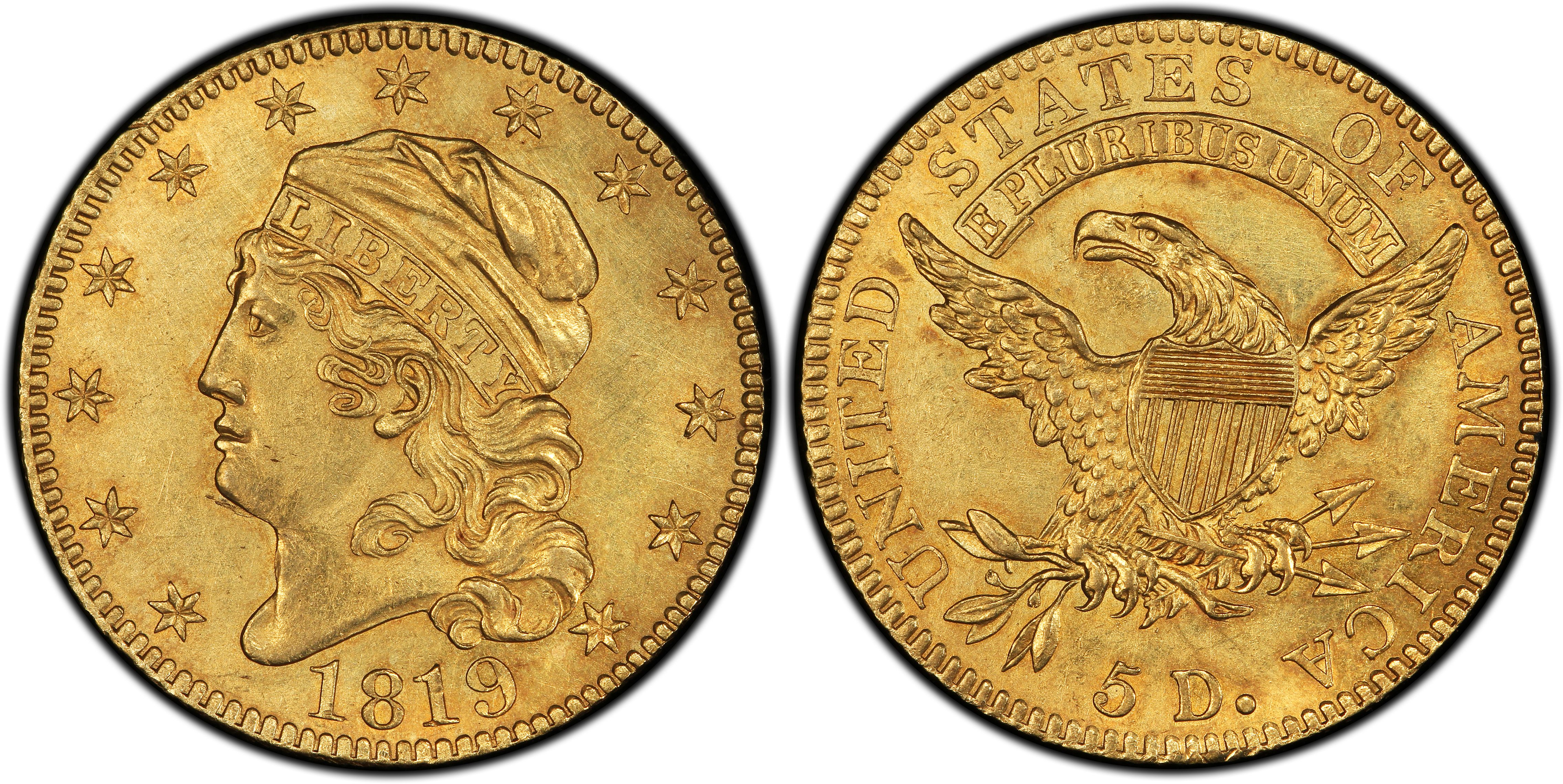
PCGS MS61
- PCGS #:
- 8123
- Designer:
- Robert Scot & John Reich
- Edge:
- Reeded
- Diameter:
- 25.00 millimeters
- Weight:
- 8.75 grams
- Mintage:
- N/A
- Mint:
- Philadelphia
- Metal:
- 91.7% Gold, 8.3% Copper
- Auction Record:
- $55,000 • AU58 • 10-01-1987 • Bowers & Merena
Major Varieties
- 1819 $5
Go To Grade
Current Auctions - PCGS Graded
Current Auctions - NGC Graded
For Sale Now at Collectors Corner - PCGS Graded
For Sale Now at Collectors Corner - NGC Graded
Rarity and Survival Estimates Learn More
| Survival Estimate | |
|---|---|
| All Grades | 7 |
| 60 or Better | 2 |
| 65 or Better | |
| Numismatic Rarity | |
|---|---|
| All Grades | R-9.6 |
| 60 or Better | R-9.9 |
| 65 or Better | R-10.1 |
| Relative Rarity By Type All Specs in this Type | |
|---|---|
| All Grades | 4 / 22 TIE |
| 60 or Better | 2 / 22 TIE |
| 65 or Better | 1 / 22 |
| Relative Rarity By Series All Specs in this Series | |
|---|---|
| All Grades | 6 / 42 TIE |
| 60 or Better | 4 / 42 TIE |
| 65 or Better | 1 / 42 |
Condition Census What Is This?
| #1 MS61 PCGS grade |
| #2 AU55 estimated grade |
| #3 VF35 estimated grade |
David Akers (1975/88):
This is another of the many famous rarities of this type. However, contrary to the comments made by some cataloguers, it is less rare as a date than the 1815 with possibly 15-18 specimens known in all grades. Unlike the 1815, however, it is not the case with the 1819 that most known specimens are uncirculated as a number of the existing examples are in the VF to EF range. There are two major varieties of this date, one with "normal dies" and the other with the 5D over 50 reverse of 1818. The two varieties are of comparable rarity and neither would bring a premium over the other.