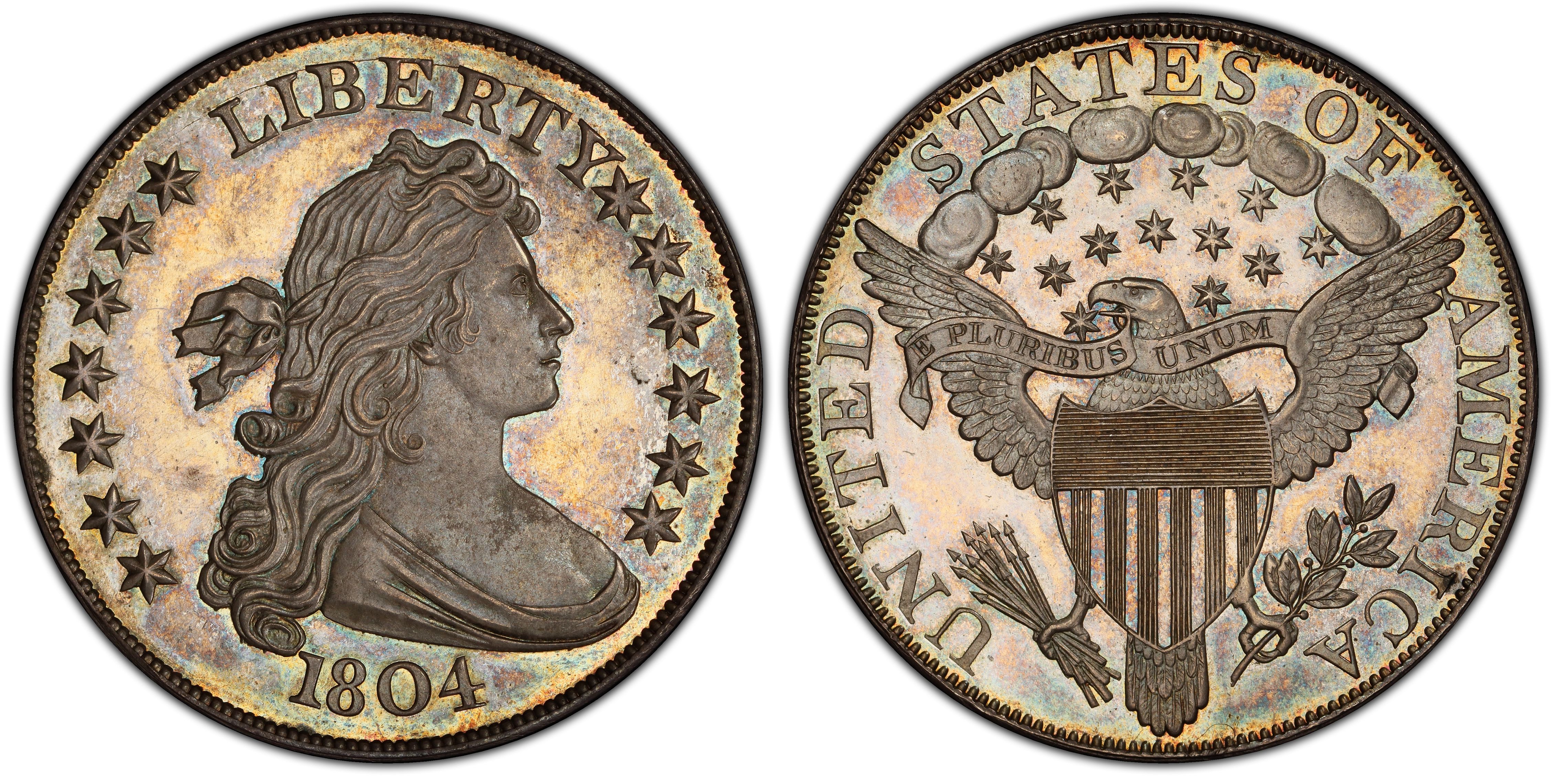
PCGS PR67

PCGS PR65
- PCGS #:
- 6907
- Designer:
- Robert Scot
- Edge:
- Lettered: HUNDRED CENTS ONE DOLLAR OR UNIT
- Diameter:
- 40.00 millimeters
- Weight:
- 27.00 grams
- Mintage:
- 8
- Mint:
- Philadelphia
- Metal:
- 90% Silver, 10% Copper
- Auction Record:
- $7,680,000 • PR68 • 08-25-2021 • Stack's Bowers
Rarity and Survival Estimates Learn More
| Survival Estimate | |
|---|---|
| All Grades | 8 |
| 60 or Better | 6 |
| 65 or Better | 4 |
| Numismatic Rarity | |
|---|---|
| All Grades | R-9.6 |
| 60 or Better | R-9.7 |
| 65 or Better | R-9.8 |
| Relative Rarity By Type All Specs in this Type | |
|---|---|
| All Grades | 2 / 5 TIE |
| 60 or Better | 2 / 5 TIE |
| 65 or Better | 2 / 5 |
| Relative Rarity By Series All Specs in this Series | |
|---|---|
| All Grades | 2 / 5 TIE |
| 60 or Better | 2 / 5 TIE |
| 65 or Better | 2 / 5 |
Condition Census What Is This?
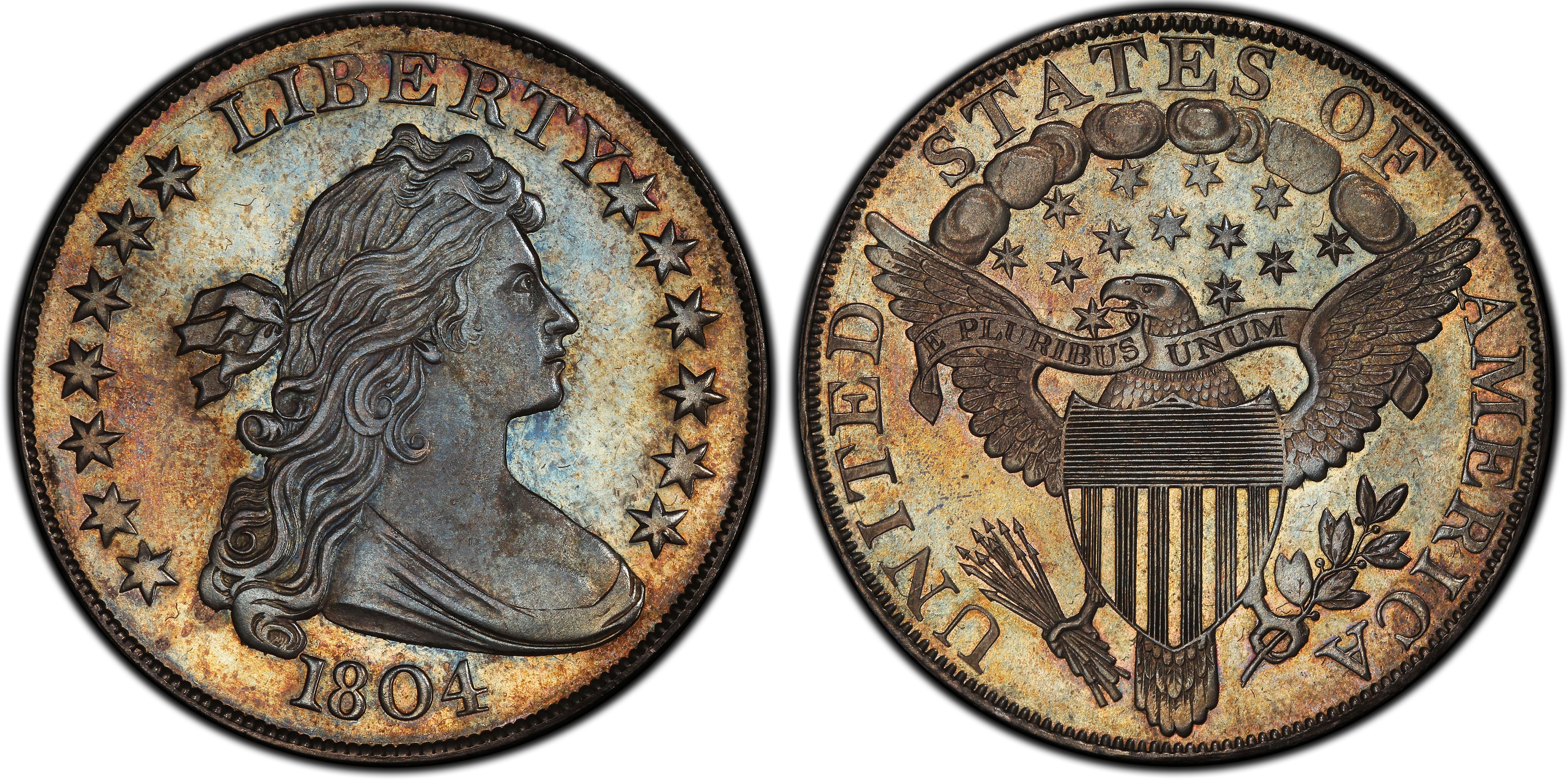 #1 PCGS PR68
Chief Coiner Adam Eckfeldt; U.S. Department of State, c/o Edmund Roberts; Sayyid Sa'id bin-Sultan (Sultan of Muscat), as part of a cased presentation set; unknown intermediaries; Charles A. Watters (Liverpool, England); "The C.A. Watters Collection," Glendening & Co., May 1917, Lot 227 - £330; Henry Chapman, sold privately, June 20,1918 - $2,500; Virgil M. Brand, later Brand Estate; Armin W. Brand - Horace Louis Philip Brand, sold privately, August 10, 1945 - $3,150; Ruth and Charles Green, October 1, 1945 - $5,000; Charles Frederick Childs, for his son, Frederick Newell Childs, who in turn gave his collection to his son, Charles Frederick Childs II; "The Walter H. Collection," Bowers & Merena, August 1999, Lot 458 - $4,140,000; Mack and Brent Pogue. As PCGS PR68 #03459822. "The D. Brent Pogue Collection," Stack's/Bowers & Sotheby's, May 2016, Lot 4020 - Reserve Not Met after $9,200,000 bid; Stack's Bowers & Sotheby's August 2021, Lot 4114 - $7,680,000. Deeply mirrored and boasting intense colors of blue, gold, and red, this is the finest known 1804 Dollar. Though the coin's 2016 high bid would have set a world record for the highest price paid for a U.S. coin, just beating the 1794 "Cardinal" Dollar, the ultimate record was later secured by the 1933 Double Eagle at $18.9 million in 2021. |
|
#2 PCGS PR67
Chief Coiner Adam Eckfeldt; U.S. Department of State, c/o Edmund Roberts; King Ph’ra Nang Klao (Rama III) of Siam; presumed remaining in the family until about 1950; Anna Leonowens and her descendants (unconfirmed); David Spink, purchased in 1962 and displayed at the 1962 American Numismatic Association in Atlanta, Georgia; Elvin I. Unterman, via agent Lester Merkin; Unterman loaned the coin to the Smithsonian Institution for display from 1983 to 1984; Bowers and Merena, October 1987, Lot 2209 - Passed; Rarities Group (Martin Paul) and Continental Rarity Coin Fund I (Greg Holloway); Superior May 1990, Lot 3364 – $3,190,000; Iraj Sayah and Terry Brand; Superior, January 1993, Lot 1196; Spectrum Numismatics; private western collection, 2001; Goldberg Coins to Steve Contursi and private collector, via private treaty, November 2005 - $8.500,000 (reported). As PCGS PR67 #21594249. "The Tyrant Collection." Pedigree information is for the complete King of Siam Set. |
|
#3 Est. PR65
Chief Coiner Adam Eckfeldt; Matthew Adams Stickney, May 9, 1843, by trade; Henry Chapman, June 1907, Lot 849 – $3,600; Col. James W. Ellsworth; Wayte Raymond; William Cutler Atwater, later, Atwater Estate; B. Max Mehl, June 1946, Lot 213 – $10,500; Louis E. Eliasberg, Sr., later, Eliasberg Estate. As PCGS PR65 #0001804. "The Louis E. Eliasberg, Sr. Collection," Bowers and Merena, April 1997, Lot 2199 – $1,815,000; Spectrum Numismatics; “The Larry H. Miller Collection,” Stack’s Bowers, December 17, 2020, Lot 1094 – $3,360,000. Medium grey with lilac overtones. The first 1804 Dollar in American collector hands. This coin is not currently in a PCGS holder. |
|
#3 PCGS PR65
Chief Coiner Adam Eckfeldt; unknown intermediaries; S.H. and H. Chapman; Adolph Weyl, Berlin, October 1884, Lot 159 – $216; S.H. and H. Chapman; Chapman Brothers, May 1885, Lot 354 – $1,000; Scott Stamp & Coin Company; James Vila Dexter, later, Dexter Estate; H.G. Brown; Lyman H. Low October 1904, Lot 431 – $1,100; William Forrester Dunham; B. Max Mehl; B. Max Mehl, June 1941, Lot 1058 – $4,250; Charles M. Williams; Abe Kosoff and Sol Kaplan; Harold Bareford; Stack’s, October 1981, Lot 424 – $280,000; RARCOA (Ed Milas); Leon Hendrickson and George Weingart. As “Choice Proof”. RARCOA’s session of Auction ’89, Lot 247 – $990,000; American Rare Coin Fund, Ltd. (Hugh Sconyers, manager); Northern California collector; Superior, July 1993, Lot 551 – Passed; Northern California collector; Superior, May 1994, Lot 761; Harlan White; private southeastern collection; Stack’s, October 2000, Lot 1167. As PCGS PR65 #31530374. Mack and Brent Pogue; “The D. Brent Pogue Collection, Part V,” Stack’s Bowers, March 31, 2017, Lot 5045 – $3,290,000; Kevin Lipton and John Albanese; Bruce Morelan, via private treaty sale. Tiny D stamped into cloud under "O." The Dexter Dollar was marred by controversy after Édouard Frossard alleged the Chapman Brothers had manufactured a phony European pedigree by placing the coin in a German catalog. James Dexter even filed a lawsuit against the dealers, but was ultimately convinced of the coin's "genuineness" when the Chapmans produced affirming documentation. This coin was later the focus of Mark Ferguson's book, The Dollar of 1804: The Mint's Hidden Secret. |
|
#4 Est. PR64
Chief Coiner Adam Eckfeldt; unknown intermediaries; E. Harrison Sanford, acquired in 1868 from an “aged lady” who claimed to have purchased the coin directly from the Mint at face value sometime between 1845 and 1849; Edward Cogan, November 1875,, Lot 99 - $700; Lorin G. Parmelee; New York Coin & Stamp Co., June 1890, Lot 817 - $570; Byron Reed; Omaha City Library; Western Heritage Museum (now the Durham Museum). Steel grey with bluish overtones. |
 #6 PCGS PR62
Chief Coiner Adam Eckfeldt; unknown intermediaries; Henry C. Young, a teller at the Bank of Pennsylvania, circa 1847; Joseph J. Mickley, circa 1847; W. Elliot Woodward, October 1867, Lot 1676 – $750; William A. Lilliendahl; Edward Cogan, 1868; William Sumner Appleton, 1868; Massachusetts Historical Society, 1905; Stack’s, October 1970, Lot 625 – $77,500; Chicago collection; Reed Hawn, private treaty via Stack’s, 1974; Stack’s, October 1993, Lot 735 – $475,000; David Queller. As NGC PR62 #27860093. “The Queller Family Collection,” Heritage Auctions, April 17, 2008, Lot 2089 – $3,737,500; Heritage Auctions, August 9, 2013, Lot 5699 – $3,877,500; Heritage Auctions, June 14, 2018, Lot 4003 – $2,640,000. As PCGS PR62 #27860093. Dell Loy Hansen. |
|
#7 Est. PR58
Chief Coiner Adam Eckfeldt; Mint Cabinet; National Numismatic Collection at the Smithsonian Institution. |
|
#8 Est. PR30
Chief Coiner Adam Eckfeldt; unknown intermediaries; Edward Cohen, acquired in Richmond, Virginia; Col. Mendes I. Cohen; "The Col. Mendes I Cohen Collection," Edward Cogan, October 1875, Lot 535 – $325; Henry S. Adams; Edward Cogan, November 1876, Lot 356 – $500; Lorin G. Parmelee; Henry G. Sampson; Major William Boerum Wetmore; Chapman Brothers, June 1906, Lot 208 – $720; S.H. and H. Chapman; Thomas L. Elder; James H. Manning; B. Max Mehl, May 1921, Lot 778 – $2,500; Elmer S. Sears; B. Max Mehl; Lammot DuPont; Willis H. DuPont; unknown thieves, recovered in Zurich, Switzerland, on April 23, 1993; donated to the American Numismatic Association's Money Museum. |
The King of American Coins: Unraveling the Many Mysteries of the 1804 Dollar
The 1804 Draped Bust Dollar, often hailed as a pinnacle of American numismatics, is a coin cloaked in decades of controversy and intrigue. With only 16 specimens known to exist, its rarity is surpassed only by the extraordinary circumstances of its creation—it was not struck in 1804 at all.
Numismatic Diplomacy (Class I: The Originals)
The true story of the 1804 Dollar begins in 1834. While collectors of the era assumed the Draped Bust Dollar series had ended in 1803, the U.S. Mint had a secret. The Mint, then organized under the State Department, was tasked with preparing special diplomatic Proof Sets for presentation to foreign dignitaries by U.S. envoy to the Far East, Edmund Roberts. The order was to include "duplicate specimens of each kind now in use. In contructing the set, a problem arose: the silver dollar and $10 gold eagle denominations had been suspended for about 30 years. Believing 1804 was the last year of the series, the Mint backdated the new diplomatic coins to that year to avoid issuing 1834-dated rarities with obsolete designs. The irony is that all Draped Bust Dollars actually produced in 1804 were dated 1803. Because additional examples were secretly struck decades later in a Mint-for-profit operation, the original 1834 strikes are officially categorized as Class I: Originals.
These Class I dollars were struck using the only known obverse die and Reverse Die X. The coins famously exhibit flattened edge lettering, a signature result of the striking process.
We know that two of these original sets were successfully delivered: one to the Sultan of Muscat (Said bin Sultan) in 1835, and another to King Rama III of Siam (Thailand) in 1836, before Roberts' death ended the mission.
A Secret Revealed
For nearly a decade, the coin’s existence was a closely held Mint secret. This changed with the 1842 publication of A Manual of Gold and Silver Coins by Jacob R. Eckfeldt and William E. Du Bois, which included a pantograph reproduction of the coin, shattering the long-held collector belief that 1803 was the final date.
In May 1843, renowned numismatist Matthew A. Stickney became the first private collector to secure an example, famously exchanging several rarities—including a unique gold Immune Columbia piece—for a duplicate 1804 Dollar held in the Mint Cabinet. For over a century, however, controversy swirled around the origins of the Class I "originals." Even expert researchers Kenneth Bressett and Eric P. Newman found little surviving evidence of the diplomatic sets and were prepared to dismiss the idea of the presentation story as bunk in their book The Fantastic 1804 Dollar. The printing of their manuscript was halted when the King of Siam Proof Set suddenly resurfaced, providing undeniable physical evidence that the diplomatic gifts were, in fact, real.
The Unauthorized Restrikes (Classes II & III)
Following the abolition of the Large Cent and Half Cent in 1857, coin collecting experienced a significant boom. As the hobby expanded, so did the temptation for Mint insiders. With the reserve of "official" Class I 1804 Dollars depleted, unscrupulous employees (such as the likely suspect, Theodore Eckfeldt) began surreptitiously producing unauthorized restrikes to sell for a profit to eager dealers.
- Class II Dollar (Unique): Produced around 1858, the unauthorized Class II restrike is unique for two reasons: it has a plain edge and was struck over an 1856 Swiss Shooting Thaler. The sole known example is permanently housed in the Smithsonian Institution.
- Class III Dollars: Also struck after 1857, these were fitted with added edge lettering after striking, a process that left the coin surfaces slightly concave. Seven of these restrikes are known, with four purposefully worn to simulate circulation.
The Die Diagnostics
Regardless of its Class, every authentic 1804 Dollar was struck from the same polished obverse die and one of two polished reverse dies, designated Reverse X (for Class I) and Reverse Y (for Classes II/III). The difference is subtle, focused on the placement of the legend and the berries above the eagle:
"S" in STATES
- Reverse X (Class I): Slightly to the left of the gap between the two leftmost clouds
- Reverse Y (Classes II/III): Entirely positioned above the leftmost cloud
TOP-LEFT BERRY
Revese X (Class I): Touches the leaf and is positioned higher than the top-right berry.
Reverse Y (Class II/III): Centered between the leaves, nearly level with the top-right berry.
* * *