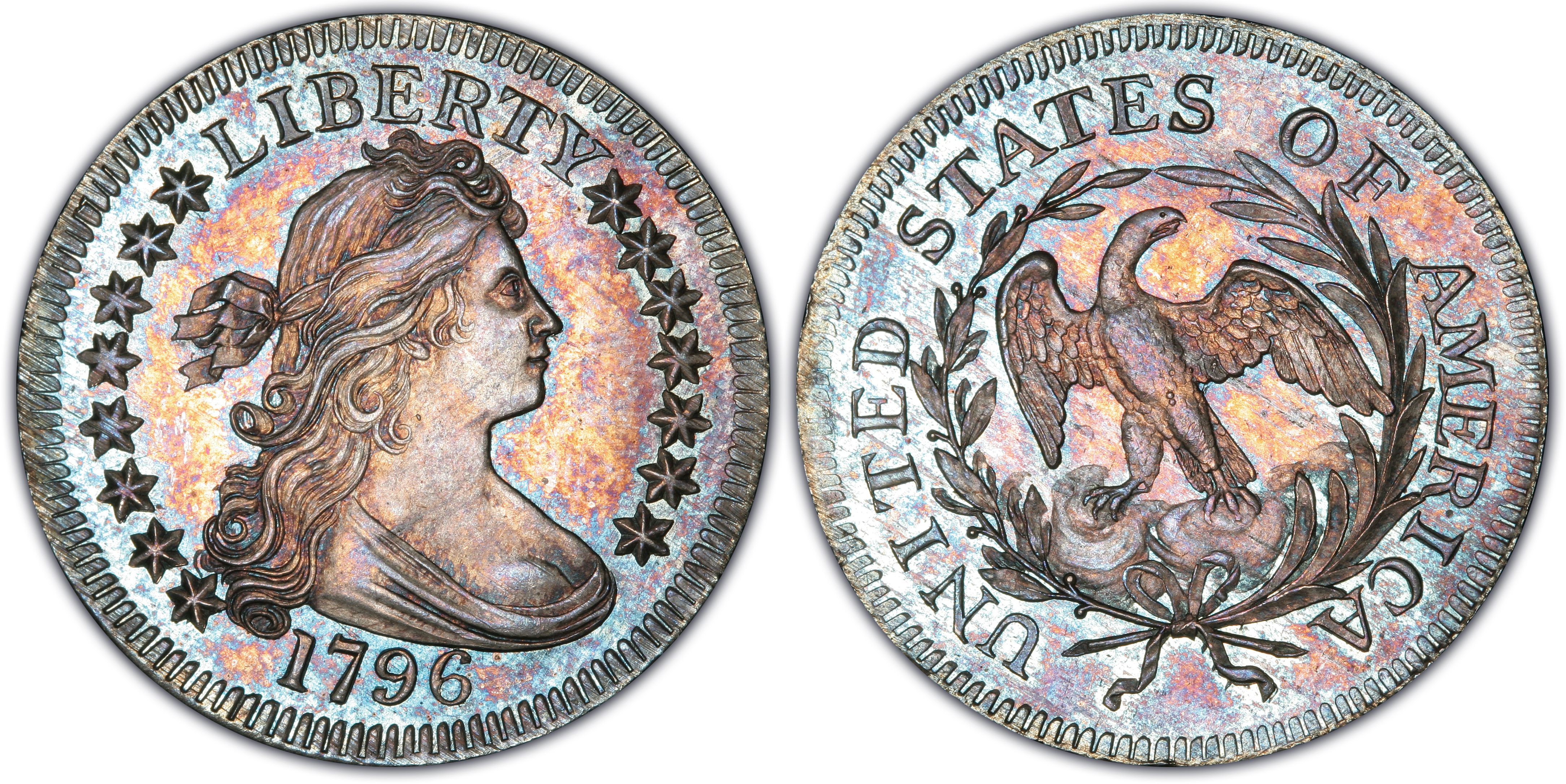
PCGS MS67

PCGS MS66
- PCGS #:
- 5310
- Designer:
- Robert Scot
- Edge:
- Reeded
- Diameter:
- 27.50 millimeters
- Weight:
- 6.74 grams
- Mintage:
- 6,146
- Mint:
- Philadelphia
- Metal:
- 89.2% Silver, 10.8% Copper
- Auction Record:
- $1,740,000 • MS66 • 01-16-2022 • Heritage Auctions
Rarity and Survival Estimates Learn More
| Survival Estimate | |
|---|---|
| All Grades | 650 |
| 60 or Better | 90 |
| 65 or Better | 5 |
| Numismatic Rarity | |
|---|---|
| All Grades | R-5.7 |
| 60 or Better | R-8.1 |
| 65 or Better | R-9.7 |
| Relative Rarity By Type All Specs in this Type | |
|---|---|
| All Grades | 1 / 1 |
| 60 or Better | 1 / 1 |
| 65 or Better | 1 / 1 |
| Relative Rarity By Series All Specs in this Series | |
|---|---|
| All Grades | 2 / 6 |
| 60 or Better | 6 / 6 |
| 65 or Better | 5 / 6 TIE |
Condition Census What Is This?
 #1 PCGS MS67
“Colonel” E.H.R. Green; Green Estate; Partnership of Eric P. Newman / B.G. Johnson d.b.a. St. Louis Stamp & Coin Co. As “Brilliant Proof”. Eric P. Newman – $100.00; Eric P. Newman Numismatic Education Society. As NGC MS67+* #2037631-001. “Selections from the Eric P. Newman Collection, Part II,” Heritage Auctions, November 15, 2013, Lot 33327 – $1,527,700. As PCGS MS67 #57233700. B-2. Fully struck and target-toned, featuring an attractive blend of blue, green, violet, and magenta at the borders surrounding champagne-grey centers. A faint die crack is noted at the top of Star 3. On the reverse, a small mark is visible between the ribbon and the letter U. |
|
#1 PCGS MS67
Larry Stack; Eric Streiner; Jay Parino; John Albanese; East Coast collector. B-2. Gold and redish-gold center toning. Ice blue and violet toning along the periphery. |
|
#3 PCGS SP66
“The Matthew Stickney Collection,” Henry Chapman, June 1907, Lot 1116; John H. Clapp; Clapp Estate; Clapp Collection sold en bloc to Louis E. Eliasberg, Sr., February 1942; “The Louis E. Eliasberg, Sr. Collection,” Bowers and Merena, April 1997, Lot 1356 - $176,000. As PCGS SP66 #4714887. Heritage Auctions, August 7, 2014, Lot 5565 – $881,250. B-1. Boasting brilliant surfaces and sharp, even milling, this specimen features golden-orange toning that blends seamlessly into the silver centers, punctuated by vibrant cobalt along the margins. It is one of only two possible presentation strikes produced for the 1796 Draped Bust Quarter. As its counterpart has remained untraced since the late 1940s, this represents a singular opportunity for the sophisticated cabinet. Old Green Holder. |
|
#3 PCGS MS66
Waldo Newcomer; "Colonel" E.H.R. Green; J.G. MacAllister; T. James Clarke; "The T. James Clarke Collection," (New Netherlands, April 1956), Lot 1557; (possibly) Gene Reale; Jay Parrino (The Mint); Gary Minsey. The coin was raw when Richard Burdick offered Minsey $100,000 for the coin, but he turned the offer down; Minsey to Rarcoa; Rarcoa to Richard Burdick for $130,000 in trade; Claude E. Davis, M.D, October 1995. As NGC MS66 #957212-062. "The Foxfire Collection (Davis)." As PCGS MS66 #44161266. "The Bob R. Simpson Collection, Part VII," Heritage Auctions, January 13, 2022, Lot 3755 - $1,740,000. B-2. Violet, gold, and blue toning throughout. Eagle's head mostly complete. Sharply struck example. |
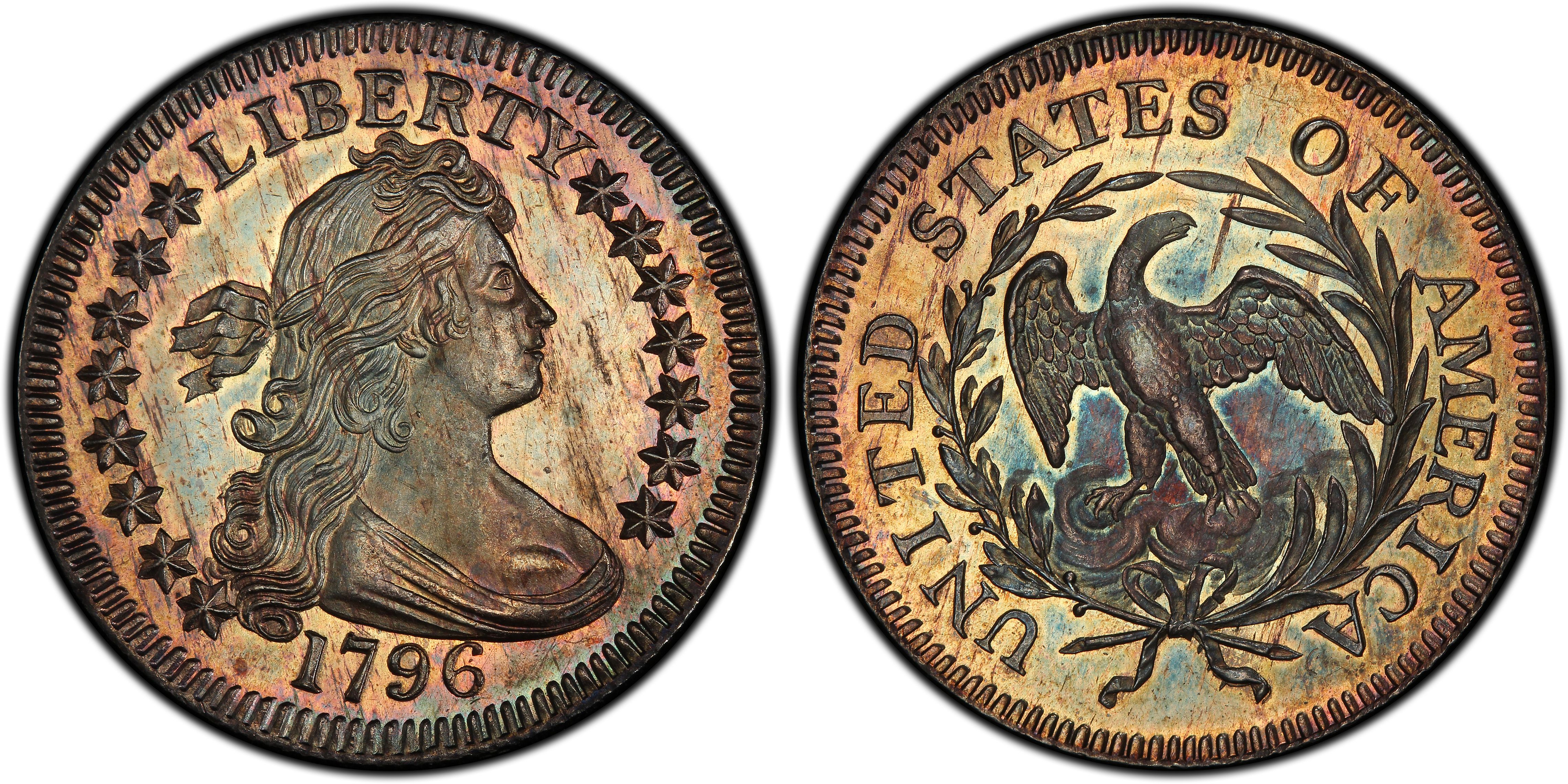 #3 PCGS MS66
James Ten Eyck; “The James Ten Eyck Collection,” B. Max Mehl, May 1922, Lot 507; Milton A. Holmes; “The Milton A. Holmes Collection,” Stack’s, October 1960, Lot 2918. As “Perfect Brilliant Proof.” Stack’s, May 31, 1975, Lot 824 – $27,000; L.A. Collection of U.S. Type Coins; Stack’s, October 1990, Lot 1634. D. Brent Pogue. As PCGS MS66 #09006459. “The D. Brent Pogue Collection, Part I,” Stack’s Bowers / Sotheby’s, May 2015, Lot 1051 – $1,527,500. B-2. Once described as a Proof, this specimen exhibits deeply mirrored fields and a razor-sharp strike. The surfaces display sea-green and blue centers with vibrant rose and gold toning along the periphery. Most notably, the obverse toning presents a distinctive, nearly vertical diagonal overlay that adds significant character to the eye appeal. |
|
#6 PCGS MS65
"The Terrell Collection," Bowers and Ruddy, May 1973, Lot 46 - $17,000; "The Austin Collection," Bowers and Ruddy, May 1974, Lot 546 - $18,500;. As "Brilliant Uncirculated." "The Reed Hawn Collection of United States Quarters," Stack's, March 1977, lot 259 - $16,500. As "Choice Brilliant Uncirculated." Stack's, October 1994, Lot 342 - $57,500. As PCGS MS65 #21072242. "The Oliver Jung Collection," American Numismatic Rarities, July 2004, Lot 46 - $230,000; "Property of a Texas Gentleman," Stack's Bowers, November 11, 2025, Lot 3039 - $480,000. B-2. Early die state, but eagle's head lacks definition. Faint die crack above star 3. Small void on the drapery at Liberty's right breast. Apparent fingerprint toning on the reverse. Sold in James A. Stack Collection sale, but obviously not a Stack coin. |
|
#6 PCGS MS65
“The Norweb Collection,” Bowers and Merena, March 1988, Lot 1512. As PCGS MS65 #13154977. Heritage Auctions, August 2010, Lot 3107 – $322,000; “The Pannonia Collection, Part I,” Heritage Auctions, September 4, 2014, Lot 3116 – $411,250. B-2. Russet, sea-green toning highlights a layer of deep gold toning. Prooflike fields. Light adjustment marks on the reverse. |
|
#6 PCGS MS65
"The Driftwood Collection" (PCGS Set Registry). |
The 1796 Draped Bust Quarter
Authorized by the Coinage Act of 1792, the quarter dollar did not actually enter production until 1796. That same year, the last two authorized denominations debuted alongside the 1796 Draped Bust Quarter. These were the Draped Bust Dime, featuring a Small Eagle reverse (the same as the quarter), and the Draped Bust Quarter Eagle, which boasted a more formal "Heraldic Eagle" design on its reverse.
The Heraldic Eagle design would soon become the standard for U.S. gold and silver coin reverses. Consequently, when production of the Draped Bust Quarter resumed in 1804 after a seven-year gap, it did so with this new reverse design.
This design transition gives the 1796 Draped Bust Quarter two distinct honors: it is the only quarter dollar struck in the 18th century, and it is the only issue to feature the Small Eagle reverse, making it a coveted one-year type coin.
|
1796 Draped Bust Quarter Dollar Deliveries |
|||
| April 9, 1796 | 1,800 delivered | May 27, 1796 | 2,530 delivered |
| June 14, 1796 | 1,564 delivered | February 28, 1797 | 252 delivered |
| Total: 6,146 coins | |||
The Mint recorded four deliveries of the 1796 Draped Bust Quarter (PCGS #5310). Three of these occurred in 1796, followed by a final, small emission recorded on February 28, 1797. Numismatist Ard W. Browning, whose 1925 classification system remains the standard for identifying Draped Bust Quarter die varieties, identified two die marriages for this year: Browning-1 (B-1, #38919) and Browning-2 (B-2, #38920). Later research by Steve M. Tompkins, published in his book Early United States Quarters: 1796–1838, suggests the emission sequence was actually B-2 first, followed by B-1.
Of the two varieties, the B-2 survives in much larger numbers and is the marriage most frequently found in Mint State condition. Assuming the ratio of surviving specimens reflects the original mintage, the logical conclusion is that B-2 was struck during the April and May deliveries, while B-1 debuted in June and was utilized again for the final 252 pieces struck in 1797.
The two die marriages share the same reverse, but the obverse dies each have unique quirks and features that allow for easy identification. Let's discuss them in their emission sequence:
The Browning-2 (The "High 6")
Rarity-3 | Emission Sequence: First
- The Date: Known as the "High 6," the final digit of the date is tucked so high it nearly grazes the base of Liberty’s bust. Star 13: The final star sits at a respectful distance from Liberty’s chest.
- Liberty position: The word LIBERTY is shifted left, with the second hair curl positioned directly under the lower arm of the "E."
- Die Progression: As the die aged, it suffered. The Mint attempted to save it through "lapping" (polishing), which erased fine hair details around Star 1. Eventually, the die literally shattered. This "Shattered Die" state was so ellusive that it went unremarked upon for over a century until a 1935 London auction.
The Browning-1 (The "Low 6")
Rarity-4+ | Emission Sequence: Second
When the B-2 die finally succumbed to its cracks, the Mint brought out the B-1. This variety is significantly rarer, likely comprising the final June 1796 and February 1797 deliveries.
- The Date: Often called the "Low 6," though "Crooked 9" might be more accurate. The 6 isn't remarkably low, but the 9 is canted sharply to the left, marked by a tiny raised dimple near its base.
- Easy Pick-Up Point: Look for the "Blundered Tooth." Between Stars 1 and 2, a single denticle (the "teeth" around the rim) appears as a strange, rounded mound rather than a sharp line.
- Star 13: Unlike the B-2, Star 13 is huddled close to Liberty’s drapery.
- Reverse Die Progression: The B-1 used the same reverse die as the B-2. By the time the B-1 was being struck, this reverse die was exhausted. This explains why B-1 quarters almost always feature a weakly struck eagle’s head and a die crack splintering through the "F" and "A" of AMERICA.
Collecting the 1796 Draped Bust Quarter
More 1796 Draped Bust Quarters were saved than one might expect for an 18th-century issue with a mintage of just 6,146 pieces. Reviewing the PCGS Population Report and internal data (including "No Grades"), it appears that at least 10–12% of the mintage has survived, with perhaps 50–60 extant in Mint State. A few examples in our records were graded in the late 1990s and have not appeared at auction since; while these are excluded from our Condition Census tables, their numbers are few and do not skew the data significantly. Notably, most high-grade survivors are B-2s, including the two finest-known PCGS MS67 examples.
Collectors and catalogors have noted that many mint State 1796 Draped Bust Quarters exhibit Prooflike or Semi-Prooflike surfaces. PCGS will now apply the PL designation to examples that grade MS60 or better and show clear reflectivity at a distance of two to four inches. If the cartwheel effect or striations cause an area to lose clarity, the designation will not apply.
Vintage Market Snippet
The apparent high survival rate of the 1796 Draped Bust Quarter has always been something of an enigma. Typically, when coins survive at rates higher than their age and mintage would suggest, researchers attribute the phenomenon to the emergence of a hoard or a small accumulation.
In the case of the 1796 quarter, a popular numismatic legend involves a supposed hoard of 100 to 200 coins once owned by "Colonel" E.H.R. Green. However, modern research into the Green inventory has debunked this theory, revealing no such hoard. In fact, Green owned only six Mint State Draped Bust Quarters—one for each date, plus the 1806/5 overdate (PCGS #5315). Ultimately, we cannot credit Green for the preservation of these 18th-century rarities; we must thank serendipity instead.
* * *
The 1796 quarter was the first U.S. quarter. It is also a one year only type coin...Draped Bust, small eagle...and the only U.S. quarter struck in the 18th century. This is a rare coin in all grades. However, it is available in mint state condition since in the early part of the 20th century coin collector/hoarder extraordinaire Col. E. H. R. Green aquired a hoard of as many as 100 uncirculated specimens. There is one 1796 quarter that stands out above all the rest, the PCGS graded MS67 pictured above. The quality and eye appeal of this specimen are truly off the charts.