Walter Breen's Encyclopedia of United States and Colonial Proof Coins 1722-1989
Walter Breen
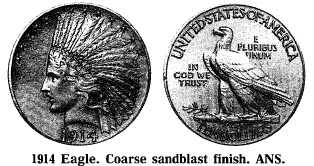
Eagle. [50] Identical comments. Cf. Geiss: 1934, S. A. Tanenbaum: 389. Ullmer: 518 (rim nick at 12th star) brought $5,000. This could almost be called extremely rare.
Double Eagle. [70] Identical comments. Rarer than the mintage suggests. Record $3,200, 1964 ANA Convention sale. Cf. Wolfson: 1015, reasonably at $2,400; Baldenhofer: 1632, ex Bell I (the same coin?); S. A. Tanenbaum: 366; Geiss: 2065; WGC: 920; "Memorable":741; Mocatta Metals.
Gold proof sets. Not more than 50 could have been made, possibly fewer. The only set to be offered in recent decades was B. G. Johnson's, lot 1403 of the 1951 Schulman sale.
Complete proof sets. As in 1908.
1915
Cent. [1150] Surface as on 1914. Many very dubious coins have been offered as matte proofs. Reread the criteria elaborated for 1909 VDB. Record $310, 1964 ANA Convention sale, supported by several private sale reports which apparently are reliable. At least part of the price level so implied is attributable to the speculative activity affecting uncirculated pieces, but much of it is nevertheless a matter of the rarity of this date in proof. Toning as on 1914; often spotty.
Five Cents. [1050] Surface as in 1914. Border often a little narrower at right obv. than elsewhere, but still sharp. Very rare, seldom available without some doubt attached. Use the criteria elaborated under 1913 for dubious coins. Good luck: you'll need it.
Minor proof sets. There may have been a thousand or so made, but none seen in the last 15 years or more; evidently they were broken up long ago for date collectors of cents and nickels.
Dime. [450] Numerals on all 1915 dimes cruder than on any preceding years. No variation noticed, save in the amount of cleaning inflicted on the coins. Auction records range from $275 to $320, most of this level due to speculator activity.
Quarter. [450] Auction records $325 to $450 from the same source. Much hoarded, and here we cannot ascribe any part of the hoarding to a shortage of uncirculated coins.
Half Dollar. [450] Second lowest reported mintage of Philadelphia business strikes of this design. Same comment therefore as to 1914, even to the two bags and the location of the biggest hoard. Auction record $825 in the same Northern California 1964 sale; $850,Sept. 1974. Has been price-bracketed with 1914 since a Norfolk, Virginia hoarder, ca. 1956-62, succeeded in removing nearly half the available survivors from the market.
Silver proof sets. [450] Evidently long since broken up on behalf of speculators, but a few are being reassembled.
Quarter Eagle. [100] Identical finish to 1914. Ullmer's brought $2,300. Rarest date of the design in proof state; unappreciated.
Half Eagle. [75] Identical finish to 1914. Cf. S. A. Tanenbaum: 395, butno recent auction records are known. Extremely rare, few survive. Many rumored to have been melted in 1916-17.
Eagle. [75] Identical comments to half eagle. A most elusive coin, probably rating the Extremely Rare label. Cf. Wolfson: 840; Menjou-Lahrman:897; S. A. Tanenbaum: 389. No recent auction records.
Double Eagle. [50] Identical comments to half eagle. Extremely rare, no recent auction records; possibly a dozen survive. (1) Smithsonian, ex Mint. (2) Smithsonian, ex J. K. Lilly. (3) Eliasberg. (4) WGC: 921. (5) "Memorable": 742. (6) Menjou: 1858- Lahrman: 897 in set. (7) Col. Green - Geiss: 2067. Compare Baldenhofer: 1635, S. A. Tanenbaum: 367. Probably some of these were melted.
Gold proof sets. Not over 50 could have been made, probably fewer and very likely some of these were melted, most others broken up. Only auction records in the past couple of decades: B. G. Johnson estate: 1404, Schulman 1951 sale; Menjou-Lahrman:897. Note that in the 1948 Scrapbook article giving proof mintage figures is a mention of 175 gold sets between July 1915 and June 1916, and - most paradoxically - 175 more between then and the end of 1916. If these figures mean anything at all, they can only mean sets held over from earlier years, probably to be melted in 1916 or 1917. There were no regular gold coins minted in Philadelphia in 1916, of course, and the only gold proof sets emanating from that mint with that date are Cuban - in far smaller numbers, to be sure.
Complete proof sets. As in 1908.
Commemoratives. Panama- Pacific Half Dollar. Without S mint mark. Two gold, 6 silver (at least) and 3 or 4 copper proofs minted at Philadelphia, supposedly from one of the pairs of working dies later shipped to San Francisco, before the mintmark was punched in. The proofs are supposed to be satin finish. There is also a report of at least two more or less brilliant silver proofs bearing the S mint mark at date. Any purported proofs would necessarily have exceptionally sharp central details - on drapery, liberty cap, child's head, eagle's breast, etc. At least one of the coins in silver without S mint mark was bought as a regular uncirculated piece.
- Panama-Pacific Gold Dollar. At least one and probably two reeded edge gold proofs without S mint mark, brilliant like the silver one; one gold piece without S with plain edge. Also reportedly (not verified) at least one brilliant proof with S mint mark. No auction records.
- Panama-Pacific Quarter Eagle. Rumored to exist in brilliant proof in gold without S mint mark (the S is far to right of date). Not verified.
No rumor of any Pan-Pacific fifties in proof, though trial pieces exist without S, in various metals. (The S is r. of pine cone next to ornamental border, some distance below dot following UNUM.)