Walter Breen's Encyclopedia of United States and Colonial Proof Coins 1722-1989
Walter Breen
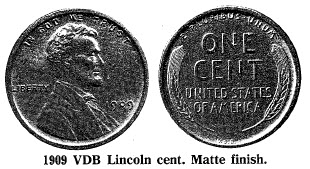
Lincoln, VDB. [420] By Victor D. Brenner. This is one of the three proof Lincolns least often available free of doubt. There appear to be two styles of finish, which makes matters worse. The ANS coin is doubtless authentic owing to its striking qualities (far sharper on all details, notably Lincoln's beard and curls, than regular unc. coins) and its borders, which are unusually broad and flat with sharp inner and outer edges. Yet its surface is satin finish, unlike that on any other VDB's yet examined, nearest to that on the 1909 plain Lincoln proofs below. It is unusually light in color.
All other VDB's examined to date which qualified as proofs by the same criteria have a modified matte finish unlike the 1909 plain Lincolns, more like those of 1911-12, and sometimes rather hard to tell from the uncirculated coins. As hundreds, possibly thousands, of well struck 1909 VDB's have been offered through error or cupidity as matte proofs (including several broken out of rolls), certainty is as important as it is elusive. Most dealers have never seen a genuine one. Look first for the broad flat borders with sharp inner and outer edges; rounding on inner edges is grounds for rejecting the coin. There mayor may not also be knife-edges outside. Edges (cylindrical surface) will be very brilliant, though this does not necessarily hold true of cleaned pieces. There will be no shiny spots in field - look especially near E PLU. Surfaces may be more difficult to use as evidence as cleaning has modified some of them - a cleaning perhaps understandable in that many of the VDB's and later Lincoln cent proofs, retrieved from the mint wrappers, showed up as markedly discolored, often streaked, stained, spotted or with a peculiar granular deposit ranging from reddish brown to sepia. Sharpness on all relief details must be demonstrably superior to that on uncirculated pieces, and you'd better have one there for comparison.
Auction records $330 (Gardner) to $360 (1964 ANA Convention) for pieces "carrying their own credentials", not much higher since. Unverified private sale records above $400. At various times in the 1950's I owned eight or nine of them, cherrypicked as "gem unc." or "toned unc." or "stained unc."; the coin is rare but not prohibitively so.
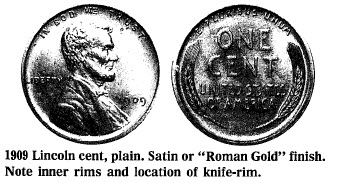
- Lincoln, plain. [2198] Two types of finish. (I) The ones usually seen have satin finish quite unlike the uncirculated, most like "Roman Gold" finish. I once owned one with obv. proof, rev. unc.; it had the full striking characteristics of proofs. (II) The ANS coin is again an anomaly - matte surface with unusually pronounced grain. As its 1910 is similar, possibly it was one of the last 1909's.
Five Cents. [4763] Brilliant proof as in former years, of course. Too often available only cleaned.
Minor proof sets. [4763?] I have seen original 2-piece sets from the Mint of two types, one with the Indian cent, the other with Lincoln plain. Most of the sets appear to have been broken up on behalf of collectors of the cent. It is rather unlikely that 3-piece sets (with both cents) were made, though assembled silver-minor proof sets are now known with both cents.
Dime. [650] No peculiarities.
Quarter. [650] Another one too often found cleaned to death, almost as often as 1903. No peculiarities of die work.
Half Dollar. [650] Same comment.
Silver proof sets. [650] As in 1907.
Quarter Eagle. [139] So-called "Roman Gold" finish, so designated since the early 1940's (I have been unable to find the actual source of the term). Surfaces light in color, midway between satiny and mirrorlike, entirely without the granularity of matte orsandblast. Wayte Raymond used to call them "brilliant matte proofs." Rarer than the mintage figure suggests. Record $3,250, Ullmer sale. A few fraudulent instances of buffing on regular quarter eagles have been seen. Genuine proofs have much sharper design details than these, of course.
Half Eagle. [All kinds 78] Matte finish, dark color, like 1908. DiBello: 1004. No duplicate reported.
- "Roman Gold" finish, like 1910. Very rare, same as the quarter eagle.
Eagle. [All kinds 74] Matte finish, dark color, like 1908. (1) DiBello:1177. (2) Beck 1:548. Exceedingly rare, but see next entry.
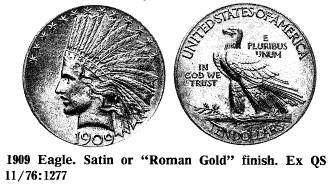
-"Roman Gold" finish, like 1910. Very rare; similar to the quarter eagle. Cf. G. H. Hall:2227, S. A. Tanenbaum:384, etc., etc. Most of these late proofs are traded privately. A collector could probably assemble a complete set 1908-15 for a price, lacking the variant finishes within anyone date, but he might have to wait a good while for some of the lower mintage coins, especially in $10 and $20 denominations.