Walter Breen's Encyclopedia of United States and Colonial Proof Coins 1722-1989
Walter Breen
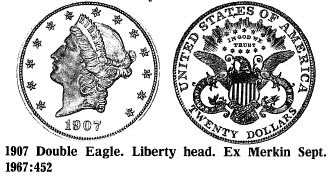
Double Eagle. Liberty head. [78] Popular final year of the design; becoming appreciated as such. Date almost centered, slants up; "broken nose" as in 190(t Ullmer's brought $9,500. Many survivors are impaired. LM /67:452 was a gem.
9 - St. Gaudens. As proofs have been claimedof all the various versions of this Standing Liberty design, it is necessary here too to investigate the claims in detail.
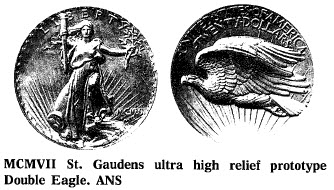
1. Ultra High Relief. [22?] Date MCMVII; excessively concave fields, double the normal thickness at edge; no border at all, only a knife-rim. MCMVII distant from drapery; Capitol building very small; star well to left of E; star above extreme left corner of T; star above end of left arm of Y; only 2, rather than 3, narrow folds in skirt just past Ms. Liberty's r. leg (at observer's left), and oval section of underside of skirt beyond those is very large. Rev. 14 rays in sunburst. As all these were made by9 or 10 blows apiece from the dies, at 172 tons force in the hydraulic press, they are technically made like medals and count as proofs. All have satin finish. All were intended for presentation purposes, mostly via Theodore Roosevelt, as his "pet crime." Originally only 16 were to have been made; the true number is unknown but was probably 24 minus two remelted. Each took many hours to complete, as the coins had to be annealed between successive impressions to remove stress - hardening and prevent cracking or shattering. Listed as Judd 1778, AW 1741. A reported silver impression (AW 1742) has never shown up. Two were found in the Barber estate, per note of T. L. Comparette to Farran Zerbe, July 2S, 1920. Aside from these, Wayte Raymond and I were able in 951 to trace 10 different survivors.
-Lettered edge. (1) Mint, S1. (2) C. E. Barber, ANS. (3) Theodore Roosevelt Museum. (4) Cased 1908 set, ex "a Mint employee" (Barber?), via St. Gaudens family, S 1952, 56, 62, exhibited at 1956 ANA. (5) Theodore Roosevelt, unnamed close personal friend, Ullmer: 546, $200,000, Manfra Tordella & Brookes, to nationwide newspaper publicity, (6) Eliasberg. (7) Lilly, SI. (S) 1956 ANA: 1773, Dr. Wilkison, Paramount, A-Mark. (9) Bell I':S67A. (10) KS 2/61:1417. (11) Farouk:296, (12) Kern:626. Any of the last four may duplicate nos. 7 or 8.
- Plain edge. Cracked rev. die. Cased 1908 set. The above handful of coins represent, beyond doubt, the supreme triumph of medallic achievement at the Philadelphia Mint, though issued over the most vigorous objections of Mint Engraver Barber, despite administrative and technical difficulties almost beyond belief, including officious interference overtly intended to sabotage the project, on behalf of the dying St. Gaudens, who never got to see any of the finished coins, but who is remembered for them today far more than for his lifesize sculptures all over New England. The art expert Cornelius Vermeule has justly compared this issue to the Nike of Samothrace.
II. Normal MCMVII. [5+] Different hubs. Broad flat borders both sides; earlier impressions without knife-rim, later ones with. MCMVII close to drapery; large Capitol; star partly above left upright of E; star centered above left arm of T; star nearly centered above Y; 3 narrower folds in skirt just beyond left leg (at observer's r.); small oval section of underside of skirt left of those. Rev. 13 rays in sunburst. The 11,250 (some say 12,153) struck received an average of 5 blows apiece from the dies. As the blanks were not thereafter routinely given any kind of special chemical treatment, the coins show typical mint bloom though in finer detail than most. Even with the multiple blows, some details of Ms. Liberty's hair, drapery, face, oak leaves, sunburst, and eagle's tail feathers frequently show local softness or indefiniteness, and edge lettering is not to plain.
True proofs do exist, though, and these appear to have received 6 or 7 blows from the dies rather than the normal 5. They do not have pronounced knife-rims; generally no trace of any, though rims are not as rounded as on normal impressions. Fields are most often satin finish, nearest to that on some proof 1909-10 Lincoln cents, but on one coin are sandblast type. Inner and outer edges of flat border sharp, relief details fully brought up, berries rounded, all Capitol pillars countable, clear ends to tail feathers; edge lettering much bolder than on normal strikings, with horizontal striae between edge letters. Charles E. Barber gave out the information that only 5 were struck on the medal press, but this was an outright lie as he owned seven or more himself. Proofs were evidently made on several occasions for presentation purposes, from more than one of the pairs ofdies used for this issue, with two different edge collars, and in several different finishes.
Sandblast (similar to 1908): DiBello: 1317.
Satin finish. Dies I-B (with tiny spine from left edge of L of LIBERTY), collar I (bases of M level).
1. Ex Mint, Charles E. Barber, Barber estate, William H. Woodin ca. 1918, Waldo Newcomer, Wayte Raymond ca. 1933, F.C.C. Boyd, Boyd estate, John J. Ford, Abner Kreisberg, KS2/4/60:2934, Max L. Justus for Jack Collins, KS 3/65:207, various intermediaries including one alleged thief, "Gilhousen": 991, Julian Leidman, Joe Flynn, private collection. This was involved in litigation 1974-75 but the case has been settled out of court and title is deemed clear.
2. Mint, Barber estate, Woodin, Newcomer, Raymond, Joseph Spray.
3. Mint, Barber estate, Woodin, Newcomer, Raymond, consigned to James Kelly, 1951 ANA: 770A.
4. Mint, Barber estate, Woodin, Newcomer, Raymond, James Aloysius Stack estate.