Walter Breen's Encyclopedia of United States and Colonial Proof Coins 1722-1989
Walter Breen
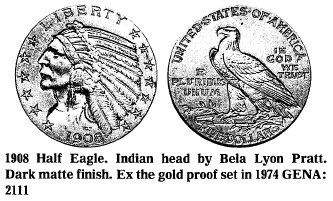
Half Eagle. Indian head design. [167] Same comments as to the quarter eagle. Ullmer: 478 brought $3,500.
- In ANS 1914 exhibition, Woodin loan, was a group of Liberty head half eagles ending with 19GB, described as all proofs. This is the only report of a 1908 Liberty head half eagle in proof (presumably the old style brilliant proof); if it is not a typographical error, it would represent one of the rarest of all U.S. gold proofs.
Eagle. "Indian Princess" head. No proofs reported of the type without motto.
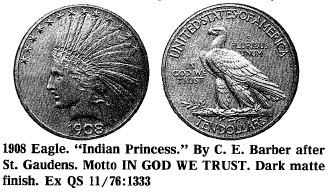
- With motto IN GOD WE TRUST. By C. E. Barber after St. Gaudens. [116] Three types of finish, all very rare; popular as first proof mintage of the design, and even the regular dark matte type is rarer than mintage suggests.
Light matte finish. Pale orange-yellow, many shades lighter than next. Only one seen (Lester Merkin, 1965). The color difference is plain enough to be visible clear across the room! Not the same as the "Roman Finish" below; granular, not satiny.
Dark matte finish. Between khaki and olive color, similar to the $2 1/2 and $5. I have seen a couple of dozen in all, nearly half of them with nicks or shiny spots.
"Roman Gold" finish, as in 1909-10. Light yellow color; satiny, sometimes called semi-brilliant (entirely unlike the light matte finish first mentioned), and often described as a hybrid between matte and brilliant when on coins of 1909 or 1910. Only one reported: Boston Museum of Fine Arts, later 1976 ANA:3151, $7500.
Double Eagle. None reported of first design without motto, either of the short rays type (as in 1907) or the long rays (as in Motto coins and 1909-33). (Short rays: ends are plain and make an arc, the nearest one missing end of Ms. Liberty's branch by over 1 mm. Long rays: ends rather indefinite, the nearest one almost touching ends of branch.)
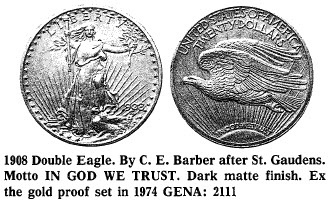
- Motto IN GOD WE TRUST. By C. E. Barber after St. Gaudens. Long rays as just described. [101] Three types of finish. The date is now very rare, more so than the mintage would suggest, and extremely popular because first obtainable proof of the design, initial year with motto.
Light matte finish. Pale orange-yellow, matching the eagle of the same finish. Three reported: one owned by Lester Merkin in 1965 from the set which yielded the similar eagle; two others observed by Ronnie Carr. The color difference from the next is plain enough to be visible across the room, as with the eagle.
Dark matte finish. Between khaki and olive color, similar to lower denominations, identical to the eagle. I have seen at least 20 different, mostly nicked up; some from sets broken up very recently. Record $9,000 in Ullmer, May 1974; private sale records allegedly still higher.
"Roman Gold" finish, as in 1909-10. Light yellow color; satiny or semi-brilliant exactly as with the similar eagle. Boston Museum of Fine Arts, later 1976 ANA:3302, $10,000. No duplicate reported.
Some explanation for the undue rarity of 1908 proof gold may be found here: "Less than 100 sets of proof gold (2nd type with In God We Trust) struck at Philadelphia. Five collectors and one dealer purchased these sets, the remainder destroyed at the mint, 1-2-1909." (Green's Mint Record and Type Table, 1936, p.139.) No other record of meltage but it is probably correct. Note that in 1909 far fewer proof gold coins were made, reflecting poor sales in 1908.
Gold proof sets. Not more than 101 could have been made, and if the above mentioned notation is correct, the true number is probably 90 to 95, of which some were melted. One such set appeared in the B. G. Johnson estate remnants offered in the 1951 Schulman auction: 1397. (Either Johnson or H. Chapman was probably the dealer alluded to by Green.) This or another one showed up in KS 5/66: 1830 and/or S5/57:660. A similar set was in Pine Tree's 1974 GENA: 2111; another (offered singly) was in Breen II: 162A, 301, 485 and 680, total $16,800.
Complete proof sets. Smithsonian and a few others, but I cannot swear that these are as obtained from the mint.
1909
Cent. Indian head. [2175] Now popular as final year of the design; available in almost any color desired, natural or unnatural.