Walter Breen's Encyclopedia of United States and Colonial Proof Coins 1722-1989
Walter Breen
Half Dollar. [543] Double ditto. Here it is not even low business strike mintage that could be alleged (however irrelevantly) as cause.
Silver proof sets. [543] As in 1910.
Quarter Eagle. [191] Matte finish, dull and darker than unc., nearest to 1908 but differing minutely in texture of grain. Auction record $1,900, May 1974 Ullmer sale.
Half Eagle. [139] Ditto. Scanlon's brought $1,800, Ullmer: 480 $3,750; others, mostly lower. Rare, seldom offered.
Eagle. [95] Two varieties. Matte, similar to 1908, and fine sandblast similar to 1912, darker in color than 1908. I do not know which is rarer. A census, or even a representative sample, of these coins has been extraordinarly difficult. Photographs are no help whatever; black-and-white usually cannot be subjected to strong enough magnification to distinguish the types of grain in surfaces, color photos invariably have chromatic aberration or poor dye fidelity in the yellow to orange range so that little can be judged therefrom.
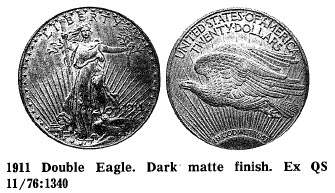
Double Eagle. [100] All seen to date are of the matte type, nearest to 1908 and of nearly the same color. Do even 20 survive? Compare Wolfson: 1008, Tanenbaum: 363, Baldenhofer: 1"623, etc.
Gold proof sets. Not more than 95 could have been made, probably fewer. Lot 1400 of the B. G. Johnson material in the 1951 Schulman sale was such a 4-piece set. It was called "sandblast proof" but that is no evidence of the actual appearance of the coins. There was evidently much experimentation going on at the mint with the object of providing surfaces enough unlike the uncs. to be readily identifiable and pleasing to collectors, without impairing the relief detail. Reversion to the old style brilliant proofs with frosted designs would have been desirable but very difficult given the unusual curvature of fields. One such set: Phila. Estate.
Complete proof sets. As in 1908.
1912
Cent. [2145] Pronounced matte finish only. Usually stained as are most other years.
Five Cents. [2145] Popular final year of the design; subject to type collector demand and also to some hoarding. Brilliant, of course.
Minor proof sets. [2145] As in 1910.
Dime. [700] No peculiarities. Hoarded almost as much as 1911 for less reason.
Quarter. [700] Ditto. Usually poorly cleaned. Half Dollar. [700] Likewise and worse, though the speculators have not been quite so insatiable. Auction records $200 to $260.
Silver Proof sets. [700] As in 1910.
Quarter Eagle. [197] Fine sandblast finish. Different from all previous matte coins; under a microscope the surfaces show millions of minute shiny facets. Much rarer than its mintage figure would suggest. Record $2,200, Ullmer sale.
Half Eagle. [144] Same finish as quarter eagle. Same comments. Ullmer: 481 brought $3,750.
Eagle. [83] Now with 48 stars on edge. Same finish. Same comments. Very rare. Cf. S. A. Tanenbaum :387; Wolfson: 257; Menjou-Lahrman: 895.
Double Eagle. [74] Obv. now with 48 stars. Same finish. Same comments. Very rare. Cf. Baldenhofer:1626, ex Bell I; Tanenbaum: 364; WGC: 918; "Memorable": 739; those in sets, in Philadelphia Estate and the usual museums. Very few of these are in dealers' stocks now.
Gold proof sets. Not more than 74 minted, probably fewer. Onewas lot 1401 of the B. G. Johnson material sold in the 1951 Schulman auction. Another was Stadiem: 746 at $5,200, 1965.
Complete proof sets. As in 1908.
1913
Cent. [2848] As in 1912. Possibly the most easily obtained of the matte proof cents, with 1911, 1912, and 1909 plain coming close. I used to make lunch money buying unrecognized examples of these dates as uncirculated, but that was many years ago. In the meantime various sharp-eyed youngsters have gone and done likewise, pretty well exhausting the supply. Now the problem is to find coins offered as matte proofs that are not mere uncirculateds.
Five Cents. Liberty head. See Restrikes and Fantasy Pieces.
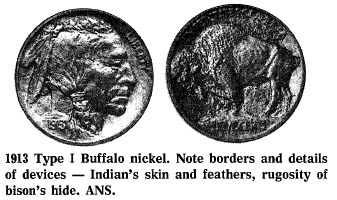
- Buffalo. Type I. Bison on mound, no distinctexergualline. By James Earle Fraser. [1520?] Rather dull matte finish. Authentic proofs are rare and sometimes hard to distinguish from well struck business strikes. Plain raised borders, completely distinct from field, inner and outer edges sharp (inner less so). LIBERTY in low relief but entirely clear. All details of Indian's hair, feathers and bison's skin very sharp, much more so than on uncirculated coins.
On Jan. 13, 1913, some 17 specimens were minted from a pair of dies almost identical to the regular Type I but lacking designer's F below date. Diameter 0.839" = 21.3mm (standard 21.2mm). Two went to Mint Cabinet, now in SI. Six more were destroyed, the remaining 9 going to Fraser and mint officials. On Feb. 13, 4 were struck from almost identical dies, without F and with round topped 3. Diameter 0.869" = 22.1mm. One was destroyed, two went to Mint Cabinet and remain in SI, the fourth to some mint official. The purpose (Taxay, 346n) was to show the effect of a small space between design and border. Possibly some of either may survive masquerading as normal unc. or proof Type I's. Did you look at yours lately?