Walter Breen's Encyclopedia of United States and Colonial Proof Coins 1722-1989
Walter Breen
(v) Experimental use of the virole brisee to produce lettered edges on coins struck in close collars.
All five of these technological improvements were tried out not only at the Soho Mint but later on by other mints in Britain, the Continent, and the United States. Correspondence between Boulton and various successive Philadelphia Mint Directors was very extensive indeed; I can only summarize here a small part of its content, as much of Boulton's experimental work related less to the proofing process than to standardizing designs and physical properties of coins. Boulton wished to make counterfeiting impossible through sheer perfection of strike, absolute uniformity of working dies, and absolute uniformity of weights and dimensions of coins. He very nearly succeeded, and he certainly has made easier the task of counterfeit detection, albeit at the cost of increasing stereotypy of coin designs.
With the vast power made available by Watt's steam engines, Boulton found he could actuate presses large enough to impart (albeit by repeated blows) entire or almost entire coin designs to working dies from hubs, minimizing handwork and maximizing both speed of multiplying dies and uniformity among them. The familiar "Cartwheel" copper twopence and pennies of 1797, and similar halfpennies and farthings of 1799, and later coppers of 1806-7, all look very much alike for precisely this reason. About the only details of handwork noticeable on the "Cartwheel" dies are the ships on reverses, though at least two working puncheons of George III portraits were in use, making several minor varieties. At no earlier time in history were fifty million coins issued so nearly indistinguishable from one another as were the 1797 Cartwheel pennies. A little more hand-tooling is found on the dies intended for proofs (as described in Peck), but even those require microscopic examination to distinguish one from another.
Boulton described his methods to the various Mint Directors from Elias Boudinot (1795-1804) on up for several decades.Even earlier than that, puncheons had been used on U.S. coins: three different eagles on 1795 half dollar reverses, a head puncheon for the three 1793 Liberty cap cent dies and the first three obverses of 1794, etc., another for 1794 half cent heads, others for the three gold denominations, and occasionally for reverse wreaths: a technique first used in the USA by Abel Buell for the New Haven Mint (1785-88). With the very limited power then available at the Philadelphia Mint, making complete reverse dies by hubbing proved impractical; much hand tooling remained necessary, even as Buell had learned on the 1786 mailed bust Connecticut coppers. At that time nobody in the U.S. knew how to make steam engines of the capacity used at the Soho Mint, so many of Boulton's inventions and adaptations remained impossible to introduce into American minting technology for many years thereafter.
But the history of minting technology in the United States remains the history of successive Mint Directors' attempts to put into effect the Boulton innovations. Complete hubbing of reverses, attempted several times without success since 1794, became practical only after steam engines of large capacity could be built for hubbing presses - in the 1830's: 1836 for half-dollars (reeded edge), 1837 for cents, half-dimes and dimes, 1838 for quarter dollars and eagles, 1839 for half-eagles, 1840 for half-cents, quarter-eagles and dollars. Complete hubbing of obverses save for dates came at the same time; complete hubbing of obverses including dates proved a more difficult proposition, involving several extra steps, and though it had been successfully done on Boulton's "Cartwheel" coppers of 1797, it was introduced on United States coins only in the 20th century: 1907 for the larger gold, 1908 for quarter-eagles and half-eagles, 1909 for cents, 1913 for nickels, 1916 for silver coins except the dollar, 1921 for silver dollars. And the viroie brisee, or segmented collar-die for imparting edge lettering in the same operation with stamping the obv. and rev. designs on a coin, though experimented with by Boulton in the 1780's, first reached successful use in America on eagles and double-eagles in and after 1907.
On the other hand, some Boulton innovations were adopted fairly soon. As many elements as could be included on puncheons were so included, as early as the 1790's in American coins. Boulton used bronzing powder on proofs from the 1780's and 1790's on, and sometime in the late 1820's or early 1830's some of this bronzing powder was sent to the Philadelphia Mint - whereupon it was applied to a few coins (1827-31 cents, 1831 half-cents) which would otherwise have been brilliant proofs, and became quite generally used for mint medals in later decades. (The pattern GOD OUR TRUST eagles and half-dollars in copper, dated 1861-63, normally come bronzed). I do not have complete information on chemistry or use of bronzing powder, but apparently it was baked onto the otherwise finished coins, producing a completely even, uniform, permanent reddish brown patina which would not be damaged by atmospheric conditions. This may not have seemed, to some eyes, like much of an improvement over the regular brilliant proofs with their combination of mirrorlike fields and frosty devices, but at least the bronzed pieces did not develop ugly spots, stains, tarnish or other damage to which brilliant proofs were and still are so vulnerable.
The only real paradox in American adoption of Boulton innovations is the close collar. Boulton early recognized that, even on plain-edged coins, use of a close collar to restrain broadening of planchets on impact from obv. and rev. dies would improve the striking qualities and impart equality to diameters –abrasion. Nevertheless, no experiments at the Philadelphia Mint with this device seem to have been made prior to 1828, when it was brought into use on the new dimes, forty years after Boulton's original experiments.
Curiously, the final pieces in the series of Colonial proofs were made in a close collar: the obscure Kentucky Myddelton token or pattern of 1796, from dies by Conrad H. Kuchler. I list it here for uniformity:
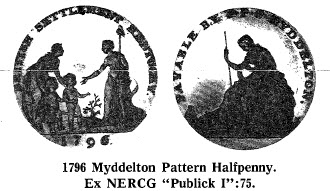
46. 1796 Pattern Halfpenny. Obv. Hope with anchor, presenting two children - the infant American nation and the infant British settlement in Kentucky? - to some goddess, whose right hand is extended to receive them, while her left hand supports liberty pole and cap; before, olive branch (for hope?); behind, cornucopia (fertility of the land?). BRITISH SETTLEMENT KENTUCKY around; 1796 in exergue. Rev. PAYABLE BY P.P.P. MYDDELTON. Rev. Britannia, dejected, with spear inverted (as the result of the ill-fated war with the American colonies, or at her people emigrating to Kentucky?); at her feet, the scales, fasces and a broken sword -this last a clear reference to the defeat at Yorktown; before her, a liberty cap rises from the earth like some kind of mushroom newly sprung up. (Description after that in "Miss Liberty's American Debut", Numismatic Journal 1, 1961.) Silver, plain edge. Scott C309. Brilliant proofs only -sometimes in small cylindrical cases. Very rare.
47. Identical to last. Copper, plain edge. Scott C308. Brilliant proofs only. Far rarer than preceeding, possibly 4 or 5 traced. In Scott, p.37, is the curious story about Philip Parry Price "Myddelton" and these suppressed coins.
I return to the Philadelphia Mint and its struggles to introduce Boulton innovations, specifically the close collar: As this subject is still much misunderstood, despite its excellent analysis in the Newman-Bressett book The Fantastic 1804 Dollar, I should summarize older and newer methods of coin manufacture, specifically with reference to proofs.