Walter Breen's Encyclopedia of United States and Colonial Proof Coins 1722-1989
Walter Breen
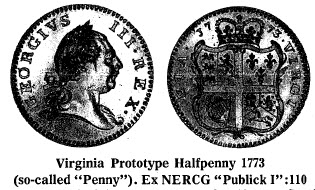
34. 1773 Virginia Pattern or Proof Halfpenny. Small 7's in date. 6 harp strings. Broad planchet. Full border beading, obv. and rev., with narrow space outside it. (Regular Virginia halfpence have radial-line or sawtooth dentilated borders.) Copper, 52 to the pound = 134.6 grains (standard for Irish halfpenny planchets). Scott C98. The Smithsonian specimen; from the Mint collection, shows edge file marks, as do many regular British proof coppers. (T.L.Comparette's catalogues of the Mint collection, 1912-14, called the piece an electrotype because of the edge file marks. When I went over the collection with the late Stuart Mosher in 1951, I found not the slightest reason to doubt the coin's genuineness.) All specimens known are from Newman's dies I-A: obv., no period after GEORGIVS; rev. very small date -much less tall, especially the Ts, than letters in VIRGINIA -and only 6 strings to harp. Copper only. Brilliant mirrorlike surfaces, moderately frosty devices, wt. 131 to 135 grains (standard for Virginia halfpence, 60 to the pound = 1162/3 grains; actual range c. 108 to 120), occasionally with rust marks on he dies. Possibly a dozen are known in all.
35. 1774 Virginia "Shilling." Obv. identical to the guinea of the period. Rev. As the halfpenny but for date. Silver. Scott CI01. Brilliant proofs of highest quality. (1) JHU. (2) Boyd estate. (3) Eric P. Newman. (4, 5) Mrs. Norweb. (6) Roper. Reported also in bronze (Atkins, 1889, p. 25), unconfirmed.
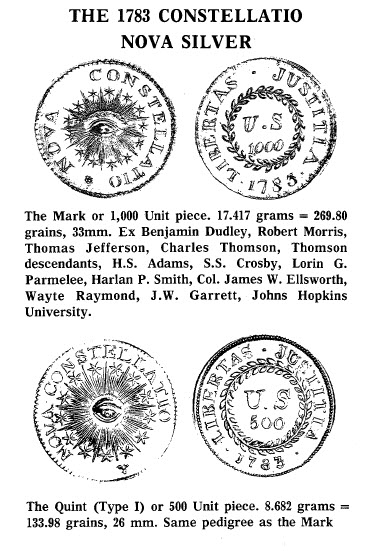
In 1782, Gouverneur Morris proposed a decimal monetary system, possibly the most ingenious and certainly the most cumbersome in history. This took as its unit V4 grain of silver = 1/1440 Spanish dollar (though in actuality the Spanish dollar weighed 416 grains rather than the 360 Morris's figure implied). The coins were to be of gold, valued at 10,000 units; of silver, valued at 1000, 5.00 and 100 units; and of copper, valued at 5 and 8 units, with other denominations possible. Robert Morris, Superintendent of Finance under Continental Congress, located a diesinker named Benjamin Dudley (the same one who later made dies for New Jersey coppers at both the Rahway and Morristown mints, 1786 and 1787), and hired him to engrave dies for several of these, notably the Mark or 1000 Unit piece, two types of Quint or 500 Units, and the Cent or Bit of 100 Units. For device Morris chose The All-Seeing Eye in glory of rays with 13 stars for the thirteen colonies, and CONSTELLATIO NOVA. Reverse had U.S. and numerical value within circular wreath, LIBERT AS. JUSTITIA. 1783 around. Dudly completed the first sample coins on April 2, 1783, using the weight standard 270 = 1000 Units. the coins are of pure silver (sp.gr. 10.50, as measured at Johns Hopkins University), and the three of larger denominations have edge onamented with twin olive leaves, after the style of the Continental Dollars of 1776. Lack of bullion, and the opposition of Thorns Jefferson made the project into a dead letter, but the coins survive, being the first proofs made in the' continental U. S.
Nos. 36 and 37 The Mark and first type Quint (with obv. inscription) went from Benjamin Dudley to Robert Morris; Thomas Jefferson, Charles Thomson (Secretary of Contmental Congress), his nephew John Thomson, 'his son Samuel E. Thomson, Rathmell Wilson (ca. 1872), J.W. Haseltine (1872), Henry S. Adams, S.S. Crosby" Lorin G. Parmelee, Harlan P. Smith, Col. James W. Ellsworth, Wayte Raymond, John Work Garrett, thence by bequest to Johns Hopkins University, where' they remain today. Crosby discovered the second type Quint (no. 38) about 1873 and sold it to Parmelee. Its later history is the same as that of the first two pieces, but it is unaccountably lightweight at only 110 grains, instead of the 135of the other one. Two 100-unit pieces (no. 39) are known, one in JHU (discovered in Scotland about 1885, thence to Parmelee and the same later owners), the other in the Eric P. Newman collection. These have plain edges. A copper 5-unit piece, with U.S 5 in wreath, was made and at one time owned by Josiah Bartlett (Signer of Declaration of Independence) and Samuel Curwen, but it has not been located.
The legends make a rude hexameter verse as follows:
Li-ber- /tas jus- /ti-ti-a / /con-stel- / la-ti-o / no-va "The sky's New Constellation - Liberty and Justice."
Latin inscriptions have long been thought easier to remember when chanted as verse, so that this was a mnemonic device, comparable to today's advertising jingles.
The coins here illustrated were photographed at Johns Hopkins University and are reproduced by courtesy of Krause Publications.