Walter Breen's Encyclopedia of United States and Colonial Proof Coins 1722-1989
Walter Breen
21. Obv. as last, uniface. Steel. Supposedly six known; one in the British Museum, one in JHU, and another in the Boyd estate.
Most of the above proofs, except for the silver ones, show edge file marks. Many non-proofs of the regular ROSA AMERICANA types also show edge filing, and it is much less carefully done; the explanation seems to be that - whether from cast blanks or because the coins were struck when very hot - edges quickly developed roughnesses making the coins very unpleasant to handle. This was a peculiarity of Bath metal; the copper coins gave no such trouble.
I shall continue the enumeration of American Colonial proofs continuously with the ROSA AMERICANA series, since so far as I know nobody has previously attempted a catalogue of them. One of its more useful features will be enabling collectors to decide which of the problematical prooflike pieces dated in the 1780's and 1790's actually were made as proofs. Most of these have been assimilated to the Colonial series because of more or less explicit legends or devices referring to America, but they actually originated with various manufacturers of halfpenny-sized tokens intended for British collectors; and the problem with them is to determine which pieces were made as intentional brilliant proofs by processes other than those used on routine tokens of the period ("Conders" or "Pye" tokens), since many are sold as proofs today on the smallest glimpse of a shiny surface.
On the other hand, the series immediately to follow, Wood's Irish or "Hibernia" coins and patterns, never referred in any way to the colonies. They have been associated with, or assimilated to, the Colonial series solely because enterprising merchants bought up the rejected Wood's pieces in quantity (doubtless as junk copper) after the patriotic Irishmen refused to take them as small change, and shipped them over to America as so many "Casks of Hard Ware," much as did others in later decades with counterfeit halfpence. The series is replete with patterns; from among them I list only the few of more or less regular design, in the feeling that only these have even the slightest claim to relevance. My precedents here are of course Peck and Seaby, who (as already mentioned) recognized the difficulty of telling whether some pieces were mere proofs or patterns.
22. 1722 Halfpenny, Wood's HIBERNIA type, first design: harp lett. Copper, Scott C340. Reliably reported to exist in proof, but I have not seen it. Recognizable dentils or narrow oval beads; may show space near edge outside this border; may show file marks on edge; will show somewhat mirrorlike surfaces and exceptionally sharp detail on drapery and king's hair. Same remarks hold for the Wood's proofs to follow. Exceedingly rare.
23. 1722 Halfpenny, harp left as preceding. Silver, Scott C341. Two reported.
24.1722 Farthing. Copper. Same type. Nelson, plate IV, 10, Scott C345, Extremely rare, generally well worn. 5 or 6 known. Newcomer 3179 was described as a perfect proof, and I have seen one other with the earmarks.
25. 1722 Halfpenny. Second design, harp at right (as in 1723-24). Regular type. Silver, Scott C343. I know only from its mention in Nelson.
26. 1723 Halfpenny. Prototype pattern (submitted to Privy 'Council for approval?). Larger head than usual, at least 2mm taller from bust point to highest part of hair than is the head on regular issues (23mm compared to 21). Full borders, as No. 22. Only one obv. die; three reverses, with 10, 11 or 12 strings to harp, all three with pellet before H, a large 3 in date (the lower curve much larger than the angular part) and full beaded borders. Copper, wt. 116-125 grains, compared to 106-113 for regular issue; diameter 27 to 30mm - very much wider than regular issue (25-28mm), but legends the same. Scott C347. Very rare; generally found bright red and choice, sometimes sold as regular issue. Cf. 1973 GENA: 27.
27. 1723 Halfpenny. As last? Silver. Included under Scott C350. Said to be only 2 known.
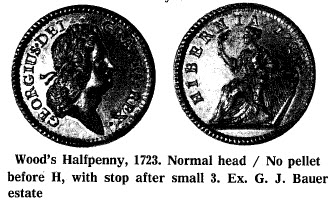
28. 1723 Halfpenny. As illustrated; 12 harpshings. Bauer, LM11/68:40, J.L.R.
29. 1723 Farthing. Similar. Copper. Scott 354. Record $1100, Dr. Spence sale.
30. 1723 Farthing. Same. Silver. Two die varieties differing in spacing of legends. Scott C355. At least 6 known, some worn (pocket pieces).
31. 1724 Halfpenny. Similar to regular type, but rev. very widely spaced legend; N above head, 4 touches harp. Silver. Scott C357. Newcomer 3199, said to be unique, ex Nelson.
32. 1724 Halfpenny. "Regular type" in silver, reported by Nelson. Unseen.
33. 1724 Farthing. Stop after date. Silver. Scott C362. Unseen.
PROOFS OF VIRGINIA
By the middle 1700's the proof-making method was fairly well standardized in Britain. The Engraver of the Royal Mint found enough demand for them that in 1746 and probably some later years early in the reign of George III, he made up presentation sets in special cases. Later ones probably included coins of mixed dates as collectors and other recipients in Britain until recent years paid far less attention to dates on coins than to slight changes in royal portraits and reverse designs. These sets seem to be the ancestors alike of the semi-official British proof sets in presentation cases for 1826, 1831, 1839, and 1853 (also issued directly from the Engraver's offices), and of their American counterparts from about 1817 or 1820 on.
lt is not surprising, then, to find that the first few patterns or proofs for the Virginia halfpence, made in the Royal Mint pursuant to George III's Warrant of May 20, 1773, closely match in fabric the proof 1770 halfpence of George III of regular British type. They were clearly made by identical processes -even to showing file marks on edge. Eric Newman has established (in his monograph Coinage for Colonial Virginia, ANS, 1956) that these proof or pattern Virginia halfpence were struck on heavier planchets originally intended for some Irish halfpence. This small weight difference, together with larger diameter of dies and flans, gave the coins the sobriquet of Virginia "Pennies." They are not pennies, however.
Despite brilliant prooflike surfaces on some of the red mint state Virginia halfpence from the Col. Cohen hoard, none of these are proofs. The only real Virginia proofs are Nos. 34 and 35. Dies for these proofs and for the regular 672,000 Virginia coins were hubbed from puncheons prepared by either Richard Yeo or Thomas Pingo.