Walter Breen's Encyclopedia of United States and Colonial Proof Coins 1722-1989
Walter Breen
(f) The dateless (1792-95?) token commonly called the "Kentucky Cent," "Triangle" or "Pyramid" token, and known to originate in Lancaster, England, presents one of the more difficult problems. The piece is attributed to Kentucky with no good reason; its legends prove it to refer to the Colonies in general. Its triangular array of 15 stars has each star stamped with the initial of a state, the topmost being K for Kentucky, the 15th state (1792), the next two being RI. and Vt. for Rhode Island and Vermont (1791), the 13th and 14th states to enter the Union. From the arrangement, one could make a very plausible guess that the token's designer was referring to the Masonic "Unfinished Pyramid" device on the $50 Continental notes of 1778-9, in the belief that the admission of Kentucky as 15th state completed the roster. (Were the roster then thought incomplete, nothing would have been simpler than to arrange the 15 stars in three rows of 6, 5 and 4, making a still unfinished pyramid.) Most lettered edge specimens of this token come with some prooflike surface; the plain edge pieces normally come Fine to AU. The prooflike ones occur in lots of unattributed British "Conders." They come on wide and narrow flans with plain edge, and on somewhat wider ones with various edge letterings and - extremely rarely - with diagonal reeding, the so-called "engrailed" edge. Once again, there seems no sharp demarcation between the most prooflike and the least prooflike ones; they come in earlier and later states of die breaks (the breaks are on the side showing hand and scroll), and even on the ones with diagonal edge reeding (which have the widest flans of all), borders tend to be weak, central area of scroll poorly brought up. I conclude that none of these were intentional brilliant proofs.
(g) Much the same comment has to be made for the 1795 Washington Grate halfpennies. Typically, the common large buttons pieces come in light olive to bright red prooflike unc., weakly struck on Washington's head and part of reverse devices, and between the earliest (and most prooflike) and the latest strikes with heavily broken dies and mint frost there is no clear demarcation. They look very much like other token-craze pieces and not like true proofs.
(h) Original Castorland half dollar. Proofs, silver and copper, reportedly gold, Scott C295-7. Made at Paris Mint, this does match French proofs of the 1790's.
(i) On the other hand, the Jacobs Penny token is part of a series known to include true proofs. All four specimens 1 have seen, though on defective planchets, show earmarks of proof status and very likely should be listed as intentional brilliant proofs.
The list of Colonial proofs, therefore, can be continued with the following:
41. 1791 Washington Small Eagle cent, brilliant copper proof in original presentation case of issue. Ex Woodward's Bache sale, March 1865, lot 3273. Unique?
42. 1792 "Roman Head" Washington cent. Copper proof, lettered edge. Approximately a dozen known or reported.
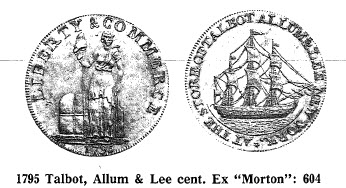
43. 1795 Talbot, Allum & Lee cent. Regular type. The most convincing specimen offered was lot 604, Pine Tree's "Elizabeth Morton" Sale, October, 1975.
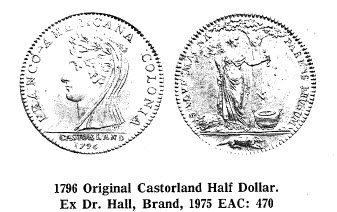
44. 1796 CASTORLAND "Half Dollar". Original. Old style lettering, unevenly placed, A below M, R leans right with respect to E-1, UG touching, etc.; thick planchet, reeded edge, no trace of ARGENT (on silver), CUIVRE or BRONZE on copper, no mint master's symbol on edge. Scott C295-297. Faint traces of rust at handle of vessel, but no break at S of PARENS. Silver (about 8 known), copper (about 4 known), including LMI0/73:222; claimed to exist in gold but we have not examined an authentic example and suspect that the claim covered an early restrike. The most convincing proofs in silver include Pine Tree's EAC sale, Feb. 1975: 470, ex Dr. Hall, Brand, Breen; Merkin 9/74: 255; Wurzbach, 1914 ANS Exhibition. Others mostly have some evidence of circulation. This historical background is most completely given in the EAC sale above mentioned.
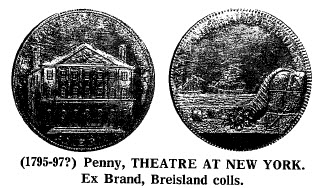
45. n.d, (1795-97?) Penny. THE THEATRE AT NEW YORK. View of the old Park Theatre, New York City. In exergue, AMERICA and signature JACOBS. Rev. Cornucopia at seashore. Copper, edge I PROMISE TO PAY ON DEMAND THE BEARER ONE PENNY. Scott C383, Adams (N.Y.) 892, Dalton & Hamer (Middlesex misc.) 167. Possibly as many as eight survive in the USA and Britain. (1) BM. (2) Norweb. (3) JHU. (4) Brand, NN 51:180, W.L. Breisland, S 6/73 :855 at $2,800; pictured in Taxay. (5) Bowers & Ruddy, 1973 FPL, $2,900, not as brilliant. (6) Pine Tree "Promised Lands": 315 (4/74) at $2,950.
MATTHEW BOULTON'S CONTRIBUTIONS
The next step in the history of the proofing process was the changes instituted by Boulton and Watt at their Soho Mint near Birmingham. Matthew Boulton, single-minded industrialist dedicated to mass production via James Watt's steam engine, and in particular to improvement of the national coinage, began experimenting with patterns for British and Colonial coinages as early as the later 1780's. Pattern halfpennies of his manufacture, embodying some features later incorporated into the regular coinage, and some few (such as the virole brisee or segmented collar-die for lettering edges) not perfected until early in the 20th century, are known from about 1788. Wilson Peck's English Copper, Tin and Bronze Coins in the British Museum gives the most nearly complete specialized study of this series ever attempted; I shall not attempt to go into the kind of detail Peck elaborated" as his chapter on the SohoMint pieces occupies in excess of fifty pages. Boulton's improvements in coining technology, specifically related to the proofing process, are summarizable under the following heads:
(i) Complete or nearly complete hubbing of dies.
(ii) Use of a close collar to equalize diameters of coins and improve striking qualities.
(iii) Concomitantly, use of steam presses and greater force more evenly applied to improve striking qualities -and to bring up borders high enough to afford greater protection of devices .from abrasion.
(iv) Experimental use of bronzing powder to produce a permanent patina on copper proofs.