Abe Kosoff: Dean of Numismatics
Q. David Bowers
The R.H. Burnie scandal affected many in the hobby. Burnie, who was an established dealer and who was respected as a prominent researcher in the field of small-denomination California gold coins and who had issued the standard reference on the subject, devised a novel fraud. A listing of coins, reputedly from an "estate," was circulated among known buyers. He stated that it was necessary to submit a deposit with bids for such pieces, not because Burnie didn't trust the buyers, but because that's what the executors of the so-called "estate" wanted. After tens of thousands of dollars' worth of deposits had been collected, Burnie and a woman companion absconded with the funds, leaving the hopeful buyers, many of whom had been his personal friends, holding nothing but canceled checks.
In November 1956, Abe Kosoff offered at public auction sale the collection of William P. Donlon. The site was the new premises of the Roy J. Goldenberg Auction Gallery. A brief biography of Donlon was given in the catalogue introduction:
"Mr. Donlon's coin collecting activities date back to early childhood when his dad, a grocer in Amsterdam, New York, gave him all the unusual and odd-looking coins that came across the counter. Bill says, 'If it didn't look odd enough, I would let a trolley car run over it!
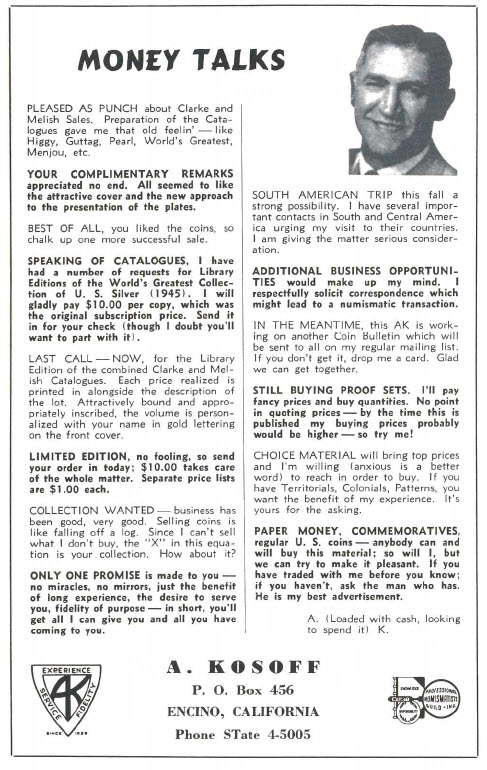
"Money Talks" as printed in the May 1956 issue of "The Numismatist."
"About 25 years ago, Bill Donlon became serious about numismatics and started to attend auction sales. Bill became a regular at Tom Elder's sales and frequently attended the Raymond-Macallister auctions. When I founded the Numismatic Gallery in New York City and began conducting auctions, Bill came down often. He also attended all of the Grinnell auctions held by Barney Bluestone in Syracuse, New York.
"Proof coins fascinated Bill Donlon, and when he approached completion of the series from 1858 on, he arranged the coins into sets by years, ordered red translucent plastic holders and specially printed cards and went about winning blue ribbons at ANA conventions in Milwaukee in 1950, New York 1952, Omaha 1955, and Chicago 1956.
"Mr. Donlon is a former theatre manager, now engaged with his two sons in the outdoor amusement business at Sylvan Beach on Oneida Lake where Mr. and Mrs. Donlon have a summer house. Their permanent address is 30 miles away in Utica, New York."
The Donlon sale commenced with an 1856 Flying Eagle cent, a Proof, which fetched $500. Abe Kosoff noted in the same catalogue:
"The 1856 Flying Eagle cent is a favorite of mine for starting a public auction sale. Insures early attendance and has always headed successful sales." He further observed:
"Dealers are planning to attend, because many fine lots are made to order for them. Besides, considerable duplication will certainly give them a chance to buy. The southland is excited about the first big coin sale since I catalogued and sold the splendid collection issued in the Menjou catalogue. The Goldenberg Gallery was the scene of that sale. This, however, is a new and modern gallery, and one of the leading auction houses on fabulous Wilshire Boulevard."
The first lot in the sale, the 1856 Flying Eagle cent, sold for $500 to Bob Schermerhorn, the Dallas numismatist who several years earlier had been a part of the American contingent at the Farouk Sale. Over 300 successful mail bidders plus an active floor audience pushed prices to $114,290.95, setting many records in the process.
Among the prices realized were: 1857 Proof Flying Eagle cent $155, Uncirculated 1864-L Indian cent $90, Proof 1848 Liberty Seated dime $77.50, Gem Uncirculated 1796 quarter dollar $1,375, Uncirculated 1795 half dollar $260, Uncirculated 1839-O half dollar $220, Proof 1851 silver dollar $575, Proof 1906 double eagle $530, Proof 1864-L Indian cent $850, Proof 1864 Small Motto two-cent piece $575, Proof 1867 with rays Shield nickel $975, 1895 Proof set from the cent through the silver dollar $650, and 1915 Proof set from the cent through the half dollar $515.
Much attention was centered on a rare variety of 1803 large cent, a piece bought as a common issue by William Donlon, which was later identified as variety NC-1 by the cataloguer. It brought $525, prompting Donlon to later mention this incident in a letter to Abe Kosoff.