Abe Kosoff: Dean of Numismatics
Q. David Bowers
"Then, in 1921, Green wrote asking what a collection of U. S. coins would cost. Mehl prepared a small group, and Green bought $1,800 worth. Later, Mehl bought the Fred Joy Collection and prepared a typewritten catalogue which he sent to Col. Green. Green wired back and bought the collection for $63,500. This was the beginning of what eventually proved to be a combination of an outstanding collection and extraordinary hoard. Green, for example, once owned all five of the 1913 Liberty head nickels. At one time he also owned a large quantity of gem quality 1796 quarters.
"Mehl was the pioneer in the use of the comic strip for advertising purposes. One of his most productive ones went something like this:
"In panel No. I, John and Jane walk along the campus, hand in hand, and both are sad. John has just said, 'My summer job fell through. That means I will not be back to school in the fall.'
"In panel 2, John says, Well, let's go to the malt shop for our last soda together.' They enter the malt shop.
"In panel 3-they come out of the malt shop.
John has some change in his hand. 'Look Jane. This funny-looking dime I just got in my change.' Jane excitedly answers, 'Hurry, let's go to my house. Junior has the Star Rare Coin Encyclopedia.'
"In panel 4-two weeks later. John is seen running to meet Jane. He is waving a piece of paper. It looks like a check, IT IS A CHECK! 'Jane, Jane. Look! I sent that dime to B. Max Mehl in Fort Worth, Texas, and he sent me a check for $400. Now I can come back to school in the fall!'
"Corny? Sure it is, but it sold Star Rare Coin Encyclopedias like hotcakes. In those days there were few limitations what advertisers could do. P.T. Barnum said, There's a sucker born every minute.' And he aimed all the corny spiels their way. Every one knew it, yet Barnum was thought of highly enough to be elected mayor of Bridgeport, Connecticut.
"For years, Mehl sponsored a 15-minute radio program on the Mutual Network. In the New York area, where I lived, we got it in prime time, about 7:15 in the evening, following a sports broadcast. For 15 minutes there followed dramatization. The cast included the widow, her beautiful daughter, the villain who held a mortgage on the old homestead, and B. Max Mehl. Mehl's part was played by a later-famous movie star. The widow was delinquent in her mortgage payments. The villain would not foreclose if little Nell, the beautiful daughter, would marry him. Curses, a fate worse than death!
"Pleading came to no avail. The hard-hearted scoundrel would marry Nell or foreclose on the mortgage. The widow was at the end of her resources. The villain, twirling his waxed mustache, grinned in anticipation. But wait! Hidden in an old pocketbook was a coin left to the widow by her dying father. Could it be? Could it save her little Nell? Let's send it to that big coin man in far away Texas. Sure enough, the little old coin is worth more than enough to save little Nell. B. Max Mehl did it again!"
Abe Kosoff continued in his reminiscences:
"I liked to hear B. Max Mehl talk about his good old days. I recall that he told me he had once at-tended an auction sale held by one of the Chapmans in Philadelphia. On his return trip by train, Max had left himself with just enough cash to pay for his meals. As the train entered Texas, but still quite a way from home, it ran into a snowstorm which caused a delay of nearly 24 hours. This created a small crisis. Additional meals had not been anticipated, and Mehl ran out of funds. His stomach would not listen to reason, so Max dug into his auction purchases and picked out a Proof Barber half dollar, using it to pay for his breakfast! Fortunately, back in those days the coin had cost him only 65c."
Friedberg-16, crisp New, was offered for $42.50, while the popular 1896 "Educational" $1 silver certificate in the same grade cost $55, the $2 version of the same issue cost $165, and the $5 was available for $150.
A New grade Deadwood, South Dakota national bank note, F-632, could be bought for $45, while a fractional currency shield was offered at $210 and a New specimen of the highly desired 1928-E small-size $1 note was listed for $15.
Coming shortly thereafter on the calendar was a mail auction sale datelined March 25, 1957, which offered coins from the collection of Willis R. Parks and other consignors, 758 lots of United States coins, Confederate States of America currency, and other items.
In the summer of 1957 it was announced by Sol Kaplan and Abe Kosoff that the Grand Duke George Mikhailovitch Russian Collection of coins and medals was available. A brochure was prepared.
Abe Kosoff related that a Col. Jackson A. Dykman, a prominent Brooklyn, New York attorney, had as a client Princess Xenia, who was the daughter of the late Grand Duke Mikhailovitch of Russia. She had inherited a collection of nearly 15,000 numismatic items and was interested in selling it.
Dykman contacted Edward Gans, a specialist in world and foreign coins, and formulated an agreement whereby Edward Gans and his wife Asya catalogued the pieces. For nearly two years, the Gans couple worked with the Mikhaliovitch coins, which arrived at their home in two crates weighing 1,000 pounds each, containing approximately 10,000 coins and 4,000 medals. The collection would have been even larger except that portions had been sold earlier. In 1939, arrangements were made with Adolph Hess, a well-known Swiss auction house, to catalogue and sell the Mikhailovitch gold and platinum medals at public auction. This sale never took place, for World War II was spreading, and the time was deemed unfavorable. Certain pieces were subsequently sold by Christie's in London in 1951. In 1954, the silver and copper pieces in the Mikhailovitch Collection were delivered to Gans.
Grand Duke George Mikhailovitch, the first cousin of the Emperor Alexander III, was born near Tiflis in 1863. His father was viceroy of that region, and his mother, the Grand Duchess Olga Feodorovna, had been born the Princess of Baden. "It was in the semi-Asiatic Tiflis that young George was drawn to the coins which made their appearance there," Abe Kosoff wrote. "He began his low-famous collection when he was 16 years old and kept adding to it right up to the time of the Russian Revolution.
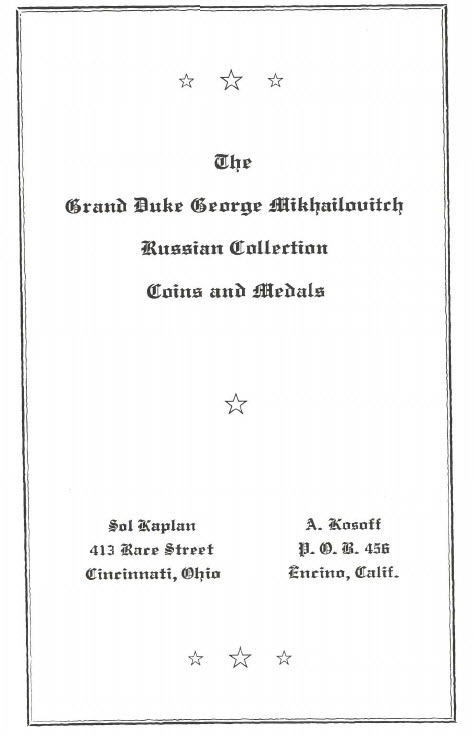
The Grand Duke George Mikhailovitch Collection was acquired by Sol Kaplan and Abe Kosoff. Above is an announcement from the July 1957 issue of "The Numismatist." The holding was eventually sold to Willis H. Dupont, who in turn donated it to the Smithsonian Institution, where it reposes today.