Abe Kosoff: Dean of Numismatics
Q. David Bowers
"According to the Princess Xenia, a surviving laughter, in the early 1900s Mikhailovitch was appointed director of the Moscow Museum by the last of the Romanoff's, Czar Nicholas II. Here he developed into the expert on Russian numismatics. In the meantime, the Grand Duke had been Cataloguing his collection and caused to be published a definitive work of 12 large volumes. Unfortunately, the bullets which snuffed out his life also put an end to the series of catalogues, of which no more had been planned.
"At the outset of the Revolution, Mikhailovitch lad transferred the collection from his home to he museum for safekeeping. Mysteriously, the collection disappeared. That was in 1919. Twelve years passed without any clarification as to the whereabouts of the greatest collection of Russian coins and medals ever put together. Numismatists eared that never again would the great Mikhailrvitch collection be seen intact. At best, perhaps one of the coins and medals might show up in different parts of the world.
"In 1931, with dramatic suddenness, the collection was removed to Kiev in the south, and from here it was taken by one of the White Armies then fighting in that region. Eventually it turned up in Yugoslavia, from whence it was returned to the Princess Xenia, her mother, and her sister, Princess Nina, who had inherited it from the Grand Duke."
The Mikhailovitch Collection was sold to Willis-1. DuPont, a Florida numismatist who subsequently donated the holding to the Smithsonian institution. For several years thereafter, Abe Kosoff participated in a campaign to reacquire some of the gold and platinum issues from the Mikhailovitch Collection which had been sold earlier, so that they could be added to the Smithsonian display. The value of the Mikhailovitch transaction was never publicly stated.
A mail auction sale held by Abe Kosoff on October 10, 1957 featured United States and world gold, silver, and copper coins as well as paper money, Bryan and Lesher "dollars," obsolete currency, and an offering of Canadian coins and currency, a catalogue comprising 2,202 lots.
Abe Kosoff's annual prediction reflected the drop in prices which occurred in the coin market toward the end of 1957, a drop prompted by speculation in Proof sets:
"The leveling-off experienced during the last quarter of 1957 will continue through the first quarter of 1958. Prices will then start a new upward trend. Just how soon this will occur depends a great deal on the stock market. Despite the sharp drop in stock values, there has only been a little 'fear' selling in the coin market. This is quickly absorbed by investors who realize that these are opportunities to buy which are unusual in the long range upward curve of coin values.
"Activity has slowed down a bit and the price level has not gone higher. However, neither has it gone lower. The situation will prevail until activity is greater. That is the time prices will start to climb."
Abe Kosoff was busy, and Kosoff's Coin Bulletin took a second seat to other activities. So, following the February 1957 issue there was a span of a full year before the next one, the issue datelined February 1958. An explanation was given:
"Hello again! This is the first issue of Kosoffs Coin Bulletin since February 1957. So many of you have written asking for recent issues of the Bulletin-it's gratifying to know that we are missed.
"The past year has by no means been spent loafing. In March we had an auction sale featuring the Parks, Conyne, and Carabin Collections. In June another auction was held-October and still another auction listing the consignment of B. Max Mehl. Max passed away two weeks before the sale was held but had expressed pleasure with the catalogue. The passing of my good friend brought with it another duty. Appraising the business assets and formulating plans for the continued conduct of 'America's Oldest Numismatic Establishment' took a bit of time.
"I am grateful for the privilege of serving so grand a man, a man who has influenced the numismatic profession to such an extent that his is an indelible mark.
"In the meantime, other events kept this A.K. busy. The Southern California Show at Los Angeles, the California State meeting in Long Beach, St. Louis for the Central States Convention, then on to Philadelphia for the big show the American Numismatic Association. Clearing up the October sale-and then off to Hawaii in November, then to the Florida United Numismatists convention in January. Yes, it's been a busy 12 months. The crowning glory was the Mikhailovitch Collection deal.
"Ten weeks right out of the heart of the year, 10 weeks of hustling-New York, Berkeley, Cincinnati, New York-Berkeley-yes, something like a merry-go-round. Well, here we are again. We'll try to get to you more regularly. Thanks for sticking around."
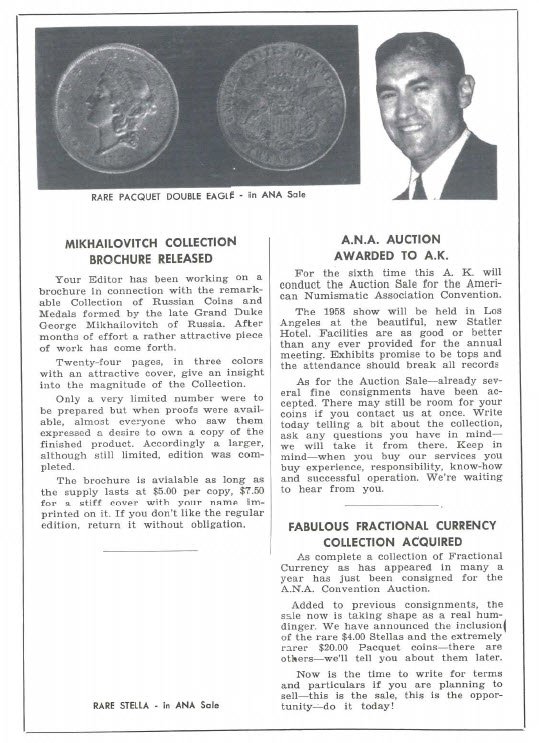
The back cover of "Kosoff's Coin Bulletin," February 1958, told of several important events.