Abe Kosoff: Dean of Numismatics
Q. David Bowers
Abe Kosoff's February 28, 1958 auction sale featured the Col. James W. Curtis collection of United States pattern coins and the B.A. Talmadge collection of United States double eagles as well as other pieces. The catalogue was illustrated with 'stock" pictures from earlier catalogue offerings. Within the covers of the modest catalogue were a number of different consignments, some of them small in nature, such as 10 Roman bronzes consigned by a New York City numismatist and eight proof trade dollars from a Hollywood source. The B.A. Talmadge collection of United States double eagles primarily consisted of common issuesi n ordinary states of preservation, while the Col. James W. Curtis collection of patterns offered many scarce and rare pieces.
A note in the February auction catalogue related to the mailing list:
"If any of your friends or club members wants our literature, their names would be appreciated. That's how we continue to fill up our mailing list.
"In order to make room for these new folks we kinda hafta drop a few now and then. 'Course we don't like to do it, but they never let a guy hear from them. Shucks, maybe they've gone to China, or heaven, or someplace. We ease them out, sorta send them nice cards and so on-and if they don't answer in a reasonable time, well, we don't have much choice. Sure, none of you folks are gonna let that happen to you. How're you gonna prevent it? Well, any activity will keep you on our active list. A bid sheet for this auction will do it or a price list order-anything so we know you are in there pitching."
In May and June 1958, Abe Kosoff, who had been awarded his sixth American Numismatic Association convention, was busy cataloguing pieces from more than 50 consignors. He took a few moments, however, to pen an anecdote-a rote about the president of one of the national parks years earlier who used to travel around the country with uncut sheets of his bank's money, signed by his cashier but not by him. He would sometimes have a bellhop deliver something, then pretend he had no change. "Just a minute," he would say. Taking an uncut sheet, he would cut off one note, sign it, and say, "Here, give me some change." It never failed-within an hour he would be contacted by the police!
For the 1958 ANA convention, held that year at the Statler Hotel, Los Angeles, Abe Kosoff prepared a sale of 2,903 lots. Assisting him was Mike Kliman, whom Abe credited in the front of the catalogue with "doing a lot of the dirty work-the time-consuming details," 58 different consignors contributed to the event, which was initiated with Lot 1, described as: 1/1856 Flying Eagle cent, Uncirculated. It has become almost traditional-this starting off with the ever popular 'first Flying eagle cent.' " The piece brought $540, a good price for the time, followed by Lot 2, an 1859 Proof Indian cent at $55.
Lot 31, a 1860 transitional pattern half dime, fetched $335; Lot 37, a 1792 half disme, described as "Choice and sharp," fetched $650, the rare 1859 transitional dime with obverse of 1859 and reverse of 1860, Proof, brought $1,125; a set of 1883-1912 Liberty nickels, Uncirculated, went to a new home at $425; a set of 1932-1952 Washington quarters, Uncirculated, crossed the auction block at $205; and numerous other pieces attracted the attention of bidders.
Included in the 1958 ANA sale was a 1943 cent struck in bronze, rather than the normal zinc coated steel used that year. The consignor was Marvin Beyer, a Southern California collector, who had taken great pains to have it analyzed in a technical laboratory.
Although Abe Kosoff expected that it would be sold to the highest bidder, after a bid of $25,000 was received Beyer took the coin back, claiming that he was being cheated, according to an article published in the Los Angeles Herald Examiner. Abe Kosoff subsequently filed suit against Beyer. The matter dragged on for three years and was finally settled in May 1962. The terms were not revealed.
In May 1959, Abe Kosoff wrote a column recommending the formation of a collection of design types. This was in response to a recent newspaper feature by national financial columnist Sylvia Porter, who wrote on coins occasionally and who on this instance suggested that the best route would be to "specialize in a series."
"I am sure Miss Porter has consulted with known specialists, for this is not her first column urging coins as an investment," Abe Kosoff wrote. "This conclusion, therefore, is undoubtedly supported by someone with professional experience. My observations should be viewed as my own opinions, opinions with which there may be disagreement.
"From where I sit, the strongest items for investment purposes are choice examples of type coins, plus selected rarities ... The danger in collecting just one series results from the fact that in coin collecting there is the equivalent of a 'style change,' call it whim, or cycles, or what have you.
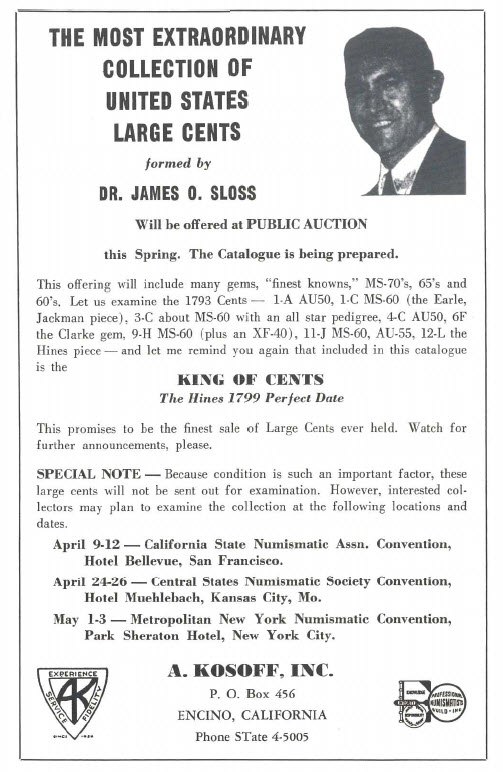
The collection of Dr. James o. Sloss, a Pennsylvania numismatist, featured many outstanding large cents and created a sensation when it was auctioned in 1959. ("The Numismatist," April 1959)