Abe Kosoff: Dean of Numismatics
Q. David Bowers
Abe Kosoff made an early announcement that he was planning another tour across the United States not only to buy coins but also antiques, jewelry, silver, and other items for the Antique Gallery. As if this were not enough, information was given concerning the Charles M. Williams Collection. Previously, scattered mention of the Williams Collection and certain of its rarities, particularly the 1822 half eagle, had crept into print, but now more details were noted:
"In the most spectacular numismatic transaction ever concluded, the famous collection formed by Mr. Charles M. Williams, insurance executive from Cincinnati, Ohio, was sold outright for a sum in excess of one quarter of a million dollars to Sol Kaplan and the Numismatic Gallery.
"No description could do justice to this collection short of a voluminous catalogue. Suffice it to say that it included the greatest of rarities, many of which have been privately placed. The famous Dexter 1804 dollar is now in the cabinet of a discriminating New York collector. The Dunham 1822 half eagle has been sold at a record price. Many of the territorial rarities have been sold. In this issue of the Numismatic Gallery Monthly we list the Williams Collection of private coinage, offered subject to prior sale. We are proud, indeed, to have participated in this history-making event."
Offered were such delicacies as the 1830 Templeton Reid $2.50 in Extremely Fine grade at $475, the $5 at $6,250, and the $10 at $8,750-with the notation that all three had been sold; the listing was just for the record. Clark, Gruber & Co., coinage from Colorado included an Extremely Fine 1861 $20 at $650 and copper strikings of various issues from $25 upward. A Parsons & Co. $2.50 was priced at $2,500, while a $5 from the same issuer was offered for $5,000. J.J. Conway $2.50 and $5 pieces were reported sold at $5,250 and $3,250 respectively.
The rare Mormon 1849 $10, described as Fine, was available for $1500, while the $20 cost $1,000. A spectacular offering of Baldwin coinage from California included an 1850 $5 in Very Fine grade at $175, an 1850 $10 "Horseman" in Uncirculated preservation at $1,500, an 1851 $10 in Extremely Fine grade at $1,350, and an 1851 $20 Very Fine, for $7,500.
An 1849 Cincinnati Mining & Trading Co. $10 with reeded edge, Very Fine, and another variety with plain edge were both listed at $7,000 with the notation that each had been sold. Also sold was a Dubosq $10 in Very Good preservation at $2,500. A Dunbar $5, About Fine, was priced at $1,200 and had not yet attracted a buyer.
A specimen of the famous 1855 Kellogg $50 with some surface marks fetched $5,000, and an Ormsby $5 piece found a buyer at $7,500. A $10 of the same issue was sold for $5,500. Quite expensive, but marked "sold," was an 1849 Pacific Co. $10 at $12,500, accompanied by a $1 of the same issuer, with a hole, at $1,500 and a $5 at $5,000.
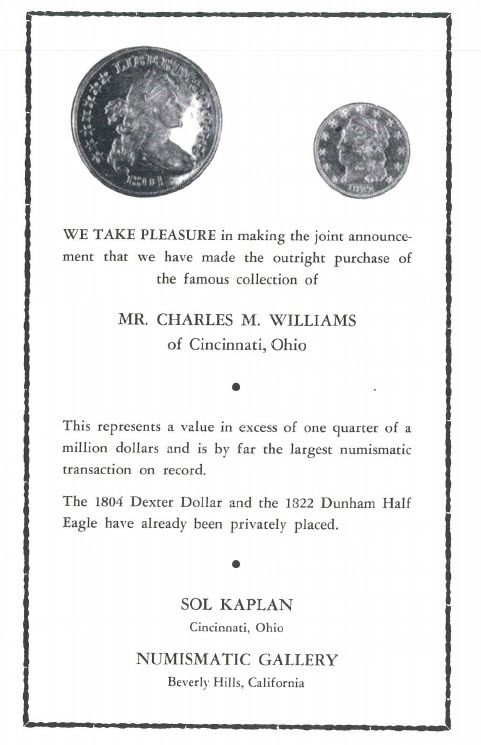
In 1950, the collection of Charles M. Williams, of Cincinnati, Ohio was purchased outright in a transaction arranged by Sol Kaplan. "This represents a value in excess of one-quarter of a million dollars and is by far the largest numismatic transaction on record," this notice from the January 1951 issue of "The Numismatist" relates.
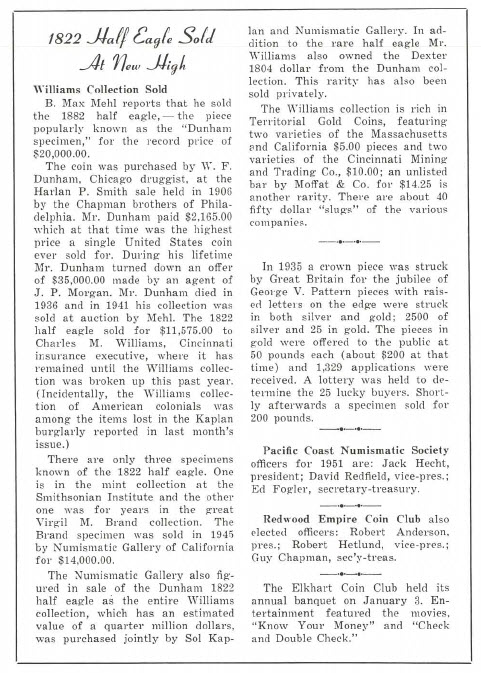
A page from the January 1951 issue of "The Numismatic Scrapbook Magazine" tells of the famous 1822 half eagle and the sale of the Williams Collection.