Abe Kosoff: Dean of Numismatics
Q. David Bowers
"As these words were written, a letter comes from one of our many friends who will forgive us if we quote him: 'I wouldn't pass up the opportunity to get another catalogue like the one I have from the World's Greatest Sale, for all the tea in China. I am sure that if every collector saw one of these catalogues, you would be swamped with orders.'
"We appreciate the many letters from all parts of the world, we like your kind words, we hope this catalogue will fulfill your expectations. -A. Kosoff, Abner Kreisberg."
The auction was held over a span of three days, June 15th through 17th, at the Roy J. Goldenberg Auction Gallery just a few steps away from Numismatic Gallery headquarters on Wilshire Boulevard in Los Angeles. In addition, a mail bid section of the catalogue closed on June 20th.
Lot 86, 1795 half dime described as: A magnificent Brilliant Proof Gem, the finest of this date we have ever seen," realized $77. Lot 97, an 1802 half dime in Very Fine condition, described as "one of the prizes of American numismatics," fetched $425.
Among dimes, Lot 311 was described as follows: "1894-S dime. The rarest dime in any of the mints. This coin is one of the rarest of United States silver, or for that matter gold coins. There were only 24 specimens minted, and of these only about seven are known to exist. We are proud to be able to offer this specimen which is the second we have sold at auction." The coin sold for $1,850.
From the viewpoint of history, one looks back on the Menjou catalogue and considers the most important coin to have been Lot 399, a piece which later was determined to be unique-the only specimen known-but at the time it was catalogued, research was not as advanced as it would be decades later, and its unique status was not realized. However, its extreme rarity certainly was appreciated, as the description indicates:
'This excessively rare coin is among the rarest of all United States coins, not excluding any of the better known rarities, such as the 1804 dollar or the 1913 nickel, etc. In fact these coins have been offered several times in the past few years. When was the 1873 no arrows dime of Carson City offered last? The World's Greatest Collection of dimes was complete-except for this one dime. Atwater didn't have one, Neil didn't have one Stickney didn't have one, Higgy didn't have one You'll have to search far and wide to find another To own this gem is to own a coin the equal which will probably never appear. With all due respect to estimates of others for a coin they may never have seen, we will predict that this specimen will bring (and it's still a bargain!) $1,000."
The 1873-CC dime without arrows caused; spirited floor bidding contest and when all was said and done it sold for $3,650.
Immediately following dimes came an offering of United States gold dollars. The tradition of listing Philadelphia Mint pieces first, followed by branch mint issues, was continued. Lot 443, a Brilliant Proof 1875 gold dollar, fetched $275 while Lot 477, a Very Fine example of the 1860-D brought $100, and Lot 478, a Very Fine example of the famous 1861-D sold for $250.
As part of a complete set of twenty-cent piece the 1876-CC was offered and was described a follows:
"The excessively rare 1876-CC twenty-cent piece. A beautiful uncirculated gem with min lustre, this twenty-cent piece minted in Carson City in 1876 is among the rarest of all United Stated coins. Many of our leading collections do not in elude this rarity which is in a class with the 1827 quarter, the 1875 $3 gold piece and the1894-Sdime. There are probably not more than 10 specimens known, and this superb example is a: nice as we have seen." The piece sold for $1,325
A 1796 quarter, Lot 665, was described as "; splendid coin with prooflike lustre," and with sorry planchet defects. It realized $170.
Lot 696, an 1827 quarter, was described a: follows: "1827 original. The outstanding rarity it the quarter series, if not in the entire United State: silver series, comparing favorably with the 1804 dollar. As a matter of record, several advancer collections have offered the 1804 dollar but did no have the 1827 quarter; the Atwater Collection is a recent example. I doubt if more than five or so specimens of this date exist. We are justifiable proud to state that this is the second one to be offered in a Numismatic Gallery auction." The coin fetched $2,725.
The following Lot No. 697, an 1827 restrike sold for $675.
An indication of the advancing coin market was provided by Lot 909, a 1901-S quarter, which was described as follows: "1901-S. A rarity in the San Francisco Mint series. The 1901 keeps climbing. In 1938 it was listed at $3. Today the same catalogue values it at $300, and it brings even more!" The piece sold for $340.
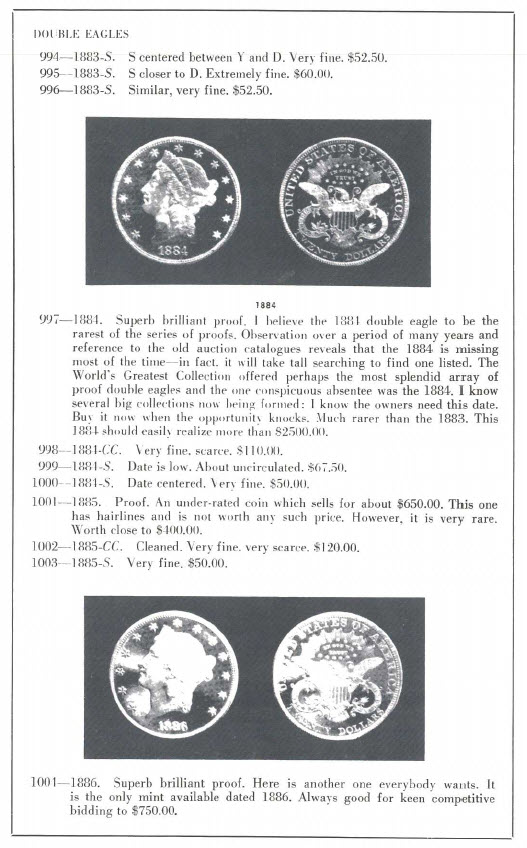
The Melish Collection featured many gold rarities. Lot 997 fetched $1,900, while Lot 1004 brought $775.