Abe Kosoff: Dean of Numismatics
Q. David Bowers
Chapter 7
The Early 1950's
The collection of Charles M. Williams, a Cincinnati collector, was acquired in a transaction involving the Numismatic Gallery and Sol Kaplan. Many rarities were obtained, including an 1804 dollar and an 1822 half eagle. The latter coin was sold in 1950 to B. Max Mehl. Williams had acquired the coin from the William Forrester Dunham Collection sold by Mehl in 1941. Earlier, Mehl had acquired the Dunham Collection by direct purchase, although this was not disclosed in the "auction" catalogue. Efforts had been made to sell the 1822 privately, including to John Work Garrett, but no success was achieved, so it was listed in the catalogue along with numerous other rarities.
After acquiring it from the Numismatic Gallery, Mehl sold it to his friend, Amon Carter, who was a local oil and newspaper man and who was co-founder of American Airlines. Mehl once related to the present author (Q. David Bowers) that he knew Carter to be a wealthy man and had encountered him often at weekly Rotary meetings in Fort Worth, where both gentlemen lived. On a whim, he asked Carter his birth date, to learn that it was 1879. Soon, a gift was made of an 1879 gold quarter eagle in a special case. Carter's curiosity was piqued. What other 1879 coins exist? Soon, he owned the scarce 1879 Flowing Hair stella, then a complete set of stellas, then, over a period of years, one of the greatest coin collections ever formed! After Amon Carter's death, the collection passed to his son, Amon, Jr., who pursued numismatics with equal enthusiasm, but in a slightly different direction, preferring to emphasize new purchases in the categories of paper money, Mexican and Canadian issues, and other specialties.
The Carter 1822 half eagle was sold to Stack's, who then sold it to Josiah K. Lilly, the pharmaceutical magnate. Following the death of Lilly, the 1822 half eagle and other items in the, Lilly Collection-thousands of gold coins totally-went to the Smithsonian Institution. There the 1822 half eagle joined the Mint Collection specimen, leaving the Louis Eliasberg coin as the only one in collectors' hands. The Eliasberg coin was catalogued by Q. David Bowers and auctioned in 1982 for $687,500, tying the unique 1870-S $3 in the same sale for the highest price ever accorded a United States federal issue (but a bit less than the $725,000 the Uncirculated 1787 Brasher doubloon in the Garret Collection fetched in 1979).
Over a period of time, other coins, sets, and series from the Williams Collection were sold privately or were included in Numismatic Gallery auction sales.
In the February issue of Numismatic Gallery Monthly Abe Kosoff philosophized:
'What makes a numismatist? Buying a coin card, searching for dates, filling in your card does that make you a numismatist?
"Perhaps, but if it's a Lincoln cent page wouldn't you enjoy it all the more if you knew that the V.D.B. stands for Victor D. Brenner, the designer of the coin? One step further and a bit of Brenner's history-and for that matter Lincoln's-and your enjoyment is tripled. Interesting facts pertaining to the issue all make for more pleasure-like the 1909, the year of issue-why that's 100 years after Lincoln's birth! Say, Washington's 1932 issue was 200 years after his birth, too! Oh, there are a million and one things about your coins that would put you in the class of a numismatist instead of just a coin collector. In this issue we have tried to give you a few 'coins with stories.' In each instance you can dig up more facts about the coin."
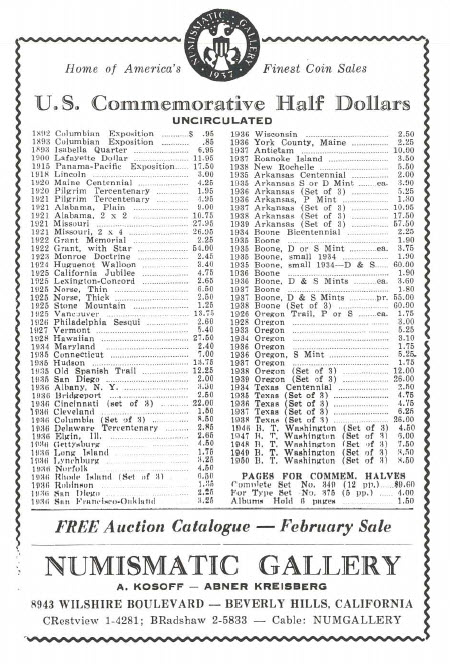
Among the storied coins offered were a $4 stella of 1879, complete with a description of how it was issued, priced in Proof grade at $490, an offering of Connecticut copper coins, 1785-1788, some as low as 20c each, various commemorative issues, ancient coins, European pieces, and others. The "interesting coin" idea was expanded, and Numismatic Gallery clients were invited to submit their favorite stories concerning different issues.
"Money Talks" noted that a California senator proposed a 7 1/2 cent piece, a suggestion backed by the president of Squirt, a soda pop, who, presumably, would benefit from a coin of this unusual denomination. Needless to say, nothing further was heard of the idea.
The passing of Farran Zerbe, the dean of American numismatists, was noted. The collection of Adolphe Menjou, the famous movie star, was acquired-and more announcements were promised in due course.