Abe Kosoff: Dean of Numismatics
Q. David Bowers
The March 1950 issue of the Numismatic Gallery Monthly was 20 pages in length and was devoted to Auction Sale No. 61. The last lot in the mail bid offering consisted of a collection of 53 miscellaneous dimes sent in by a 10 year old girl, who wanted the proceeds to go to the March of Dimes charity.
Toward the end of the issue, a collection of three different Sommer Islands (Bermuda) pieces was offered for $250, noting that separately the coins had auction records in the $900 range-obviously quite a bargain.
Abner Kreisberg was planning a spring trip to buy coins, visit collectors, and spread good will. "Folks, if you would like to have him see you on his spring trip, write us now so that arrangements can be made. He's really a soft touch and loves to write checks."
It was noted that Arthur Friedberg, the owner of Capitol Coin Company in New York, had a new acquisition: Arthur Louis born on January 23, 1950-with "mint lustre!"
The subject of grading came up, and Abe Kosoff noted: "Allen P. Gough challenges dealers, collectors in the American Numismatic Association to get together on the classification of condition of coins. Bravo! We're with you 100%."
Another news item: "M.H. Bolender's long experience with silver dollars will be reflected in a book on that subject now being prepared by him. He hopes to make simple the task of attributing these popular coins. We can think of no one more qualified for the job."
Offered at fixed prices were many different coins in the Numismatic Gallery Monthly issue of April 1950. Heading the list was a round $50 piece from the Panama-Pacific Exposition in 1915, priced at $590 in Uncirculated grade, followed by the octagonal version of the same piece at $495. 1909-S V.D.B. Lincoln cents were offered one-to-a customer for $10.50 each. Uncirculated commemoratives had dropped in price slightly. Offerings included a 1893 Isabella quarter at $6.95, a 1915 Panama-Pacific half dollar at $17.50, a 1918 Lincoln-Illinois at $3, a 1920 Maine at $4.25, a 1925 Lexington at $2.65, a 1925 Stone Mountain at $1.25, a 1925 Vancouver at $13.75, a 1928 Hawaiian at $27.50, a 1934 Maryland at $2.35, a 1936 Cleveland at $1.50, a 1937 Antietam for $10, and a 1949 Booker T. Washington set for $8.50. A Proof specimen of the rare 1863 quarter eagle, noted as being worth $1,250, was offered for just $950.In an editorial note, Abe Kosoff related that the estate of the late B.G. Johnson contained an unlisted territorial pattern. Struck in silver on a planchet the size of a dime, it was a quarter eagle pattern by the Sierra Nevada Mining Company. "The obverse has a head of Liberty high with the date 1850 below it, surrounded by a circle of stars. The reverse has a spread eagle with denomination below and the name of the company around. The style, especially the reverse, is contemporary. Since no coinage of a Sierra Nevada Mining Company is known, we prize this item very highly. It seems to have been badly handled, but it has found a good home."
To its clients the Numismatic Gallery offered 1949 coinage for face value if the request was accompanied by an order for other pieces, a gesture that generated good will and brought favorable comments.
In the Numismatic Gallery Monthly W.S. Bitler's article, "My Dream Cent," told of a 1793 Liberty Cap large cent for which he paid $250 but would not take $1,000 cash if offered. Why? The story follows:
"I was studying this particular coin once: it was late at night and I was weary, my eyes gradually closed; or perhaps they didn't, I can't say. Did I see Liberty's head turn slightly? Did her lips move? I'm sure they did, because a soft, soothing voice began to speak ... 'I know I'm an Extremely Fine coin though not Uncirculated; I wouldn't want to be, because then I would be uninteresting, and I'm not that. I've belonged to quite a few famous persons and I've been in some fine collections. The mint master sent me to President George Washington to show him what fine work the mint did. The president kept me on his mantle for six years, until he died in 1799. Mrs. Washington gave me to a little colored boy, the son of one of the president's ex-slaves. He kept me until he died in1825. I passed through many hands in the next week or two and finally into the hand of a young boy, just 16; he took me across the counter of a country store, looked admiringly at me and said: Much more beautiful than the cents of today.' His name was Abraham Lincoln! I then passed into the hands of a young girl who admired me so much she kept me until late in the 19th century, packed away in a little box of cotton. Her heirs sold me and I brought $35 but 'was promptly resold to an old gentleman who paid $60 for me. Later still a fine gentleman bought me for his collection, and I remember him saying, 'this is the finest Crosby 14-K I've ever run across.' His name was Henry Hines. In 1944 I was sold again, and again in 1946. Dr. William H. Sheldon owned me then, and finally you bought me in 1947. I hope you like me as well as the rest:
"I was looking at the head on the coin. I believe it turned back slowly into profile. The lips had stopped moving, the soft voice had ceased, but what a story, rich in history, I had listened to from this fine circulated 1793 cent. Do you blame me for my fondness to this particular coin and my preference for fine circulated coins, rich in history? I have told my story-I'd like to listen to the others."
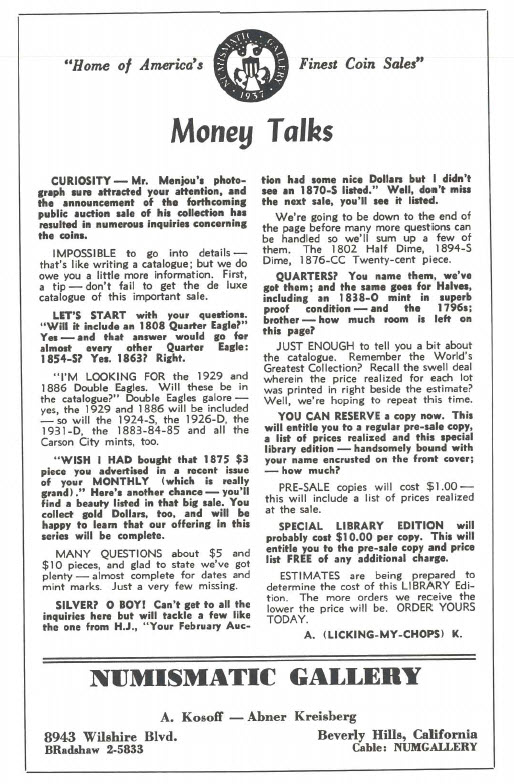
"Money Talks," as printed in the April 1950 issue of "The Numismatist," told of the forth coming Menjou Collection offering.