Abe Kosoff: Dean of Numismatics
Q. David Bowers
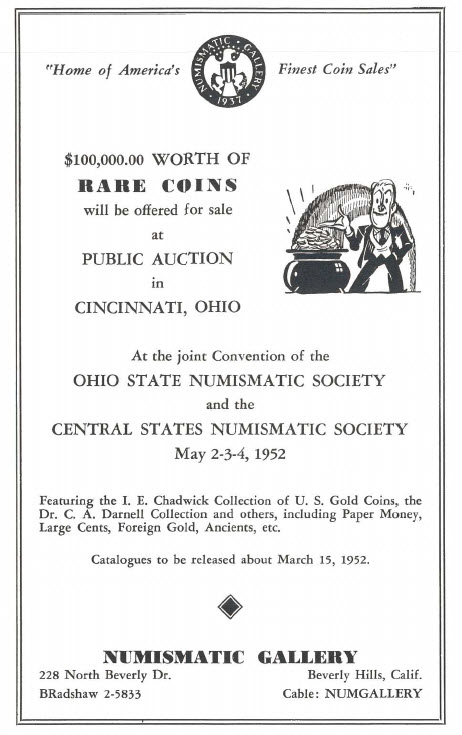
An announcement of the May 1952 auction sale to be held in Cincinnati in conjunction with the combined conventions of the Ohio State Numismatic Society and the Central States Numismatic Society. ("The Numismatist," February 1952)
"Dr. CA. Darnell chose quality as his goal, and he result is a small but choice collection which hould appeal to the discriminating ...
'Nice to be going to Cincinnati again. That gang leaded by the convention chairman, Sol Kaplan, makes one feel so at home. A bit unfortunate, in a way, because as Shaw said, 'I dislike feeling at home when I'm abroad.' I like to feel I'm in Cincinnati ... "
It was later reported that over 150 active bidders participated in the auction sale. Abe Kosoff acted as the auctioneer, with several members of he Cincinnati club assisting. In addition, 800 mail .idders participated. The 1856 Flying Eagle cent old for $201, an 1859 Proof double eagle brought $525, but a $20 Clark Gruber issue slept at $625. All in all the activity indicates the continued strong market in all series," Abe Kosoff reported. The fact that many dealers were among the buyers is evidence of their need for inventory."
The August-September 1952 Numismatic Gallery Monthly noted the passing of T. James Clarke-"a milestone in numismatic history-not many of the old guard are left." Much of the Editorial section of this issue was devoted to an appeal to collect pattern coins. Abe Kosoff noted rat patterns were interesting, numismatically important, and low-priced. Thus the stage was set or a detailed offering scheduled for a future issue.
Walter Breen, who was to become an outstanding numismatic scholar, was just beginning to publish his findings. Wayte Raymond encouraged Breen and paid for much of his research conducted in the National Archives and elsewhere. Concern- 19 a recent Breen article, Abe Kosoff noted:
"Interesting conjecture regarding 1884 and 1885 trade dollars by Walter H. Breen. Why must all such stories center around 'connivance,' 'under-handedness,' etc. The practice of striking coins especially for collectors-or even for a single collector-was not unusual in other countries."
Perhaps Abe Kosoff would have felt better had e recalled that many years earlier Edgar H. Adams, one of America's greatest numismatic Students, had written a feature article in The Numismatist suggesting that 1884 trade dollars were unofficial coins, perhaps the result of "special deals" made at the Mint.
The October-November 1952 Numismatic Gallery Monthly began with a selection of foreign gold coins, highlighted by an Argentina 8 escudos of 1828, Rio de la Plata, Extremely Fine for $285, a set of four Matte Proof 100 lire coins of Italy, 1903, 1912, 1923, and 1925 at $695, a set of 16 Mexican 50-peso pieces 1921 to 1947 for $1,000, and a Transylvania 1760 10 ducat piece for $275.
A group of quarter eagles consisting of Brilliant Proofs from 1900 through 1907 and Matte Proofs from 1908 through 1915 could be had for $475, while $1,850 was the price of a complete set of 1915-S Panama Pacific coins in the original case. A 1792 Roman Head Washington cent, described as a Gem, was pegged at $275. A 1652 Pine Tree shilling, described as a "rare variety, unknown to Crosby," Very Fine, was priced at $75.
The San Francisco Mint would issue silver bars in return for bullion deposited there, and at the time such ingots were popular with Numismatic Gallery clients. The weights ranged from between five and six ounces and the prices were posted in the $12 to $15 range.
A market was made in Proof sets, and many issues of the Numismatic Gallery Monthly during the early 1950s contained listings of Proof sets from 1936 onward. The October-November 1952 prices were as follows: 1936 $57.50, 1937 $22.50, 1938 $14.50, 1939 $11.75, 1940 $8.75, 1941 $7.50, 1942 $7.95, 1950 $5.25, 1951 $3.95, and 1952 $3.10.