Abe Kosoff: Dean of Numismatics
Q. David Bowers
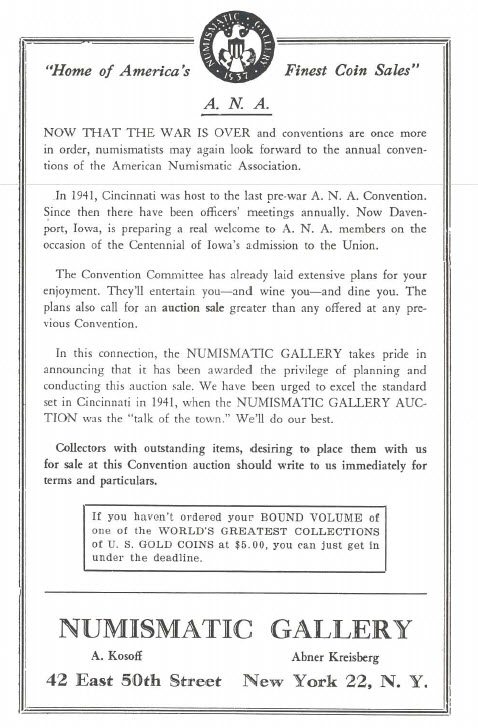
This February 1946 announcement in "The Numismatist" notes that as the war is over, ANA conventions will resume. The last convention had been held in Cincinnati in 1942 (not 1941; the above text is in error). In connection with the planned 1946 get-together in Davenport, Iowa, the Numismatic Gallery was preparing an auction.
After laying plans for this venture, Hans Schulman proposed creating a United Nations
Monetary Essai, or pattern coin, to honor the United Nations and its principals. Meetings were held with the Medallic Art Company's president, Clyde Trees, and with sculptor Karl Grouppe. Abe Kosoff suggested a design, which was implemented, consisting of an obverse depicting the flags of the "Big Five Nations" over a rising sun. At the top was the inscription in two lines: MONETARY UNITY / WORLD PEACE, while at the bottom appeared UNITED NATIONS/ESSAI-DUCATON/1946.
The reverse showed FREEDOM at the top, and at the center, surrounded by allegorical figures, the inscription in a circle: RELIGION, FEAR, SPEECH, WANT.
Seeking to create a coin which would be interchangeable in all member countries of the United Nations, the entrepreneurial trio enlisted the assistance of merchant Bernard Gimbel, Congressman Maury Maverick, New York City Mayor Fiorello H. LaGuardia, and others. A ceremony was slated in which Trygve Lie, the first secretary-general of the United Nations, was to receive a gold striking of the medal, President Harry Truman or his representative was to receive a similar piece, and other dignitaries would be likewise honored.
The Medallic Art Company struck 313 specimens in nearly pure gold and 1,000 each in silver and in bronze. A few unusual pieces were also struck in several thicknesses, and a few were made in platinum, the latter unusual pieces for special sale to King Farouk and another collector.
With all good intentions, a specimen in gold was sent to Hon. Nellie Tayloe Ross, director of the Mint, and another was dispatched to the Smithsonian Institution. "Keep in mind, we had no delusions about our Essai being the 'coin of the world.' We hoped that the idea would be adopted and that our samples would merely show what could be done," Abe Kosoff later related.
Clouds developed, and soon lightning struck. A letter from Mrs. Ross informed Kosoff, Kreisberg, and Schulman that she could not accept any gratuity and that an agent would return the gold striking. The next day a representative delivered it. On the following day Abe Kosoff received a letter from Dr. Leland Howard, who then served as assistant to Mrs. Ross. Dr. Howard stated that he believed that the partners were in violation of the Gold Act, a rather frightening thought. The president of the Medallic Art Company and several lawyers were consulted, and all agreed that no violation had occurred. Dr, Howard was asked to identify which section of the Gold Act had be violated, to which he replied that the letter of the Act had not been violated but the spirit had! The Essai looked too much like a coin, he stated, ft it had about the size and weight of a French 100-franc gold piece.
The partners were asked to cease making any more pieces, to refrain from selling any, and to destroy all in their possession, as well as the dies held by the Medallic Art Company. An agreement was finally reached whereby no more would be struck and the dies would be destroyed. However the partners were allowed to dispose of the holdings. "A good idea went down the drain Kosoff noted ruefully.
Later, the same Dr. Leland Howard was a pointed director of the Office of Domestic Go and Silver operations by President John F. Kennedy. In that office he incurred the enmity of cc lectors by making it exceedingly difficult for the to import gold coins from foreign countries. Extensive paperwork was required, even for issue not considered to be controversial or banned. Finally, under the administration of President Richard M. Nixon, the cumbersome and complicated restrictions involving the importation gold coins and the ban on holding gold ingots were dropped, and the numismatic fraternity was free to buy, sell, and trade pieces as they wished.
In 1946 the Numismatic Gallery was again tapped to conduct an American Numismatic Association sale, the first catalogued by A1 Kosoff since the Cincinnati event in 1942. Again the sale catalogue was combined with the official convention program, with the somewhat curio result that the Numismatic Gallery auction w interleaved with large advertisements by B. M; Mehl, Wayte Raymond, Whitman Publishing Co. James Kelly, R. Green, David M. Bullowa, Celina Coin Company, H.W. Holzer, Hans M. Schulman, Capitol Coin Co., Stack's, Hollin beck Stamp & Coin Co., Bebee Stamp & Coin Co., Paul B. Volk & Sons, Pittsburgh Coin Exchange, S Kaplan, George J. Bauer, French's, F.K. Saa Frank J. Katen, and other competitors.
The event was sponsored by the Iowa Numismatic Association and the Davenport Numismatic Club and was held at the Blackhawk Hotel Davenport August 17-21, in the centennial ye of Iowa's statehood. During the same year special Iowa commemorative half dollar was released.