Abe Kosoff: Dean of Numismatics
Q. David Bowers
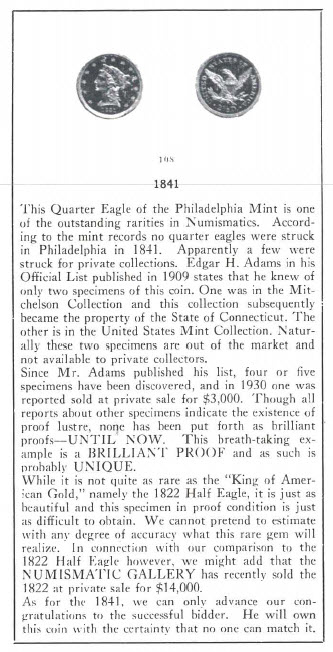
Of all rarities handled by Abe Kosoff and Abner Kreisberg during the 1940s, none was given more publicity than the 1841 quarter eagle. Shown here is Lot 108 from the "The World's Greatest Collection of United States Gold Coins." The piece sold for $6,000 on Friday, January 25, 1946.
"Well, we argued that the second option was only made during our original discussion, and when he decided on an outright purchase, the second option expired. Nevertheless, Bell insisted that he would not be able to carry out the obligations, and I was soon back at work cataloguing the collection.
"Finally, the big day came. It was late in January in 1946. Bell had come to the office two or three days earlier. He particularly wanted to buy the 1841 quarter eagle. It was a Brilliant Proof coin, undoubtedly the finest of the few known specimens. The coin had not appeared in any sale or list for many years. An unconfirmed report had it that one was sold at private sale in 1930 for $3,000. How much would he have to pay for it?
"Obviously, the answer depended on the competition-and the competition was keen and noteworthy. Louis Eliasberg of Baltimore was interested and so was Wayte Raymond. Stack's had examined the coin very carefully. Jerome Kern was coming to New York to attend the sale (it was on this visit that Kern collapsed on the sidewalk on Park Avenue, an attack from which he never recovered-quite likely his stroll was toward the Numismatic Gallery just off Park Avenue). And there were others who also wanted to buy the piece.
"For almost three days Bell kept asking how much he would have to pay for the 1841. Finally, an hour before the sale was to begin, he authorized me to bid for him up to $3,500. However, he was to be in the room bidding on other coins. Should the bidding go beyond $3,500 he wanted to take over on his own and I was to look at him-for I was the auctioneer.
"Most of those interested in the coin were either present or had representatives there, so the book bids on this lot were just so-so. I think the bidding started at $1,100 and proceeded $50 at a time, then $100 at a time, until it reached $3,000. Morton Stack then represented Louis Eliasberg, and he bid $3,250, to which I countered $3,500, as Bell's final authorized bid. $3,750 Morton continued, and I glanced toward Bell's seat-he nodded, it was $4,000, then $4,250-another nod, and now we were at $4,500. Mort went to $4,750, and Bell's nod put it at $5,000. $5,500' cried Mort, but J.F. seemed determined, and his next nod m $6,000, and $6,000 it was.
"Suddenly things went quiet. The air of expectancy caused a hush of the awed murmurs which had accompanied the bidding. I called the bid then a second time-and finally gave 'fair warning for the third and last time' while Bell sat hopefully-but prepared to continue. After son hesitancy and probing of the mind, Mort shook me off-he was through. 'Sold at $6,000 to N 18' -J.F. Bell always wanted No. 18.
'Well, after the two sessions of the auction we concluded and all were congratulating us on 01 successful conduct of the sale, J.F. Bell approach! You did a marvelous job, but there's one thing I'm not happy about.' 'What's that,' I asked. You should never have let me spend $6,000 for the 1841!' Bell replied. 'Come on J.F.' I countered, 'For three days you nudged (bothered) me with the 1841. Finally, you settled on a price of $3,500. You cautioned me to keep an eye on you-you are over 21. You competed against real competition. However, if you are unhappy, I am sure that Mc Stack will take the coin at his previous bid. I just told me he was bidding for Eliasberg, who was going to be very unhappy about not getting it. 'Chuchim (wise guy),' he responded, 'I wouldn't give it up for $10,000!"
"Louis Eliasberg was put out-he was mighty unhappy about losing out on this piece. In fact he telephoned me several days later. 'Could I get it say for $7,000?' he asked.
"I was due to be in Chicago a week later and would see what I could do, but I did not encourage him because of Bell's previous statement. As turned out, Bell wouldn't sell. Later, in 1948, we had a rough period economically in the spring, and coin sales dropped sharply as did stock mark prices. At this inopportune time, Bell decided sell. We tried to discourage him, but to no avail. He had his reasons and insisted on going ahead. As a result, the same 1841 quarter eagle final came to patient Louis Eliasberg at a price of just $4,800, I believe."
In 1946, the year after the founding of the United Nations in 1945, Abe Kosoff and Abner Kreisberg, owners of the Numismatic Gallery joined with Hans Schulman to form a partnership to run a coin display in Gimbel's Department Store in New York City. Joe Silverman, a long-time member of the Brooklyn Coin Club and a good friend, was tapped to run it.