Abe Kosoff: Dean of Numismatics
Q. David Bowers
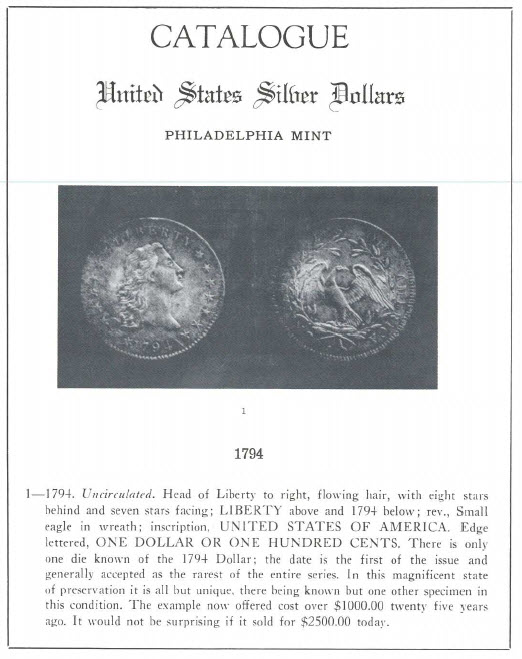
The first lot in the "World's Greatest Collection" featured an Uncirculated 1794 silver dollar. On Saturday, January 20, 1945 the coin sold for $2,000.
"Mac suggested that I take more, but my purchase already represented a sizable investment in one coin issue in those days. By the end of the day I was trying to hunt Mac down to buy more, but I couldn't reach him. When I finally caught up with him two days later, he had placed the coins. Mac had some terrific contacts among some of the leading stockbrokers in New York City, and he frequently placed groups of coins or collections with one of them in particular. Later he would have the material available, pay a profit, and resell the coins. In turn, the brokers gave Mac valuable market 'tips,' and Mac did very well indeed."
Part II of the World's Greatest Collection was estimated at $13,075.75 and realized about this price-$13,359.05. Added to the first part, the cumulative total was about $29,000, already more than Boyd's earlier $25,000 estimate.
Among the quarter dollars, the finest known 1823 sold for $700, an original 1827 brought $2,400, an 1839 Proof sold for $41, an Uncirculated 1916 Standing Liberty brought $60, and a very rare Uncirculated 1849-O fetched $115. The 1873-CC quarter without arrows, Uncirculated, sold for $725. Among Barber quarters, the three key issues, all Uncirculated, brought the following amounts: 1896-S $90, 1901-S $335, 1913-S $110.
The highlight among the 20-cent pieces was the 1876-CC, Uncirculated. This sold for $1,500 against a catalogue valuation of $750. The buyer was Harold Budd.
Part III of the World's Greatest Collection of United States Silver Coins, the half dollars from Boyd's holding, was sold on April 14, 1945 and realized $10,517. Part IV of the same offering United States dimes, half dimes, and other series-crossed the auction block on May 11th and 12th 1945, and together were designated as Sale No. 32-33. The lot numbers used to list the dimes in the sale were later adopted by Abe Kosoff as a standard reference for early dime die varieties, there being no other reference in print on the subject.
After the final parts of Boyd's collection had been sold, the realizations were totaled up and amounted to nearly $55,000, more than double Boyd's pre-sale estimate.
The last two sessions included many important pieces. An Uncirculated 1796 15-stars half dollar brought $575, an Uncirculated 1838-O half dollar fetched $1,600, an Extremely Fine 1796 half cent brought $750, and a Proof 1867 with rays nickel realized $90. The scarce 1877 Shield nickel fetched $65, and the key 1885 Liberty nickel found a buyer at $22.50.
"Boyd had an Uncirculated 1802 half dime which did not appear in the catalogue," Abe Kosoff later related. To have included it would have been a giveaway as to whose collection was being sold. So, for the same reason that the 1801 silver dollar was held back, the Uncirculated 1802 half dime was not included. "Fred promised that I would have the 1802 one day, and I in turn promised Harold Bareford that he would have firs crack when I got it. Unfortunately I never saw the piece. What happened to it I did not know."
When all was said and done, the Numismatic Gallery had spent $9,000 of its $11,000 commission on expenses, cataloguing, advertising, are related costs. While the sale of the copper, nickel and silver part of the World's Greatest Collection did not turn much of a profit, it served to solid establish the Numismatic Gallery in the front rank of coin auctioneers.
One day in 1945, Louis Eliasberg, the well known Baltimore collector, came into the office: of the Numismatic Gallery on East 50th Street in New York City. He wanted to acquire the Virgil M. Brand specimen of the 1822 half eagle, one of just three known to exist and one of just two in private hands, and asked Abe Kosoff to negotiate with Burdette G. Johnson, proprietor of the St Louis Stamp & Coin Co., who was handling man; coins for the Brand heirs.
According to Abe Kosoff's recollections Johnson had a price of $15,000 on the coin but would allow a discount of 10% to dealers, with a net price being $13,500. "Eliasberg indicated that he wanted to pay $13,750, not much margin, ever back in 1945! However, I had an appointment to see Johnson that summer. The American Numismatic Association was not having its annual convention that year because of the war.
"I had business to attend to in Mexico City are several cities on the West Coast and intended to stop by in St. Louis first in order to purchase: number of patterns for the King Farouk Collection. I expressed an interest in the 1822 half eagle His price to me was $13,500. I told him Eliasberg wanted the coin and how much he would pay.