Abe Kosoff: Dean of Numismatics
Q. David Bowers
Then came quarter eagles. A 1796 without stars, described as Extremely Fine but with slight edge dents, sold for $275, immediately followed by a with-stars variety of the same year in Extremely Fine grade at $375. The cataloguer highlighted the key coin in the sale, the 1841 quarter eagle, by giving it a full-page description:
"1841. This quarter eagle of the Philadelphia Mint is one of the outstanding rarities in numismatics. According to the mint records no quarter eagles were struck in Philadelphia in 1841. Apparently a few were struck for private collections. Edgar H. Adams in his Official List published in 1909 states that he knew of only two specimens of this coin. One was in the Mitchelson Collection, and this collection subsequently became the property of the State of Connecticut. The other is in the United States Mint Collection. Naturally , these two specimens are out of the market and are not available to private collectors.
"Since Mr. Adams published his list, four or five specimens have been discovered, and in 1930 one was reportedly sold at private sale for $3,000. Though all reports about other specimens indicate are existence of Proof lustre, none have been put forth as a Brilliant Proof-UNTIL NOW. This breathtaking example is a BRILLIANT PROOF and as such is probably UNIQUE.
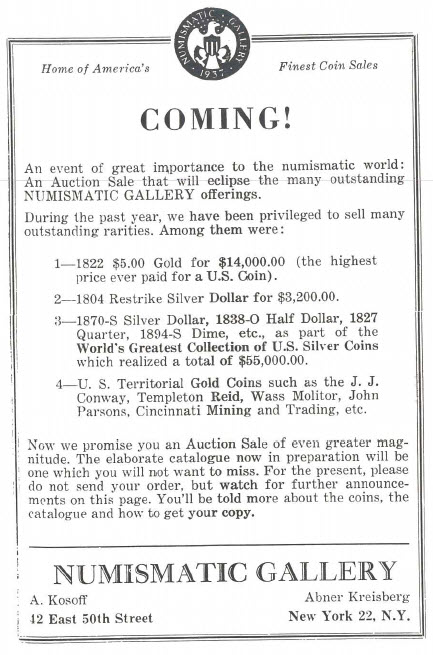
"While it is not quite as rare as the 'King of American Gold,' namely the 1822 half eagle, it is just as beautiful, and this specimen in Proof condition is just as difficult to obtain. We cannot pretend to estimate with any degree of accuracy what this rare gem will realize. In connection with our comparison to the 1822 half eagle however, we light add that the Numismatic Gallery has recently sold the 1822 at private sale for $14,000.
"As for the 1841, we can only advance our congratulations to the successful bidder. He will own this coin with the certainty that no one can match it.
When the dust settled, the 1841 quarter eagle etched $6,000, a price which was the highest realized in the entire sale.
The reference to the 1822 half eagle is of the Specimen sold to Louis Eliasberg, the famous Baltimore collector, who was well on his way to forming what became the only complete collection of United States date and mintmark varieties were assembled. Abe Kosoff maintained a close relationship with Louis Eliasberg over the years and supplied many prize pieces to his cabinet.
A 1843 Brilliant Proof quarter eagle was described as: "A distinct rarity not listed in any of as great sales of our day. Perhaps only a few proofs were struck. An invaluable addition if acquired for a leading collection. Estimates on this gem are based only on a feeling acquired through experience with the unusual, and one guess is as good as another. Ours is $350." This was not far from the mark, and the actual realization was $275. The same figure was realized for the follow- 19 lot, an 1844 Proof quarter eagle. An 1848 Proof etched $140. An example of the famous 1848 CAL., Very Fine, brought $150. Other highlights in the quarter eagle series included a Proof 1863 $1,150, a Proof 1875 at $325, and a Very Fine example of the prized 1854-S at $1,000.
The $3 series was complete from 1854 through 1889, except for the unique 1870-S. A Proof 1856 brought $260, an 1857 in the same state fetched $95, and a Proof 1858 brought $260. The three great rarities in the series, Proof examples of 1873, 1875, and 1876, fetched $275, $3,000, and $375 respectively. The 1876 was noted as "not with full brilliance."
Half eagles included many important issues. The year 1795 alone comprised seven specimens spread over four pages in the catalogue.
An example of the 1819, described as "probably the finest specimen extant of this exceedingly rare date; Uncirculated with original mint lustre," brought $1,400, while an Uncirculated 1821 brought $800 and a Gem Uncirculated 1827 fetched $2,000. Among later half eagles, a Proof of the scarce 1887 date brought $315, Matte Proofs in the Indian head series fetched in the $30 to $40 range, and an Uncirculated 1929 realized $475.
Right on the heels of the Proof 1841 quarter eagle at $6,000 was the next-highest priced coin in the sale at $5,250, the 1854-S half eagle, which Abe Kosoff and Abner Kreisberg described as:
"1854-S. In point of rarity this item is perhaps the rarest of United States coins. As a matter of fact, only two specimens are known, and this is the better of the two. It is Extremely Fine with sharp lettering, date, and features. There is no reason why this coin should not bring more than the 1822 half eagle at the present time. Up to now the demand has not been such that this coin would bring a record price. We know that the demand exists today. Several magnificent collections have been built up during the past three or four years, and all but one of the collections lacked this 1854 San Francisco Mint half eagle. We anticipate keen competition, for these outstanding collectors realize that here is truly a 'chance in a lifetime.' Once the auctioneer cries 'Sold,' the coin will probably not be offered again during this generation. Your estimate is as good as ours. In point of value, it should exceed the 1822 which only recently sold for $14,000."